Tteokbokki Recipe (떡볶이)
Jump to Section
The first time I made tteokbokki at home I used water instead of anchovy broth. The sauce thickened correctly, the rice cakes were chewy and bouncy, the gochujang colour was right. But it tasted one-dimensional, spicy and sweet with nothing underneath. I added more gochujang, more sugar, more fish sauce. The sauce got louder but not deeper. What was missing was the anchovy broth.
Dried anchovies contain inosinate, the same nucleotide umami compound as katsuobushi in Japanese dashi. Gochujang contains fermented soybean which is rich in glutamate. When inosinate and glutamate are present together, the perceived umami is multiplicative, not additive. The broth made with anchovy and kelp produces this synergy before a single other ingredient goes in. Water produces no inosinate, no synergy, and no matter how much gochujang you add, the depth does not appear. This is why Maangchi specifically noted that she made tteokbokki once without dried anchovies and it did not taste right, the inosinate was gone.
What is tteokbokki and which version is this?
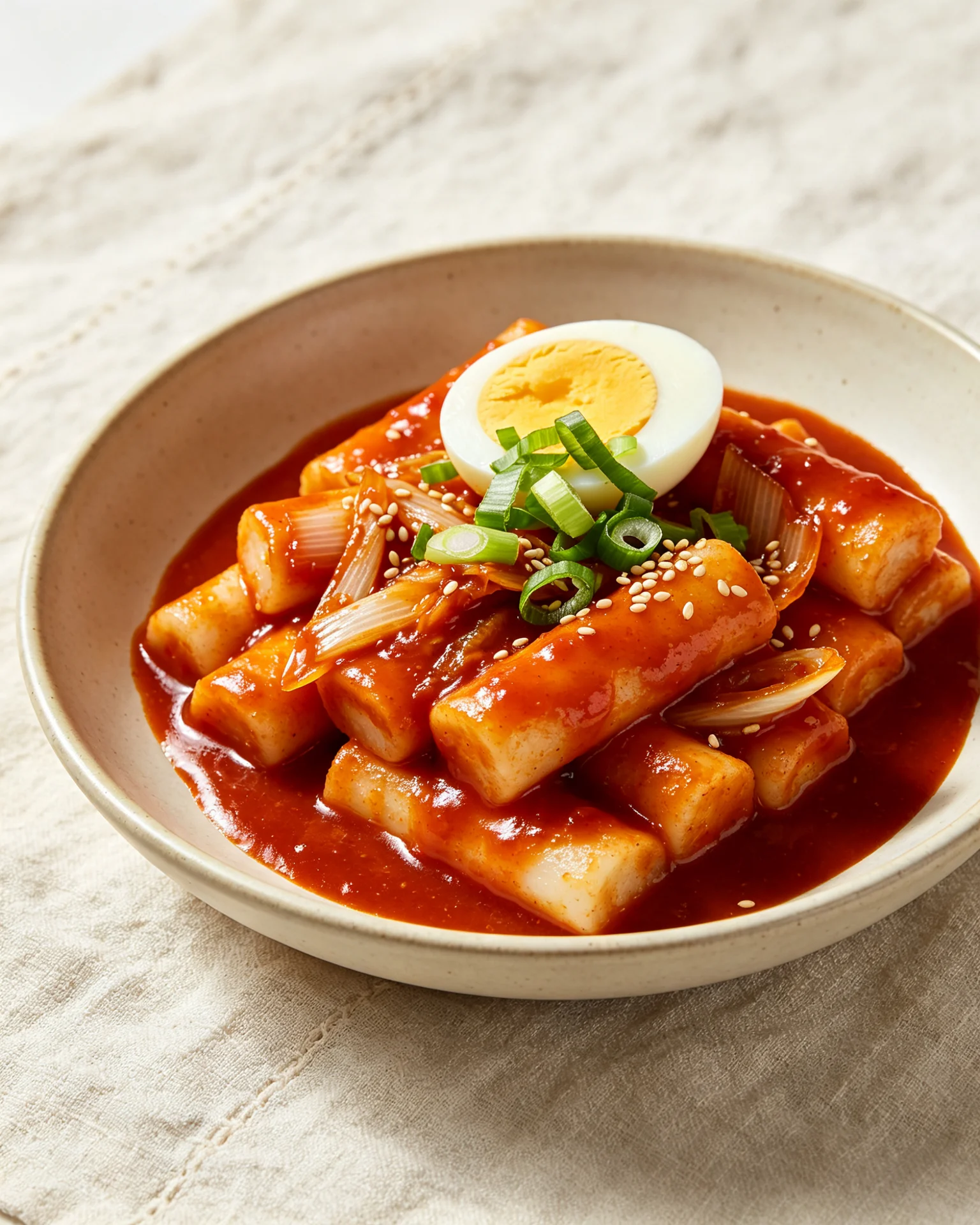
Tteokbokki (떡볶이) means stir-fried rice cake, tteok is rice cake, bokki is stir-fried, though the modern version is really braised rather than stir-fried. It is one of Korea’s defining street foods, sold from pojangmacha (street tents) and bunsik restaurants across the country, most recognisably in the winter when steam rises from the pots and the red-orange sauce is visible from metres away.
The rice cakes used are garaetteok, long, cylindrical rice cakes made from non-glutinous rice flour, sliced into short pieces for the dish. They have a dense, chewy, slightly bouncy texture with almost no flavour of their own. They are a vehicle for the sauce.
This recipe makes the classic spicy street food version, gochujang sauce, anchovy broth, fish cakes, spring onions. There is also gungjung tteokbokki (royal court tteokbokki), the original version made with soy sauce and no chilli, covered in the next section. The two are genuinely different dishes sharing only the rice cake component.
Where does tteokbokki come from and when did it become spicy?
The original tteokbokki was not spicy. Gungjung tteokbokki (궁중 떡볶이, royal court tteokbokki) was developed during the Joseon dynasty (1392-1897) as a court dish. It used soy sauce, sesame oil, garlic, and various vegetables, a savoury, aromatic preparation with the same cylindrical rice cakes, but no gochujang and no heat. This version still exists and is worth making as a different dish entirely.
The transition to the spicy gochujang version happened in the 1950s. After the Korean War, industrial production of gochujang made it affordable and widely available for the first time. A street vendor named Ma Bok-rim in the Sindang neighbourhood of Seoul is frequently credited with popularising the modern spicy tteokbokki in the mid-1950s at her pojangmacha, replacing the soy sauce base with the now-standard gochujang sauce.
The spicy version took hold rapidly because it suited street food economics and eating, inexpensive, filling, intensely flavoured, sold by the portion in Styrofoam cups with wooden toothpicks as cutlery. By the 1970s and 1980s it had become so dominant that the original royal court version was largely forgotten outside of specialty restaurants.
The dish you are making today is approximately 70 years old. The one it replaced was approximately 500 years old. Both are Korean. Both use the same rice cake.
Why does the sauce thicken on its own?
No cornstarch. No flour. No separate thickening agent. The tteokbokki sauce thickens itself, and understanding the mechanism changes how you manage the sauce.
Garaetteok rice cakes are made from non-glutinous rice flour and water. The outer surface of each rice cake contains gelatinised starch that has not fully bonded into the interior. During simmering, this surface starch slowly dissolves into the surrounding broth. The stirring and the heat accelerate dissolution, each stir releases more surface starch into the liquid.
As the dissolved starch concentration increases and the temperature is maintained at a simmer, the starch gelatinises in solution, the same process as a cornstarch slurry thickening a stir-fry sauce. The broth becomes progressively thicker, glossier, and more sauce-like as the rice cakes cook.
This mechanism explains two things that most recipes do not address. First, why the sauce volume matters: too much broth dilutes the dissolving starch and the sauce stays thin. The standard ratio for 2 servings is approximately 300-350ml of broth, enough to cook the rice cakes through without diluting the starch below the concentration needed for a proper thick sauce. Second, why you should not add more liquid if the sauce looks thin early, it thickens progressively and adding liquid resets the starch concentration.
Gochujang also contributes to thickening. Gochujang contains glutinous rice flour as part of its composition, the starch in the gochujang dissolves into the broth alongside the rice cake starch and adds to the overall body of the sauce.
Why does anchovy broth produce better tteokbokki than water?
Covered in the opening but worth mapping against the specific ingredients.
Dried anchovies (myeolchi, 멸치) are the primary source of inosinate in the broth. When simmered in water, the inosinate releases from the dried fish into the liquid. The kelp (dashima, 다시마) added alongside contributes glutamate from its natural glutamic acid content, the same reason kelp is the basis of Japanese kombu dashi.
Gochujang contains fermented soybean (meju) as a core ingredient. The fermentation of soybean proteins produces free glutamate, the same process as miso fermentation, the same reason soy sauce is umami-rich.
When the anchovy-kelp broth meets the gochujang, inosinate from the anchovies and glutamate from the fermented soybean are present simultaneously. The multiplicative umami effect produces a sauce that tastes significantly more complex than its ingredient list suggests.
Fish sauce is a partial substitute for anchovy broth, it also contains inosinate from fish proteins. But fish sauce has a stronger, more pungent character than clean anchovy broth, and the dilution required to achieve the right broth volume produces a different flavour profile. Anchovy broth is the correct ingredient.
What is the difference between gochujang and gochugaru and why does tteokbokki use both?
Most recipes use both gochujang and gochugaru without explaining why two chilli products are necessary.
Gochujang (고추장) is a fermented paste. Its primary ingredients are Korean red chilli, glutinous rice flour, fermented soybean (meju), and salt. The glutinous rice flour is significant: it contributes starch to the sauce as it dissolves, which works alongside the rice cake surface starch to produce body. The fermented soybean provides glutamate and complex fermented depth. Gochujang produces a thick, complex, slightly sweet heat with significant sauce body.
Gochugaru (고추가루) is simply ground dried Korean red chilli, no added starch, no fermentation, no glutamate contribution. Gochugaru adds a cleaner, more immediate, adjustable heat and a brighter red-orange colour than gochujang alone. It produces no thickening.
Using only gochujang: the sauce is thick and complex but the heat is rounded and can feel mild even at high quantities because the fermented sweetness softens the chilli impact.
Using only gochugaru: the sauce is spicy with clean heat but thin, lacking the fermented depth and body of gochujang.
Both together: gochujang provides the thick, complex, fermented base; gochugaru provides additional adjustable heat and visual colour intensity. The combination produces the full tteokbokki sauce character.
What does fish cake (eomuk) contribute?
Eomuk (어묵, Korean fish cake) is a processed fish cake made from white fish, starch, and seasoning, similar to Japanese fish cake but with a different seasoning profile. It is sold refrigerated in flat sheets or in tubular form and is cut into strips or triangles for tteokbokki.
Eomuk performs two functions in the dish. First, texture: the firm, slightly chewy fish cake provides a different bite from the rice cakes, creating textural contrast in each spoonful. Second, additional umami: processed fish cake contains glutamate from both the fish proteins and the seasoning. It contributes to the overall umami depth of the sauce as it simmers, particularly because the fish cake releases some of its seasoning into the broth.
The fish cake also absorbs sauce as it cooks, becoming flavoured throughout rather than just on the surface. This is why fish cake added early in the simmering process tastes more deeply of the gochujang sauce than fish cake added late.
If fish cake is unavailable, the dish works without it. The textural contrast and the additional umami layer are missed but the core dish is intact.
Why do the rice cakes harden when cooled and how do you fix it?
Leftover tteokbokki rice cakes are hard, slightly rubbery, and unpleasant to eat cold. This is not a sign the dish has gone bad, it is a predictable consequence of starch retrogradation.
Gelatinised starch, starch that has been cooked in water and is in its soft, amorphous state, begins to retrograde when cooled below approximately 15-20°C. Retrogradation means the starch molecules re-associate and crystallise into a more ordered structure. This crystallisation is what makes cold cooked rice hard, day-old bread stale, and refrigerated tteok firm and rubbery.
The process is fully reversible with heat and water. When the retrogradated rice cakes are reheated in liquid, broth, water, or a splash of both, the heat and moisture re-hydrate and re-disperse the starch molecules, returning the network to its soft, gelatinised, bouncy state. The rice cakes return to their fresh-cooked texture within 2-3 minutes of gentle simmering.
This is why tteokbokki must be reheated in liquid, not dry. Microwaving without added liquid heats the exterior of the rice cake without providing the water needed to re-gelatinise the interior starch. The outside warms but the inside stays hard and chewy in the wrong way.
Add a splash of water or broth before reheating. The cake will bounce back.
Ingredients
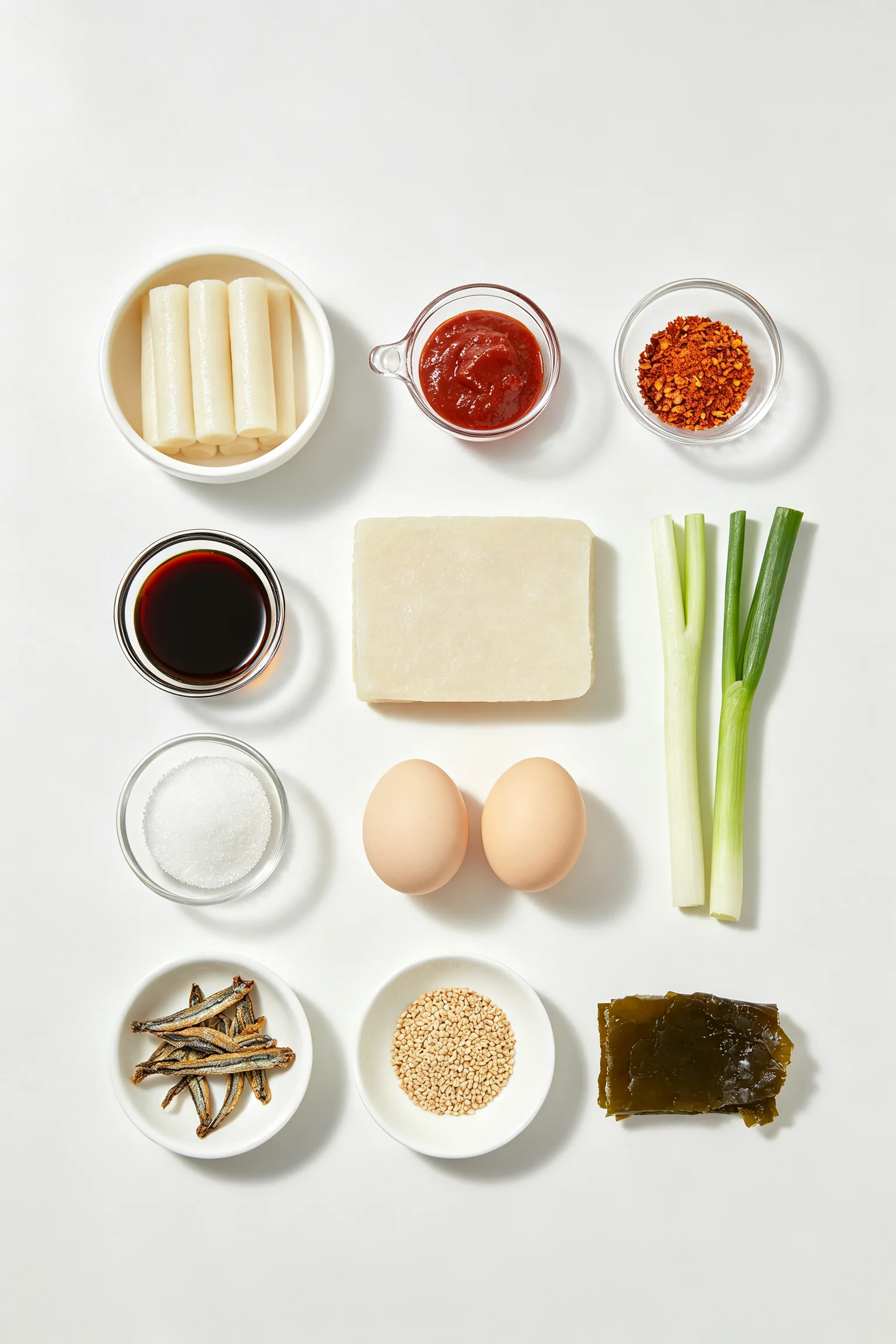
Serves 2
Anchovy broth:
- 600ml (2½ cups) cold water
- 7-8 large dried anchovies (myeolchi), heads and guts removed
- 1 piece dashima (dried kelp), approximately 10x10cm
Tteokbokki sauce:
- 2 tbsp gochujang
- 1 tbsp gochugaru (adjust for heat preference)
- 1 tbsp soy sauce
- 1 tbsp sugar or honey
- 1 tsp sesame oil (added off heat)
Main components:
- 300g (10.5oz) garaetteok (cylindrical rice cakes), fresh, refrigerated, or frozen and soaked
- 100g (3.5oz) eomuk (Korean fish cake), cut into strips or triangles
- 2 spring onions, cut into 5cm pieces
- 2 boiled eggs, peeled (optional but traditional)
Finishing:
- 1 tsp sesame seeds
- Extra spring onion greens, thinly sliced
Instructions
If using frozen or refrigerated rice cakes, soak in warm water for 15-20 minutes first until pliable. Drain before using. Fresh rice cakes do not need soaking.
Step 1: Make the anchovy broth
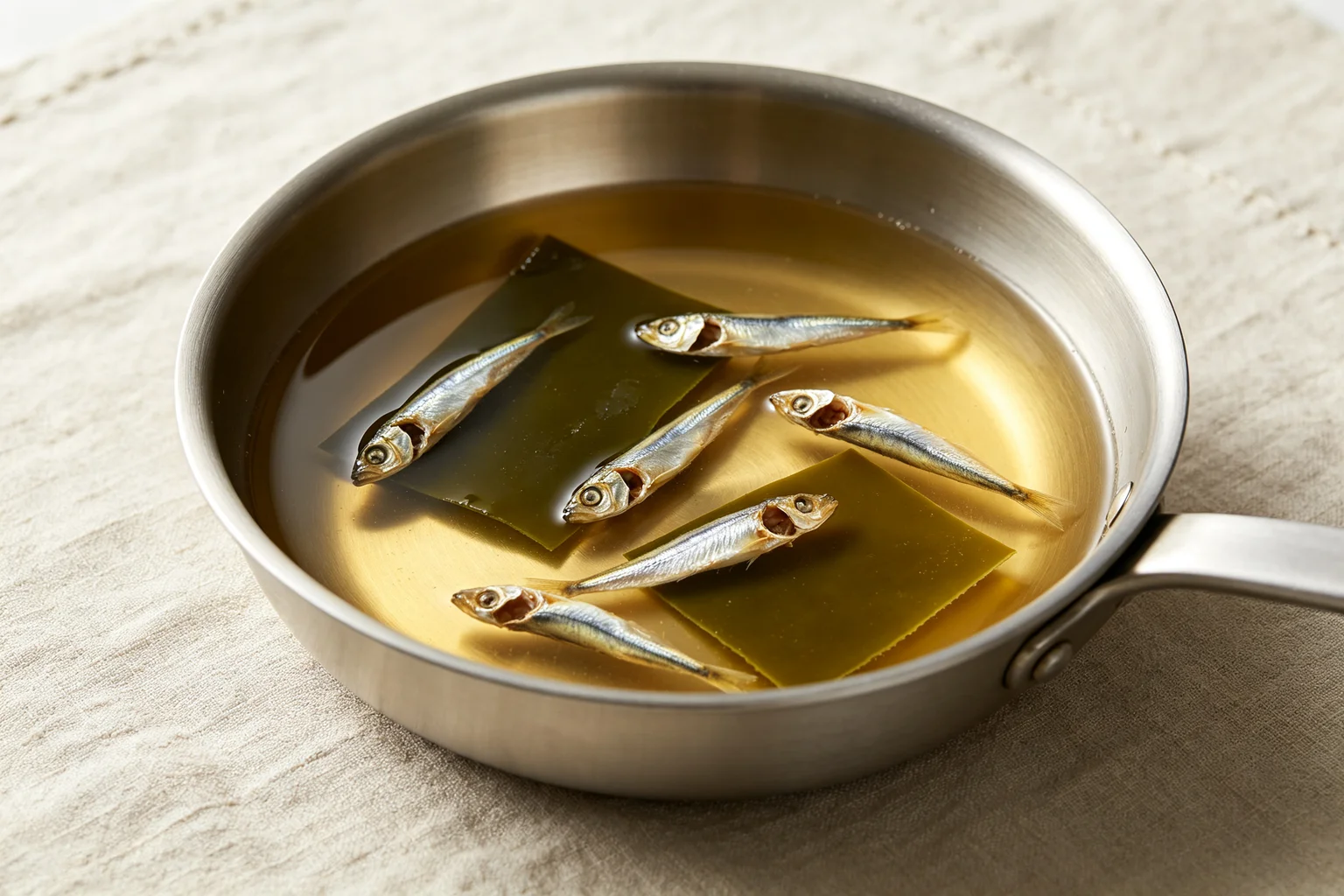
Combine cold water, dried anchovies, and dashima in a medium saucepan. Bring to a simmer over medium heat.
Step 2: Mix the sauce
In a small bowl, combine gochujang, gochugaru, soy sauce, and sugar. Mix until fully combined.
Step 3: Add sauce to broth and simmer
Pour the anchovy broth into a wide, shallow pan, wider is better, more evaporation surface helps the sauce concentrate. Add the sauce mixture and stir to combine.
Step 4: Add rice cakes and fish cakes
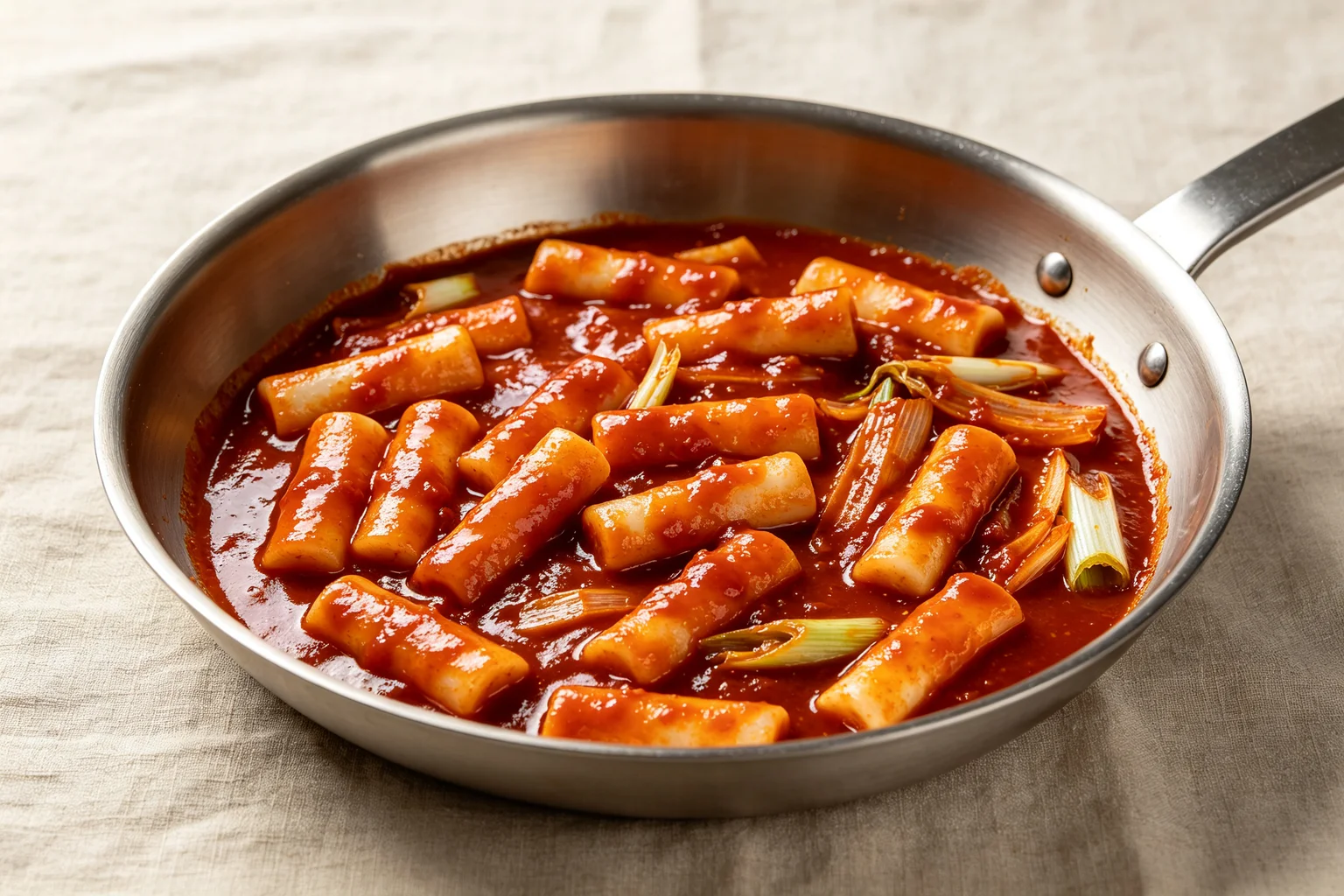
Add the soaked and drained garaetteok to the simmering sauce. Add the fish cake pieces and boiled eggs if using.
Simmer over medium heat for 12-15 minutes, stirring frequently. The sauce will thicken progressively as the rice cake surface starch dissolves into the broth. By the 10-12 minute mark the sauce should be noticeably thicker and glossier than at the start. Continue until the rice cakes are completely soft throughout, press one with a spoon; there should be no resistance at the centre.
Step 5: Add spring onions and finish
Add the spring onion pieces in the final 2 minutes of cooking. They should wilt slightly but retain some texture.
Taste. Adjust with more gochujang for heat and body, more sugar to balance, or more soy sauce for salt and umami.
Step 6: Serve immediately
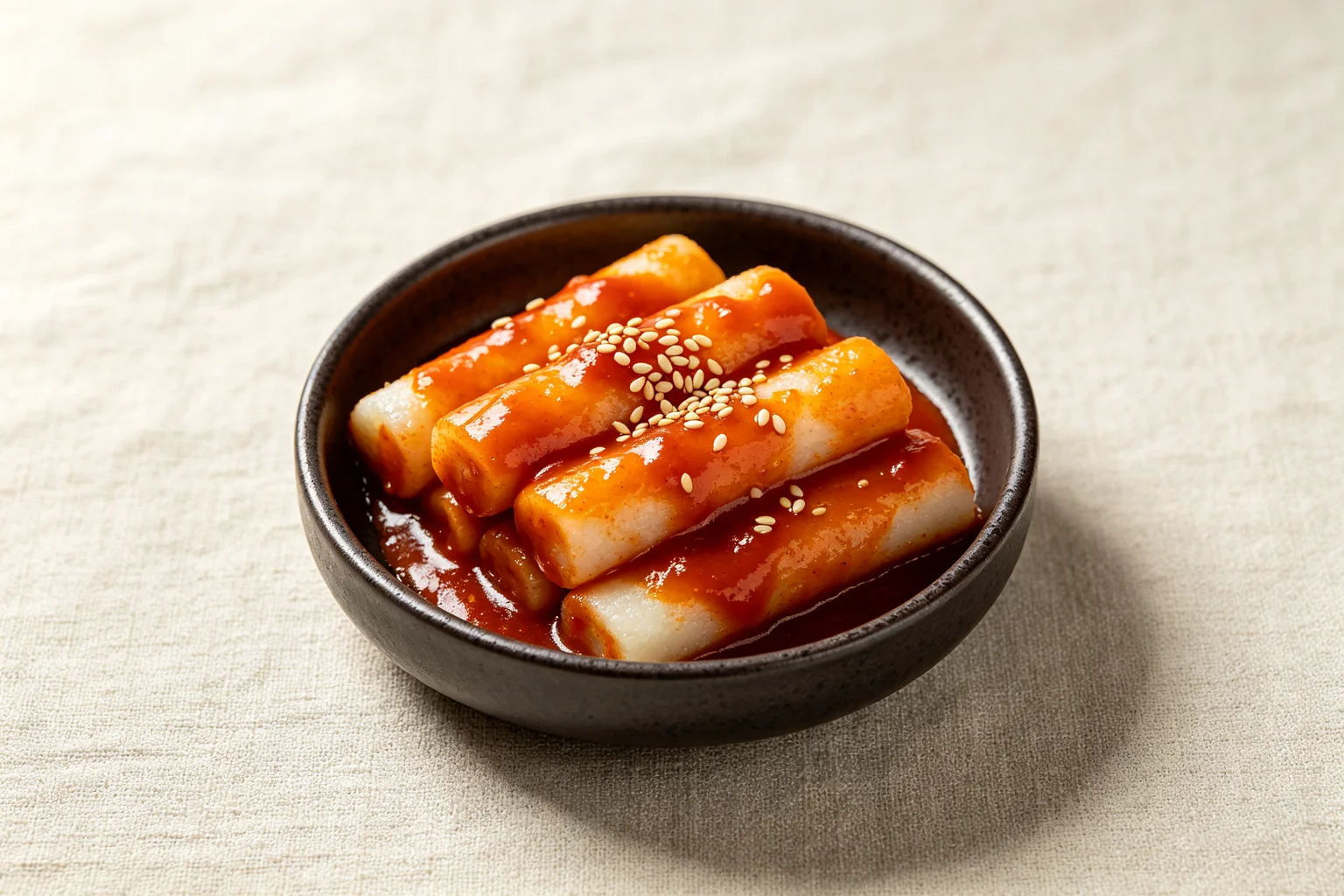
Plate in shallow bowls. Scatter sesame seeds and fresh spring onion greens over the top.
How do you store and reheat tteokbokki?
Tteokbokki keeps in the refrigerator for 2 days. The sauce thickens significantly as it cools and the rice cakes harden from retrogradation, both are reversible.
To reheat: transfer the cold tteokbokki to a pan. Add 3-4 tablespoons of water or broth. Heat over medium heat, stirring gently, until the sauce loosens and the rice cakes return to their bouncy texture, approximately 3-4 minutes. The added liquid re-gelatinises the starch in the rice cakes and re-incorporates into the sauce as it warms. Do not add too much liquid or the sauce will be too thin.
Do not microwave without liquid. The rice cakes will warm on the outside but stay hard inside.
Tteokbokki does not freeze well. The rice cake starch structure changes during freezing and the texture after thawing is gummy and unpleasant.
Love Korean food?
Check out my complete guide to Korean home cooking, pantry essentials, and techniques.
FAQ
Why is my tteokbokki sauce thin and not thickening? Too much broth was used. The sauce thickens through the dissolution of rice cake surface starch into the broth, if the broth volume is too high, the dissolved starch is too diluted to produce a thick sauce. Use 300-350ml of broth for 2 servings. If the sauce is already too thin, increase the heat slightly and stir more frequently to accelerate starch dissolution, or remove some of the liquid and continue simmering.
Can I use water instead of anchovy broth? Yes, but the tteokbokki will taste noticeably less complex. Anchovy broth provides inosinate that produces a multiplicative umami effect when combined with the glutamate in gochujang. Water provides none of this. The sauce will be spicy and sweet but flat in depth. Dashi powder (Japanese or Korean) dissolved in water is an acceptable shortcut, it contains both inosinate and glutamate and takes 2 minutes to prepare.
What are the different spellings of tteokbokki and do they all refer to the same dish? Yes. Tteokbokki, ddeokbokki, dukbokki, and topokki all refer to the same dish. The variations come from different systems for romanising the Korean characters 떡볶이. The Korean government attempted to standardise the romanisation as “topokki”, Maangchi famously refused to change her site because she felt it sounded wrong. For search purposes, all four spellings refer to the same dish and the same recipe.
Can I make tteokbokki without fish cake? Yes. The fish cake adds textural contrast and some additional umami from the fish proteins, but the dish works without it. A vegetarian version using the anchovy broth (or mushroom broth for fully vegetarian) with just rice cakes and vegetables produces a legitimate tteokbokki. Adding a small amount of extra gochujang or soy sauce compensates for the missing umami from the fish cake. Tofu cut into cubes and briefly pan-fried is a good textural substitute for the fish cake.
You might also like: Check out our complete Korean cooking guide for more essential ingredients and techniques.
Tteokbokki Recipe (떡볶이)
Korean Recipes, Tteokbokki, Korean Street Food
PT10M
PT20M
PT30M
Nutrition Facts
Ingredients
- 600ml (2½ cups) cold water
- 7-8 large dried anchovies (myeolchi), heads and guts removed
- 1 piece dashima (dried kelp), approximately 10x10cm
- 2 tbsp gochujang
- 1 tbsp gochugaru (adjust for heat preference)
- 1 tbsp soy sauce
- 1 tbsp sugar or honey
- 1 tsp sesame oil (added off heat)
- 300g (10.5oz) garaetteok (cylindrical rice cakes), fresh, refrigerated, or frozen and soaked
- 100g (3.5oz) eomuk (Korean fish cake), cut into strips or triangles
- 2 spring onions, cut into 5cm pieces
- 2 boiled eggs, peeled (optional but traditional)
- 1 tsp sesame seeds
- Extra spring onion greens, thinly sliced
Instructions
- *If using frozen or refrigerated rice cakes, soak in warm water for 15-20 minutes first until pliable. Drain before using. Fresh rice cakes do not need soaking.*
- Combine cold water, dried anchovies, and dashima in a medium saucepan. Bring to a simmer over medium heat. Simmer for 10 minutes, do not boil aggressively or the broth turns bitter from the anchovy bones. Remove and discard the anchovies and kelp. You should have approximately 400-450ml of broth remaining after simmering.
- In a small bowl, combine gochujang, gochugaru, soy sauce, and sugar. Mix until fully combined. Set aside.
- Pour the anchovy broth into a wide, shallow pan, wider is better, more evaporation surface helps the sauce concentrate. Add the sauce mixture and stir to combine. Bring to a simmer over medium heat.
- Add the soaked and drained garaetteok to the simmering sauce. Add the fish cake pieces and boiled eggs if using. Stir to coat everything in the sauce. Simmer over medium heat for 12-15 minutes, stirring frequently. The sauce will thicken progressively as the rice cake surface starch dissolves into the broth. By the 10-12 minute mark the sauce should be noticeably thicker and glossier than at the start. Continue until the rice cakes are completely soft throughout, press one with a spoon; there should be no resistance at the centre.
- Add the spring onion pieces in the final 2 minutes of cooking. They should wilt slightly but retain some texture. Remove from heat. Add sesame oil and stir once. Taste. Adjust with more gochujang for heat and body, more sugar to balance, or more soy sauce for salt and umami.
- Plate in shallow bowls. Scatter sesame seeds and fresh spring onion greens over the top. Serve immediately, tteokbokki is at its best the moment it comes off the heat when the sauce is thick, glossy, and the rice cakes are at maximum bounciness. ## How do you store and reheat tteokbokki? Tteokbokki keeps in the refrigerator for 2 days. The sauce thickens significantly as it cools and the rice cakes harden from retrogradation, both are reversible. To reheat: transfer the cold tteokbokki to a pan. Add 3-4 tablespoons of water or broth. Heat over medium heat, stirring gently, until the sauce loosens and the rice cakes return to their bouncy texture, approximately 3-4 minutes. The added liquid re-gelatinises the starch in the rice cakes and re-incorporates into the sauce as it warms. Do not add too much liquid or the sauce will be too thin. Do not microwave without liquid. The rice cakes will warm on the outside but stay hard inside. Tteokbokki does not freeze well. The rice cake starch structure changes during freezing and the texture after thawing is gummy and unpleasant.
Did you make this recipe?
Tag @asianfoodsdaily on Instagram or leave a comment below!
Testing Notes
Tested in Asha's kitchen. Last reviewed August 16, 2025.
Ingredient Substitutions
Substitution notes coming soon.
About Asha
Half Asian, half African cook raised between two food-obsessed cultures. I've spent 10 years learning Asian cooking traditions through family, friends, and thousands of hours at the stove — testing every dish until it works in a standard home kitchen.
Read my full storyRelated Recipes
More delicious dishes you might enjoy


Loading comments...