Vietnamese Lemongrass Pork Chops (Sườn Nướng Sả)
Jump to Section
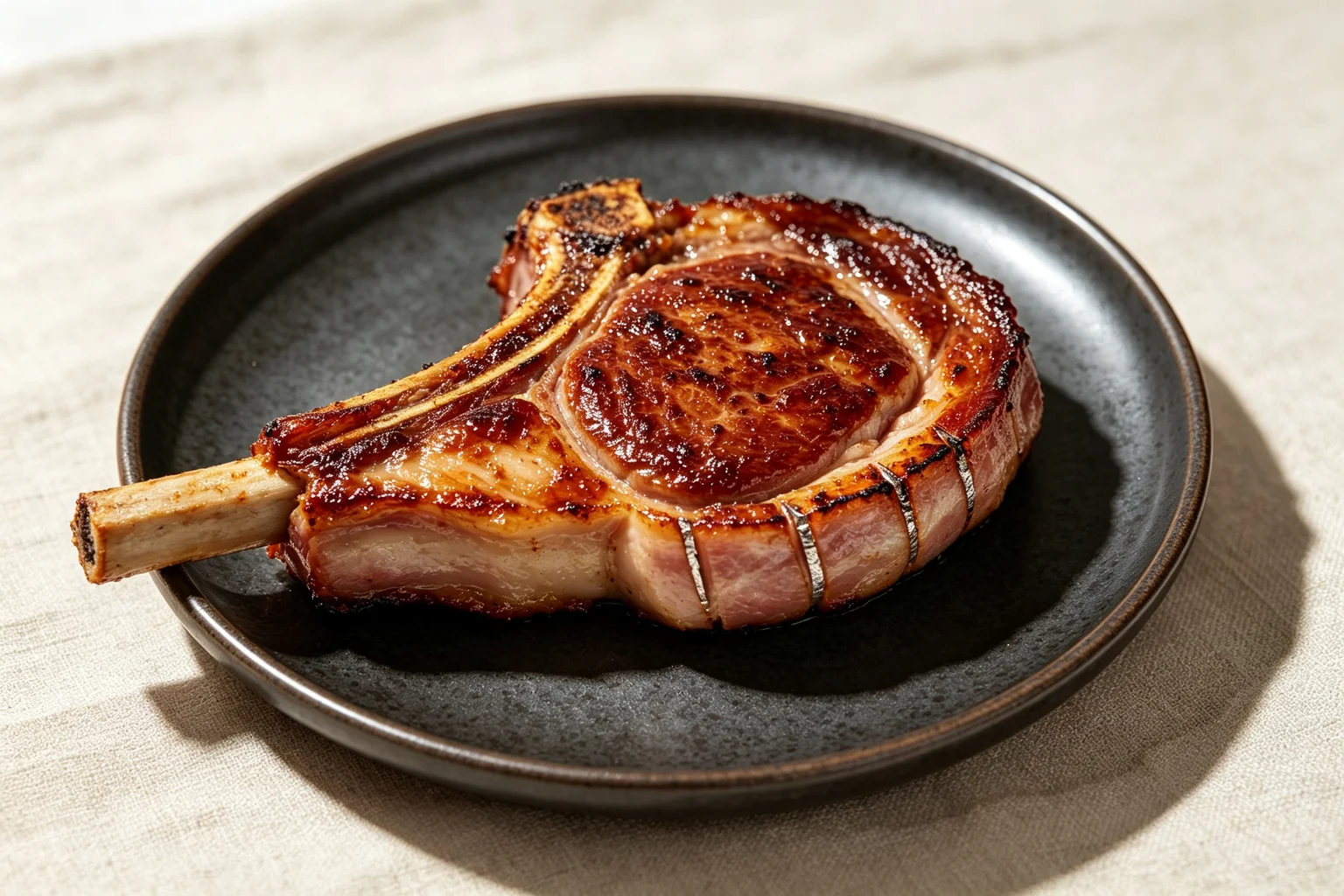
The first time I grilled these at home the chops curled immediately on the grill. The edges contracted, the centre lifted off the grate, and the char developed unevenly, dark at the edges where the meat stayed in contact, pale and steamed-looking in the middle where it did not. The problem was the silver skin on the perimeter of each chop. Silver skin is an inelastic connective tissue membrane that does not render at grill temperatures, it contracts and tightens, pulling the chop into a curl as the heat denatures the proteins. The fix is simple and takes 30 seconds: score through the fat and silver skin along each edge at 2cm intervals before marinating. The cuts sever the silver skin into short independent segments. Each can contract on its own without pulling the entire chop. The chops stay flat and the char develops evenly across the full surface.
That even char is the whole point of Sườn Nướng Sả. The dark, lacquered, slightly bitter crust is not incidental, it is the flavour. The sugars in the marinade caramelise on the hot grill surface and react with the amino acids in the fish sauce through the Maillard reaction, producing melanoidins and pyrazines. This is the same compound class that makes properly charred satay and kung pao chicken taste the way they do. Char is not burning. It is a specific flavour transformation that requires direct sustained contact between the marinade and a very hot surface.
What is Sườn Nướng Sả and what is its connection to cơm tấm?
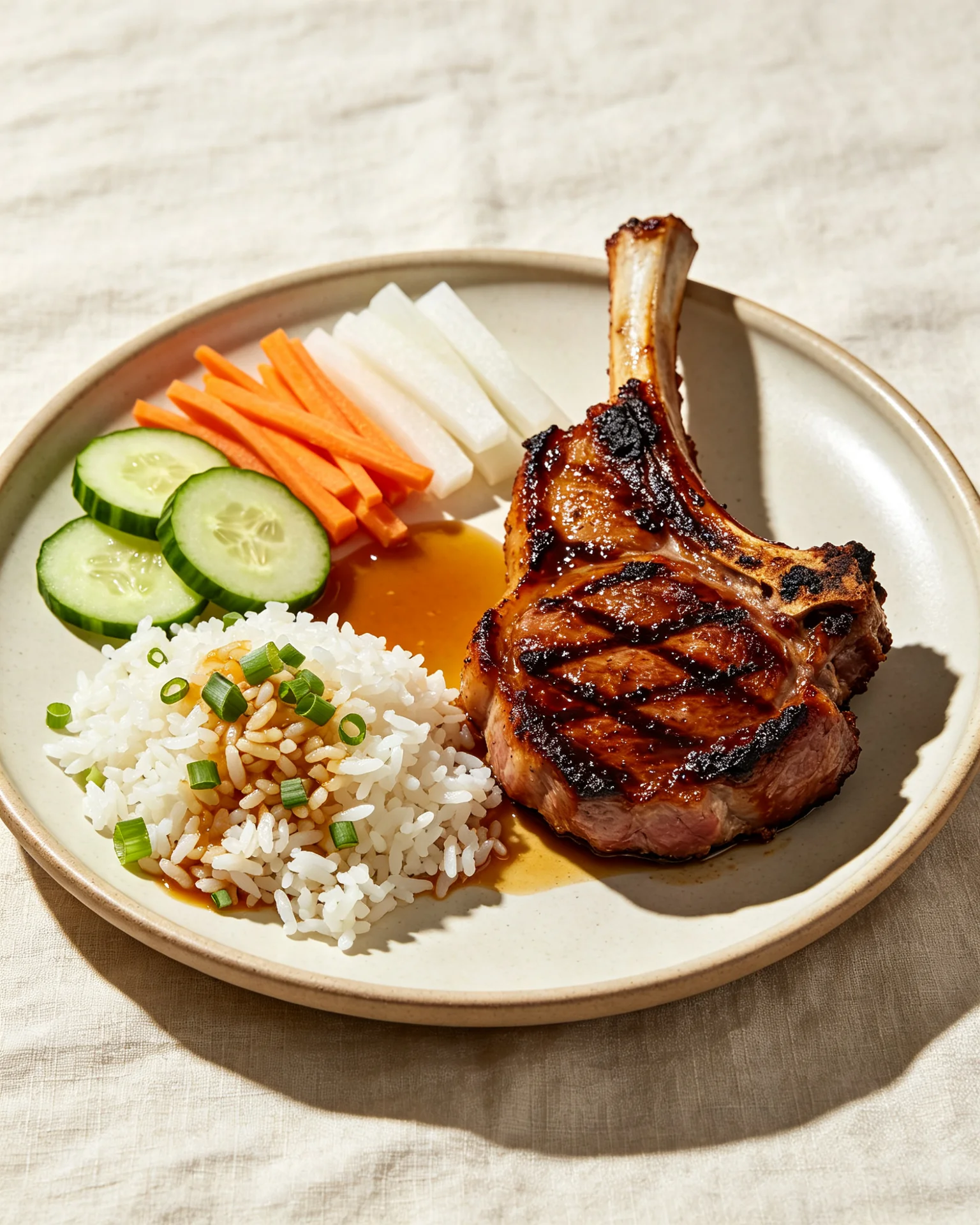
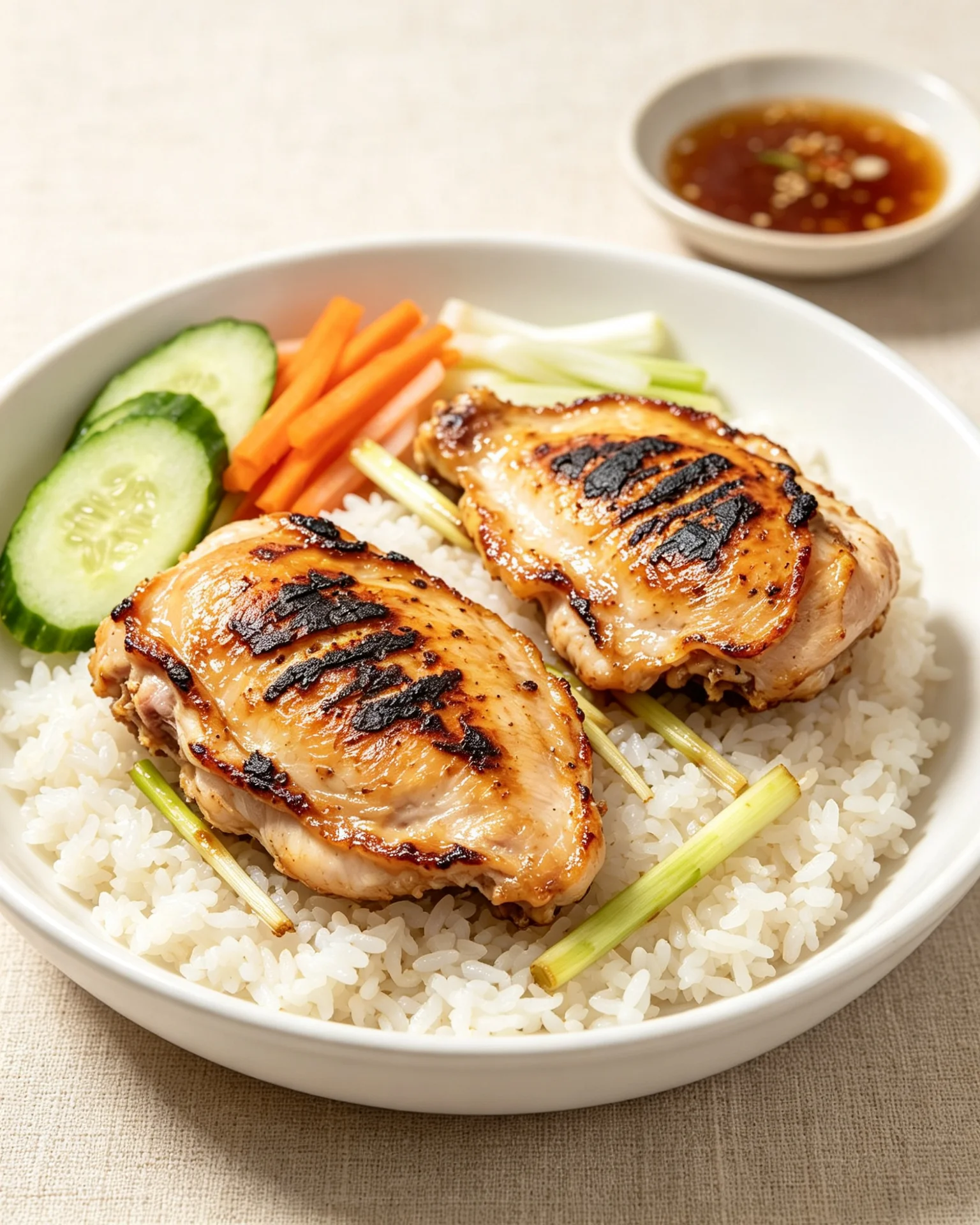
Sườn Nướng Sả (sườn = pork ribs or chops, nướng = grilled, sả = lemongrass) is the grilled lemongrass pork chop that serves as the primary protein on a cơm tấm plate. Cơm tấm is the defining street food of southern Vietnam, particularly Ho Chi Minh City, and the sườn nướng is the component that makes the plate complete. You can serve these chops on their own with rice, but their natural context is the full com tam plate: broken rice, scallion oil (mỡ hành), pickled vegetables, nuoc cham, and sometimes a fried egg or steamed egg meatloaf alongside.
The marinade is fish sauce, sugar, garlic, shallot, and a significant amount of lemongrass. The combination of fish sauce salt and sugar produces the lacquered char during grilling. The lemongrass provides the fragrance that distinguishes this from every other grilled pork preparation, when the citral and other volatile compounds hit the hot grill, they bloom and the fragrance is immediately recognisable.
What is cơm tấm and where does it come from?
Cơm tấm (literally broken rice) uses the small fragmented grains of rice that break during the mechanical milling and drying process. Commercial rice millers traditionally discarded these broken fragments as inferior, they were considered unsellable as whole grain rice and were not included in commercial rice bags.
In southern Vietnam, particularly in Saigon in the early-to-mid 20th century, these broken grains became food for market workers, rickshaw drivers, factory workers, and anyone who needed a cheap and filling meal. Street vendors built entire rice plates around them: a scoop of broken rice, a piece of grilled pork, pickled vegetables, and nuoc cham drizzled over everything.
The broken grains are slightly softer and more absorbent than whole grain rice because the starch is more exposed at each fractured surface. When nuoc cham is drizzled over the plate, the broken rice absorbs it throughout rather than the liquid sitting on the surface of intact grains. Each spoonful of rice is already slightly flavoured before the meat even reaches it.
What started as poverty food, the grain fragments discarded by the people who processed the rice, became so popular in Saigon that by the late 20th century it was eaten across all social classes and all times of day. Cơm tấm shops open at dawn and serve through to midnight. It is considered one of the defining dishes of southern Vietnamese food culture, something that came from nothing and became irreplaceable.
Why do blade chops produce better results than loin chops?
The specific cut matters more for this dish than for most pork preparations because the cooking method is fast and hot.
Blade chops are cut from the shoulder end of the pork loin, where the muscle transitions from the loin into the shoulder. This area contains more intramuscular fat and collagen than the centre-cut loin chops sold in most supermarkets. During high-heat grilling, the collagen in the blade chops begins to render at approximately 70-80°C, converting from tough connective tissue into soft gelatin and liquid fat. This rendered fat and gelatin bastes the surrounding muscle fibres from within as it liquefies, keeping the chop juicy even at the grill temperatures needed for proper char development.
Centre-cut loin chops are leaner. Less intramuscular fat, less collagen, faster moisture loss at high heat. Without the internal basting of rendered fat, loin chops dry out before the char develops. The margin for error is much smaller.
Thin bone-in blade chops at approximately 1-1.5cm thickness are the correct format. The bone adds some flavour during grilling. The thinness means the chop cooks through in the same time the marinade char develops on the surface, thick chops require longer grilling time that burns the marinade before the interior is done.
Why do you bruise the lemongrass before mincing?
Most recipes say “finely mince the lemongrass.” Some say “bruise and mince.” The difference in the marinade fragrance is immediately noticeable.
Lemongrass contains its aromatic compounds, primarily citral (a mixture of geranial and neral) and citronellal, in essential oil glands distributed through the cell walls of the stalk. These are the compounds that produce the characteristic bright, intensely citrusy fragrance of lemongrass.
Mincing cuts the cell walls and releases oil from the severed cells at each cut surface. Effective but limited: the knife contacts each stalk section once and only the cells at the cut surface release their oil.
Bruising first, pressing firmly along the stalk with the flat side of a heavy knife, the bottom of a pan, or using a mortar, ruptures the oil glands throughout the stalk before any cutting begins. The aromatic oils release from all the ruptured glands simultaneously, into the surrounding material.
Bruising then mincing: the bruising releases the citral from throughout the stalk; the subsequent mincing maximises the surface area that contacts the marinade. The combined aromatic output is significantly higher than mincing alone. You can smell the difference, a bruised-then-minced lemongrass marinade smells intensely lemongrass; a minced-only marinade smells notably milder.
Use the bottom 10-12cm of the stalk only, the pale, tender inner portion after removing the outer dried layers and the tough top. The rest is too fibrous and woody.
What produces the caramelised char on the pork chops?
The dark, lacquered char on Vietnamese grilled pork is not simple browning from heat. It is the product of two simultaneous reactions between specific marinade components.
The marinade contains significant sugar, typically brown sugar or granulated sugar, sometimes with honey. At grill surface temperatures above 160°C, sucrose begins caramelising: the sugar melts and the reducing sugars (glucose, fructose) react to produce melanoidins (dark colour compounds) and furfurals (slightly bitter, caramelised aromatic compounds).
Simultaneously, the sugar reacts with the free amino acids in the fish sauce through the Maillard reaction. Fish sauce is one of the most amino-acid-dense condiments in cooking, its free glutamate, lysine, and other amino acids react with the reducing sugars at the hot grill surface to produce pyrazines and other heterocyclic aromatics. These are the compounds responsible for the roasted, complex, slightly bitter depth of the char.
The result of both reactions together: the dark, slightly lacquered surface with a flavour that is simultaneously sweet, savoury, and faintly bitter, the char that defines properly cooked Sườn Nướng Sả. This is the same compound class produced by satay char, Peking duck skin caramelisation, and the hú là technique in Chinese stir-fry. Char is a specific flavour state, not burning.
This is why the grill or pan must be very hot before the chops go in. At medium heat, the surface does not reach caramelisation temperature fast enough, the chop cooks through before the char can develop. The result is cooked pork with some browning. At maximum heat, the surface reaches caramelisation temperature within 30-60 seconds of contact and the char develops while the interior is still cooking to temperature.
Why score the edges before marinating?
Covered in the opening but worth mapping fully.
The perimeter of each pork chop has a layer of fat and underneath it, a membrane of silver skin, the tough, inelastic connective tissue that lines the outside of many pork muscles. Unlike fat, silver skin does not render at cooking temperatures. The proteins denature and the membrane contracts and tightens as it heats.
An un-scored chop on a hot grill: the silver skin contracts along the edge while the muscle tissue in the centre expands slightly from heat. The edge contraction is stronger than the centre expansion, it pulls the chop into a curl. The centre lifts off the grill surface.
A lifted centre has no contact with the grill and cannot develop char where it is not touching. Char develops only at the still-touching edges and perimeter while the centre steams in the air above the grill. The result: overly charred edges, pale underdeveloped centre, uneven cooking throughout.
Scoring cuts through the fat and silver skin at 2cm intervals along all four edges of the chop. The cuts are approximately 5mm deep, enough to sever the silver skin without cutting into the meat. Each severed segment of silver skin can contract independently. No segment is long enough to create sufficient tension to curl the chop. It stays flat.
Score before marinating, not after, the marinade penetrates slightly into the score cuts and seasons the edge fat as well as the meat surfaces.
What is nuoc cham and why does it complete the plate?
Nuoc cham (nước chấm) is the Vietnamese dipping sauce, fish sauce, lime juice, sugar, garlic, and chilli. It accompanies virtually every Vietnamese meal and in the context of com tam it performs a specific function.
The pork chops are rich, fat from the blade chop rendering during grilling, char from caramelised sugar, fish sauce salt coating every surface. A com tam plate without nuoc cham is correctly cooked but slightly heavy after a few bites. The fat and salt accumulate.
Nuoc cham’s lime juice performs the same acid counterbalancing function as calamansi on pancit bihon or lemon juice on hibachi chicken. The citric acid provides contrast to the fat richness and prevents the dish from tasting heavy through the full plate. The fish sauce in the nuoc cham adds additional umami without additional richness, it deepens the flavour rather than adding more weight.
On a properly assembled com tam plate, nuoc cham is drizzled over both the rice and the pork. The broken rice absorbs it throughout as covered above. The pork picks up another layer of savoury-acidic contrast on top of the char. Every element of the plate is connected through the nuoc cham.
Ingredients
Serves 4
Pork chops:
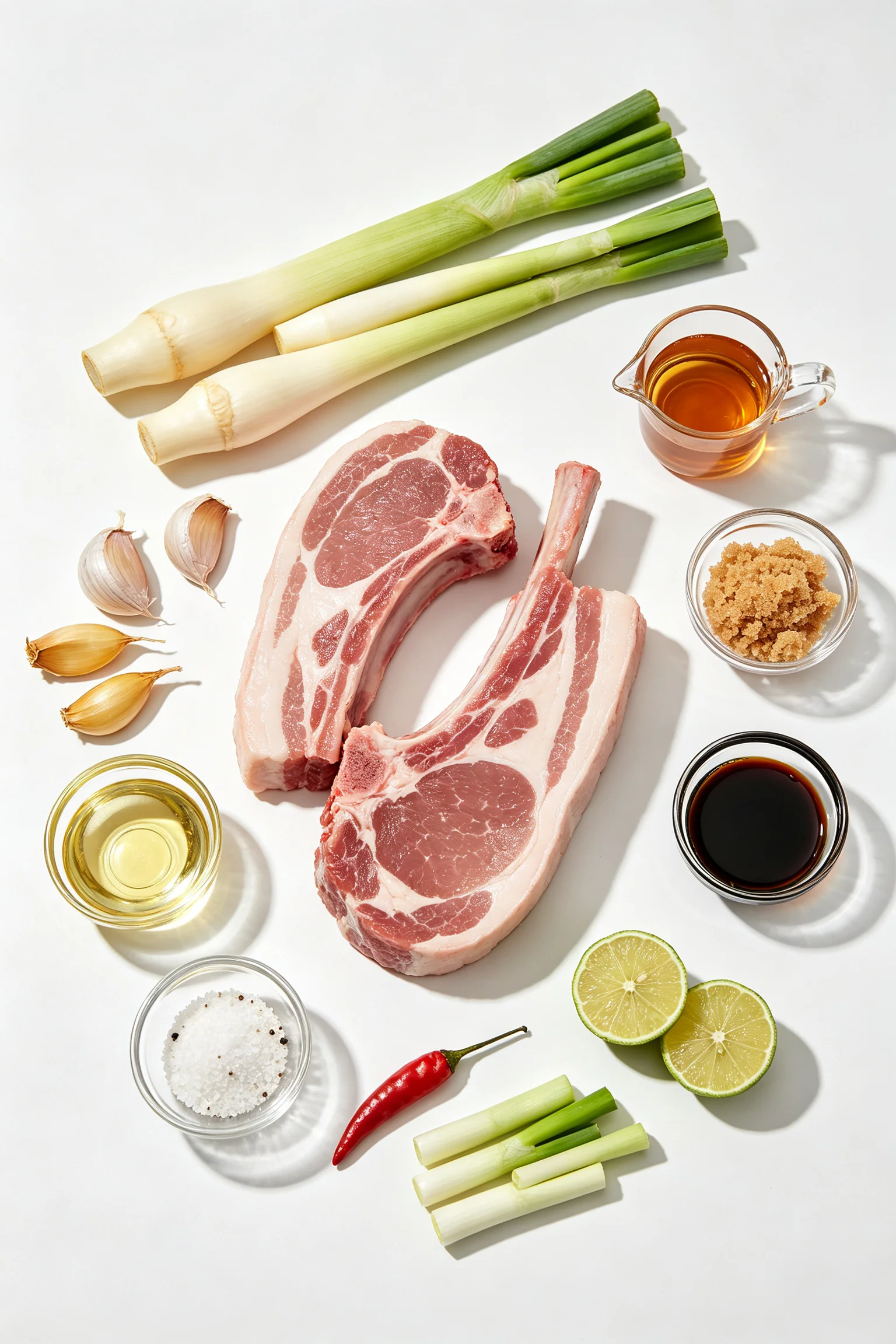
- 4 bone-in blade-cut pork chops, approximately 1-1.5cm thick (450-500g total)
Lemongrass marinade:
- 3 stalks lemongrass, bottom 10-12cm only, outer leaves removed
- 4 cloves garlic, minced
- 2 shallots, minced
- 3 tbsp fish sauce
- 3 tbsp brown sugar
- 2 tbsp neutral oil
- 1 tbsp soy sauce
- 1 tsp white pepper
- 1 tsp sesame oil
Nuoc cham:
- 3 tbsp fish sauce
- 3 tbsp lime juice (approximately 2 limes)
- 2 tbsp sugar
- 4 tbsp warm water
- 2 garlic cloves, finely minced
- 1 bird’s eye chilli, thinly sliced
Scallion oil (mỡ hành):
- 4 spring onions, thinly sliced
- 3 tbsp neutral oil, heated until smoking
To serve:
- Cooked broken rice (cơm tấm) or jasmine rice
- Sliced cucumber
- Pickled carrots and daikon (do chua)
- Fried egg (optional)
Instructions
Start the marinade the day before. Overnight marination produces significantly more flavour depth than 4 hours.
Step 1: Score the chop edges
Place each pork chop flat on a board. Using a sharp knife, make cuts approximately 5mm deep through the fat and silver skin along all four edges of each chop, spaced 2cm apart.
Step 2: Bruise and mince the lemongrass
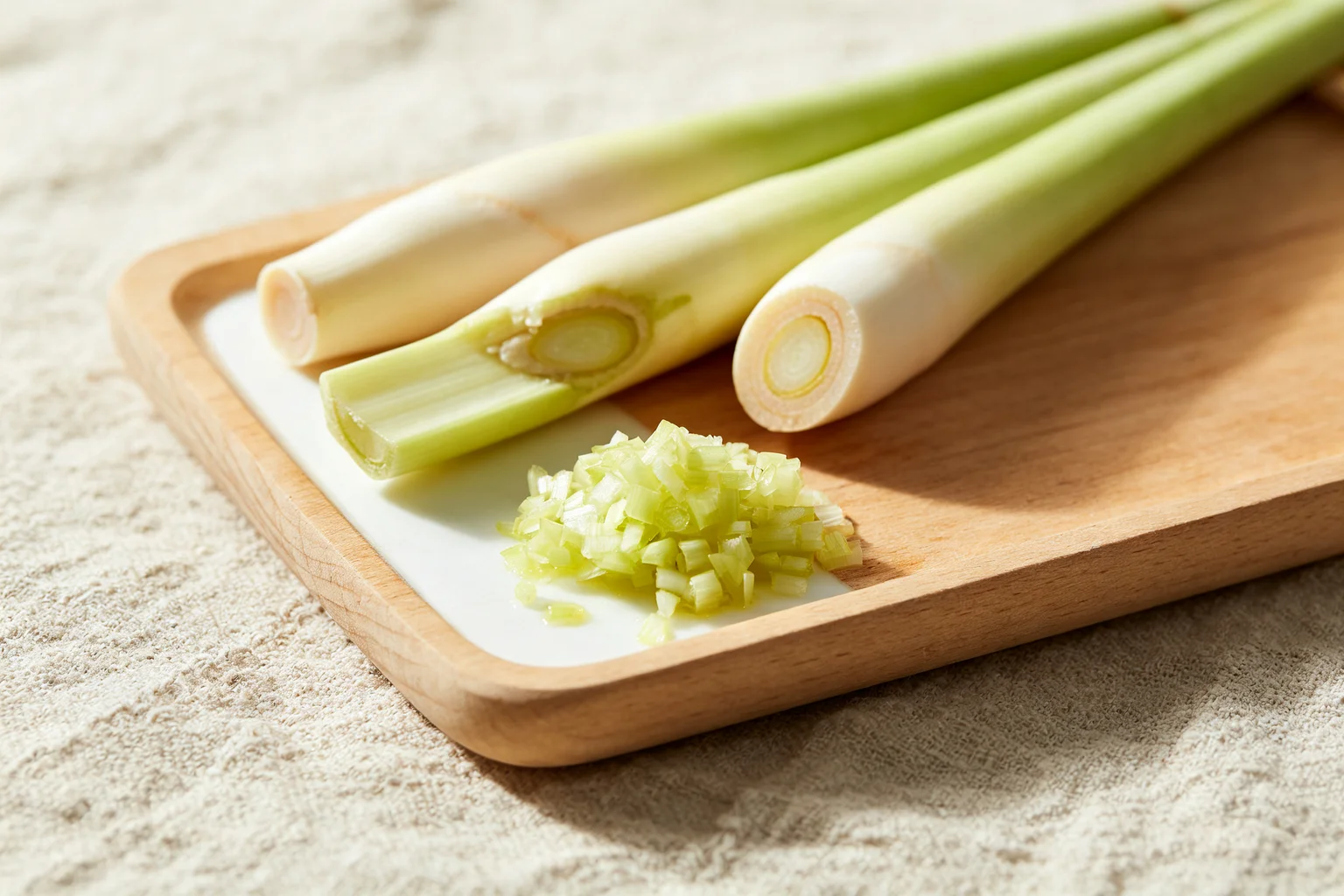
Remove the outer dried layers from the lemongrass stalks. Use only the bottom 10-12cm of each stalk.
Step 3: Marinate overnight
Combine the minced lemongrass, garlic, shallots, fish sauce, brown sugar, oil, soy sauce, white pepper, and sesame oil in a bowl. Mix until the sugar is fully dissolved.
Add the pork chops. Work the marinade into every surface, into the score cuts, and under any fat cap. Cover and refrigerate overnight, minimum 4 hours, 8-12 hours optimal.
Remove from the refrigerator 30 minutes before cooking.
Step 4: Make the nuoc cham
Dissolve the sugar in the warm water. Add fish sauce, lime juice, minced garlic, and sliced chilli.
Step 5: Make the scallion oil
Place sliced spring onions in a heatproof bowl. Heat the neutral oil in a small pan until smoking.
Step 6: Grill to char
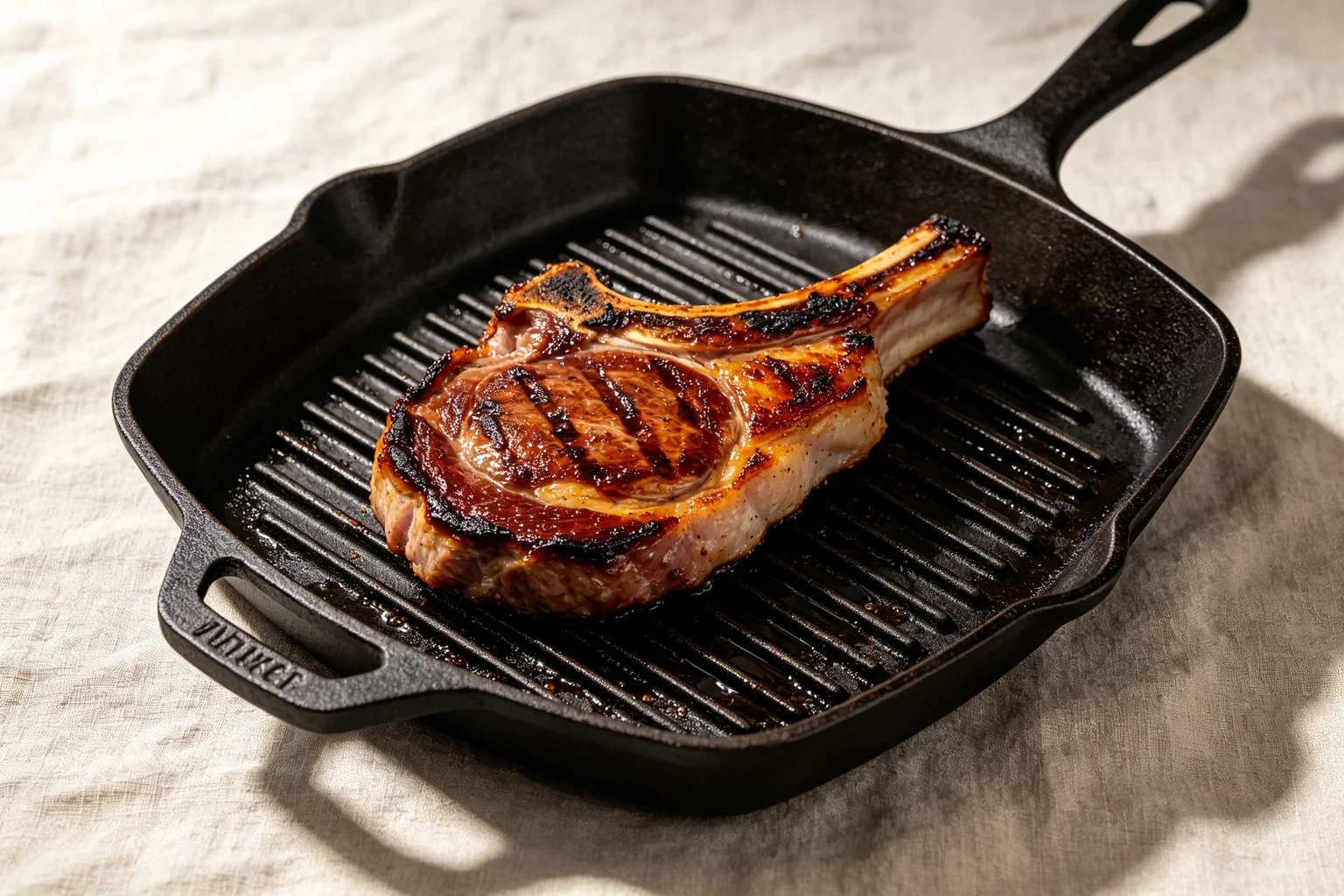
Heat a grill, grill pan, or heavy cast iron pan to maximum heat. Brush with a small amount of oil.
Remove the chops from the marinade and shake off excess, too much marinade on the surface burns before the chop is cooked through. Grill on the first side for 3-4 minutes without moving until visible char develops and the chop releases naturally from the surface. Flip. Grill 2-3 minutes more on the second side. The chops should be charred at the edges and across the surfaces, with an internal temperature of 68-70°C.
Rest 3 minutes before plating.
Step 7: Assemble the com tam plate
Scoop cooked broken rice onto each plate. Drizzle scallion oil over the rice.
How do you store and reheat Vietnamese lemongrass pork chops?
The cooked pork chops keep refrigerated for 3 days. The char softens slightly overnight but the marinade flavour deepens.
To reheat and partially restore the char: a very hot cast iron pan or grill pan for 2 minutes per side. The residual marinade on the surface re-caramelises slightly and some char texture returns. Do not microwave, it produces pale, steamed pork without any of the char character.
Uncooked marinated chops can be frozen on the marinade for up to 3 months. Thaw overnight in the refrigerator before grilling. The marinade continues working slowly during freezing and thawing, the result after overnight thaw is often more deeply flavoured than a fresh 8-hour marinate.
Love Vietnamese food?
Check out my complete guide to Vietnamese home cooking, pantry essentials, and techniques.
FAQ
Why is my pork chop curling on the grill? The silver skin on the edges was not scored before cooking. Score through the fat and silver skin along all four edges at 2cm intervals, approximately 5mm deep, before marinating. The scoring severs the silver skin into independent segments that each contract without pulling the whole chop. If the chop is already on the grill and curling, press it flat with a spatula and hold for 30 seconds, the brief pressure encourages the chop to stay flat while the surface develops enough sear to hold its shape.
Can I make this without a grill using an oven or pan? A very hot cast iron pan produces a good result. Heat the pan to smoking before adding the chops. The pan needs to be hot enough to immediately begin caramelising the marinade on contact, medium heat produces cooked pork without char. An oven at 220°C with the broiler on for the final 3-4 minutes produces some char but less than a direct grill or hot pan. Whatever method is used, the surface must reach caramelisation temperature for the char to develop.
What is broken rice and where do I find it? Broken rice (gạo tấm) is the fragmented rice grains produced during the milling process. It is sold in bags labelled “broken rice,” “com tam rice,” or “jasmine broken rice” at Vietnamese and Asian grocery stores. If unavailable, regular jasmine rice works and the flavour of the plate is the same, the texture is slightly different as jasmine whole grains are less absorbent than broken grains for the nuoc cham.
Why does the recipe use blade chops and not centre-cut loin chops? Blade chops from the shoulder end of the loin contain more intramuscular fat and collagen than centre-cut loin chops. At grill temperatures, this collagen renders into liquid fat that bastes the muscle fibres from within, keeping the chop juicy through the high-heat grilling needed for char development. Loin chops are leaner and have less tolerance for the high heat required. They dry out before the char develops. If only loin chops are available, reduce the grilling time by 30-45 seconds per side and monitor closely.
You might also like: Check out our complete Vietnamese cooking guide for more essential ingredients and techniques.
Vietnamese Lemongrass Pork Chops (Sườn Nướng Sả)
PT8H15M
PT15M
PT8H30M
Nutrition Facts
Ingredients
- 4 bone-in blade-cut pork chops, approximately 1-1.5cm thick (450-500g total)
- 3 stalks lemongrass, bottom 10-12cm only, outer leaves removed
- 4 cloves garlic, minced
- 2 shallots, minced
- 3 tbsp fish sauce
- 3 tbsp brown sugar
- 2 tbsp neutral oil
- 1 tbsp soy sauce
- 1 tsp white pepper
- 1 tsp sesame oil
- 3 tbsp fish sauce
- 3 tbsp lime juice (approximately 2 limes)
- 2 tbsp sugar
- 4 tbsp warm water
- 2 garlic cloves, finely minced
- 1 bird's eye chilli, thinly sliced
- 4 spring onions, thinly sliced
- 3 tbsp neutral oil, heated until smoking
- Cooked broken rice (cơm tấm) or jasmine rice
- Sliced cucumber
- Pickled carrots and daikon (do chua)
- Fried egg (optional)
Instructions
- *Start the marinade the day before. Overnight marination produces significantly more flavour depth than 4 hours.*
- Place each pork chop flat on a board. Using a sharp knife, make cuts approximately 5mm deep through the fat and silver skin along all four edges of each chop, spaced 2cm apart. You should feel the knife pass through the fat and hit a slight resistance from the silver skin, cut through it. This prevents the chop from curling on the grill.
- Remove the outer dried layers from the lemongrass stalks. Use only the bottom 10-12cm of each stalk. Lay flat on a board and press firmly along the stalk with the flat side of a heavy knife or the bottom of a pan until the stalk is crushed and fragrant. Then mince as finely as possible, the bruising has already released the oil so the mincing is primarily about surface area. The marinade should smell intensely of lemongrass at this point.
- Combine the minced lemongrass, garlic, shallots, fish sauce, brown sugar, oil, soy sauce, white pepper, and sesame oil in a bowl. Mix until the sugar is fully dissolved. Score marks should be visible on the chops from Step 1. Add the pork chops. Work the marinade into every surface, into the score cuts, and under any fat cap. Cover and refrigerate overnight, minimum 4 hours, 8-12 hours optimal. Remove from the refrigerator 30 minutes before cooking.
- Dissolve the sugar in the warm water. Add fish sauce, lime juice, minced garlic, and sliced chilli. Stir until fully combined. Taste, it should be simultaneously salty, sour, sweet, and slightly spicy. Adjust with more lime for sour, more fish sauce for salt, or more sugar to balance. Set aside at room temperature.
- Place sliced spring onions in a heatproof bowl. Heat the neutral oil in a small pan until smoking. Pour directly over the spring onions, they will sizzle and wilt immediately. Stir and set aside. The hot oil wilts the scallion and releases its aromatic compounds into the oil. This is the mỡ hành that goes over the rice.
- Heat a grill, grill pan, or heavy cast iron pan to maximum heat. Brush with a small amount of oil. Remove the chops from the marinade and shake off excess, too much marinade on the surface burns before the chop is cooked through. Grill on the first side for 3-4 minutes without moving until visible char develops and the chop releases naturally from the surface. Flip. Grill 2-3 minutes more on the second side. The chops should be charred at the edges and across the surfaces, with an internal temperature of 68-70°C. Rest 3 minutes before plating.
- Scoop cooked broken rice onto each plate. Drizzle scallion oil over the rice. Place the rested pork chop alongside. Add sliced cucumber and pickled vegetables. Spoon nuoc cham over both the rice and the pork. Add a fried egg if using. ## How do you store and reheat Vietnamese lemongrass pork chops? The cooked pork chops keep refrigerated for 3 days. The char softens slightly overnight but the marinade flavour deepens. To reheat and partially restore the char: a very hot cast iron pan or grill pan for 2 minutes per side. The residual marinade on the surface re-caramelises slightly and some char texture returns. Do not microwave, it produces pale, steamed pork without any of the char character. Uncooked marinated chops can be frozen on the marinade for up to 3 months. Thaw overnight in the refrigerator before grilling. The marinade continues working slowly during freezing and thawing, the result after overnight thaw is often more deeply flavoured than a fresh 8-hour marinate.
Did you make this recipe?
Tag @asianfoodsdaily on Instagram or leave a comment below!
Testing Notes
Tested in Asha's kitchen. Last reviewed July 16, 2025.
Ingredient Substitutions
Substitution notes coming soon.
About Asha
Half Asian, half African cook raised between two food-obsessed cultures. I've spent 10 years learning Asian cooking traditions through family, friends, and thousands of hours at the stove — testing every dish until it works in a standard home kitchen.
Read my full storyRelated Recipes
More delicious dishes you might enjoy


Loading comments...