Filipino Macaroni Salad Recipe
Jump to Section
The first time I made this for a gathering, I drained the pineapple for about 30 seconds and moved on. After one hour of chilling the salad looked perfect, creamy, thick, the dressing coating every piece of macaroni evenly. By the next morning it was a pool of thin, watery liquid with the pasta sitting in it. The pineapple had been releasing water into the dressing all night.
Pineapple tidbits contain approximately 85% water by weight. Even after the juice is poured off, water continues to release from the fruit into the surrounding dressing during refrigeration. Undrained pineapple is the main reason Filipino macaroni salad turns watery overnight. The fix: drain in a fine sieve for five full minutes, then press the pineapple gently with the back of a spoon to extract more liquid before adding it to the salad. That step does not happen in thirty seconds.
What is Filipino macaroni salad and what makes it different from American macaroni salad?
Both dishes are called macaroni salad and both use elbow pasta. The similarities end there.
American macaroni salad is built on a mayonnaise-vinegar-mustard base, savoury, tangy, slightly sharp. The classic Midwestern picnic version has no sweetness beyond perhaps a small amount of sugar. The flavour profile is predominantly savoury.
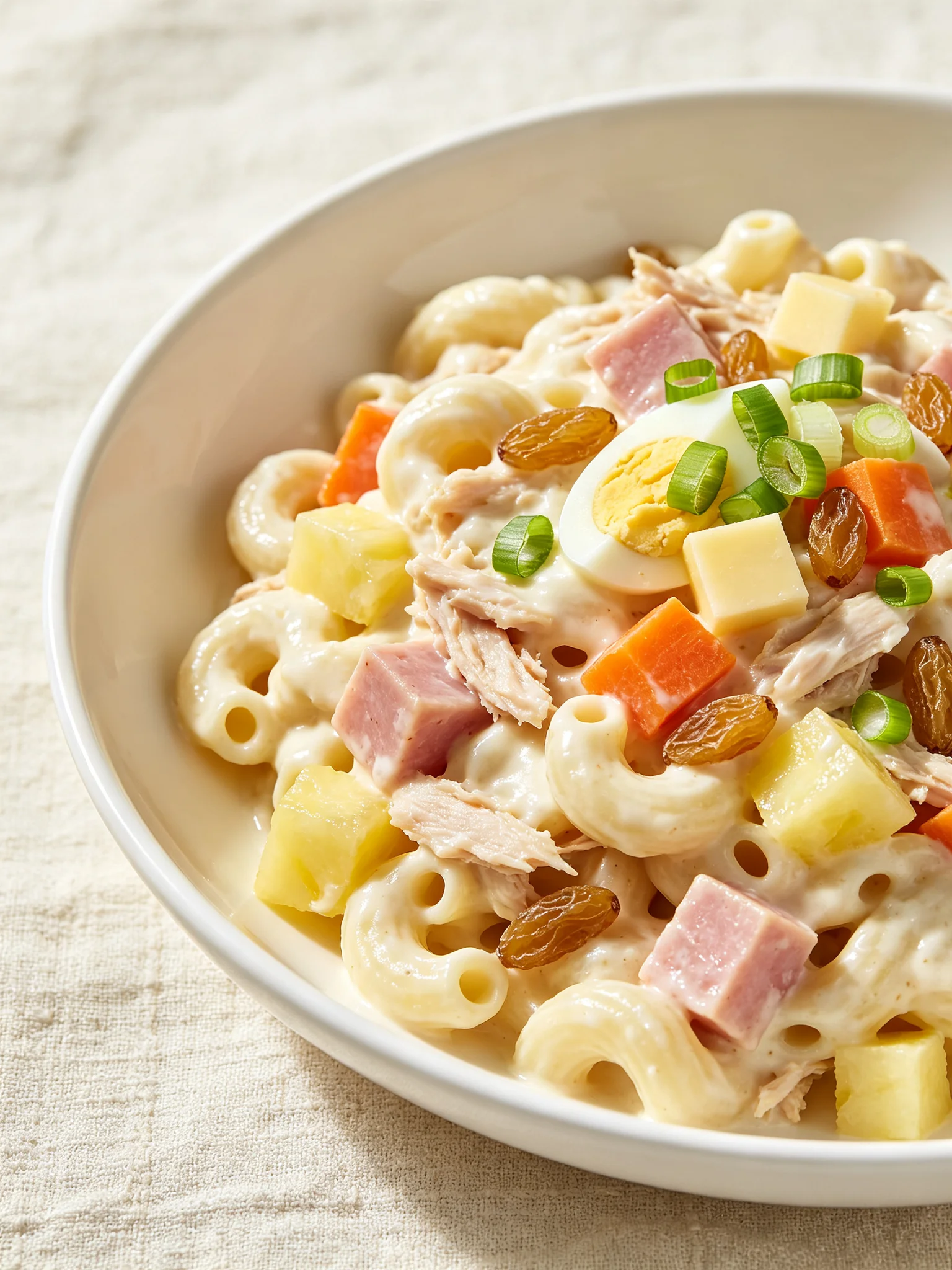
Filipino macaroni salad replaces the vinegar-mustard framework with sweetened condensed milk and adds pineapple, raisins, and ham alongside the chicken and vegetables. The dressing is creamy and noticeably sweet. There is no tartness from vinegar, no sharpness from mustard. The sweet-savoury balance is the point, it is not an accident or an error in the recipe.
Filipino macaroni salad can function as a side dish alongside grilled pork or fried chicken. It can also be served as a dessert, which happens in some Filipino households particularly at Christmas, more fruit is added, less savoury protein, and it sits on the dessert table rather than the main table. The same dish, two different contexts, depending on how it is composed.
Where does Filipino macaroni salad come from?
The United States administered the Philippines from 1898 to 1946 following the Spanish-American War. During that colonial period, American food culture entered Filipino life systematically, through public school home economics programmes modelled on American curricula, through military mess halls, and through American household management manuals distributed across the archipelago.
Pasta salad with mayonnaise dressing was standard American home cooking in the early 20th century. Filipino home cooks adopted it and adapted it to local flavour preferences. The American vinegar-mustard-mayo base was replaced with condensed milk, a pantry staple in the Philippines since Spanish colonial times, widely available and deeply familiar. Pineapple and raisins, both abundant in the Philippines, replaced the American pickles and celery. The result was a dish that kept the American form, cold pasta in creamy dressing, but had an entirely Filipino flavour character.
Today Filipino macaroni salad is inseparable from celebrations: birthdays, fiestas, Christmas, New Year. It is one of the dishes that travels with the Filipino diaspora and appears at gatherings wherever Filipino communities have settled, a direct link to a colonial culinary history that produced something genuinely Filipino in the process.
What does condensed milk do in the dressing and why does it work?
Sweetened condensed milk is whole milk with approximately 60% of its water removed and sucrose added until sucrose makes up approximately 55% of the total weight. That composition is why it functions differently in this dressing from regular sugar or regular milk.
Regular sugar dissolved in the dressing requires water as a solvent, adding sugar means adding water alongside it, which dilutes the dressing and contributes to a looser consistency over time. Condensed milk adds its sucrose without adding significant additional water, because most of the water has already been removed during processing. The sweetness is concentrated.
The remaining milk proteins in condensed milk also act as partial emulsifiers. They help the fat in the mayonnaise distribute more evenly through the dressing rather than separating into pockets of oil. The dressing coats each piece of macaroni more uniformly than mayonnaise alone would.
Two to three tablespoons per batch produces the characteristic Filipino sweetness without tipping the dressing into dessert territory. Start with two, taste, add the third if needed. The dressing should be noticeably sweet but the savoury elements of the mayonnaise and cheese should still be present.
Why must the pasta be cooked al dente?
Filipino macaroni salad is not served immediately after mixing. It chills for a minimum of eight hours, ideally overnight. During that time the pasta continues to absorb the dressing from the outside in, through the same osmotic process that cooks pasta in the first place.
Al dente pasta has a firm starch structure, the starch granules are hydrated and swollen but still have structural integrity. During overnight chilling, this pasta absorbs additional dressing and arrives at the correct final texture: tender, creamy, distinct. Each piece holds its shape.
Overcooked pasta has a starch structure that has begun to break down. It is already at the point of softness before chilling begins. During overnight refrigeration it absorbs significantly more dressing (the more permeable starch network takes up more liquid) and loses more structural integrity. The result is pasta that has swelled into a heavy, slightly gluey mass that compresses under a fork rather than holding its shape.
Cook the macaroni for 1-2 minutes less than the package’s al dente instruction. It will seem slightly too firm when drained. After overnight chilling with the dressing, it will be exactly right.
Why do you drain the pineapple completely?
The mechanism in the opening paragraph applies through the full chilling period. Pineapple tidbits contain approximately 85% water by weight and continue releasing that water into the surrounding dressing during refrigeration. The release is gradual and progressive, a little in the first hour, more by hour four, significantly more by the next morning.
The five-minute sieve drain removes the loose juice. The gentle pressing removes the additional water held in the pineapple’s cell structure. Both steps are necessary. The sieve drain alone is insufficient.
After draining and pressing: the pineapple should feel noticeably drier and firmer to the touch than freshly drained fruit. If pressed between two layers of kitchen paper, only a small amount of moisture transfers. At this point it is ready for the salad.
Do not substitute the pineapple juice that was drained off into the dressing, some recipes suggest this for flavour. The juice adds water. The pineapple flavour is already present in the fruit pieces.
Why does Filipino macaroni salad taste better the next day?
Three things happen during overnight chilling that improve the dish.
The flavour compounds in the ham, chicken, and vegetables diffuse through the dressing as the salad sits. After one hour the dressing tastes of condensed milk and mayonnaise with ingredients mixed in. After eight to twelve hours the flavours have integrated, each forkful tastes of the complete dish rather than its separate components.
The condensed milk equilibrates with the mayonnaise as the temperature drops and stabilises. The dressing thickens slightly as the milk proteins and fat interact over time. A dressing that seems slightly thin immediately after mixing typically reaches its correct creamy consistency after overnight chilling.
The pasta completes its absorption cycle. As described above, al dente pasta in contact with the dressing for eight or more hours arrives at the correct final texture. One hour is insufficient, the pasta is still absorbing and the texture has not reached its final state.
Make this the night before. The hour-before version is acceptable. The next-morning version is the real dish.
What is the correct cheese to use?
Eden cheese is the standard in the Philippines. Eden is a processed cheese product with a mild, creamy character and a lower melting point than aged cheese. The key is the word processed.
Processed cheese contains emulsifying salts, typically sodium citrate, which keep the fat and protein evenly distributed even when the cheese is cold and incorporated into a dressing. In a cold, sweet dressing, Eden cheese integrates smoothly, it softens slightly and contributes creaminess without strong flavour notes that compete with the condensed milk.
Aged cheddar contains flavour compounds, including butyric acid and other short-chain fatty acids that develop during the ageing process, which produce a perceived sharpness. That sharpness sits discordantly against the sweet condensed milk dressing. The salad tastes like two different dishes occupying the same bowl.
In the Philippines: Eden cheese. Outside the Philippines: Velveeta is the closest widely available substitute. Mild, young, unaged cheddar works acceptably. Sharp or mature cheddar does not.
Ingredients

Serves 10 as a side dish
Salad:
- 400g (14oz) elbow macaroni
- 2 chicken breasts, poached and shredded
- 200g cooked ham, cut into small cubes
- 1 can (432g / 15oz) pineapple tidbits, drained thoroughly (5 minutes in sieve, then pressed)
- 150g Eden cheese or Velveeta, cubed small
- 2 medium carrots, diced small and blanched 2 minutes
- 3 hard-boiled eggs, roughly chopped
- 100g raisins
- 2 tbsp sweet pickle relish
- 3 spring onions, thinly sliced
Dressing:
- 300g (1¼ cups) good mayonnaise (Lady’s Choice, Best Foods, or Kewpie)
- 3 tbsp sweetened condensed milk
- 1 tbsp apple cider vinegar or white vinegar (balances the sweetness)
- ½ tsp salt
- ¼ tsp white pepper
- 3 tbsp heavy cream or all-purpose cream (optional, makes the dressing richer and smoother)
Instructions
Step 1: Poach the chicken
Place chicken breasts in a saucepan. Cover with cold water.
Step 2: Cook the macaroni
Bring a large pot of well-salted water to a boil. Cook macaroni for 1-2 minutes less than the package’s al dente instruction.
Step 3: Drain the pineapple properly
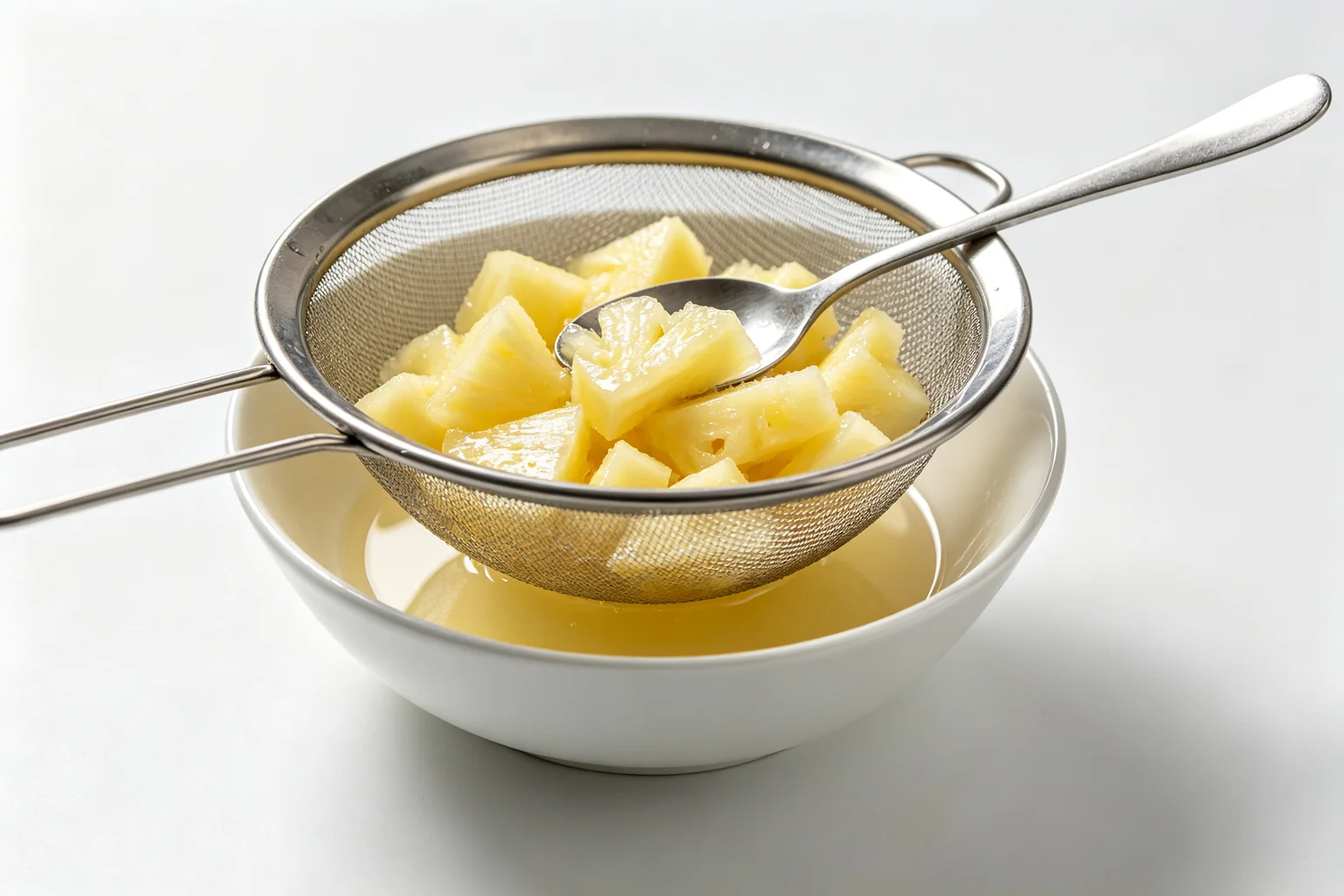
the pineapple tidbits into a fine mesh sieve over a bowl. Leave to drain for 5 full minutes.
Step 4: Make the dressing
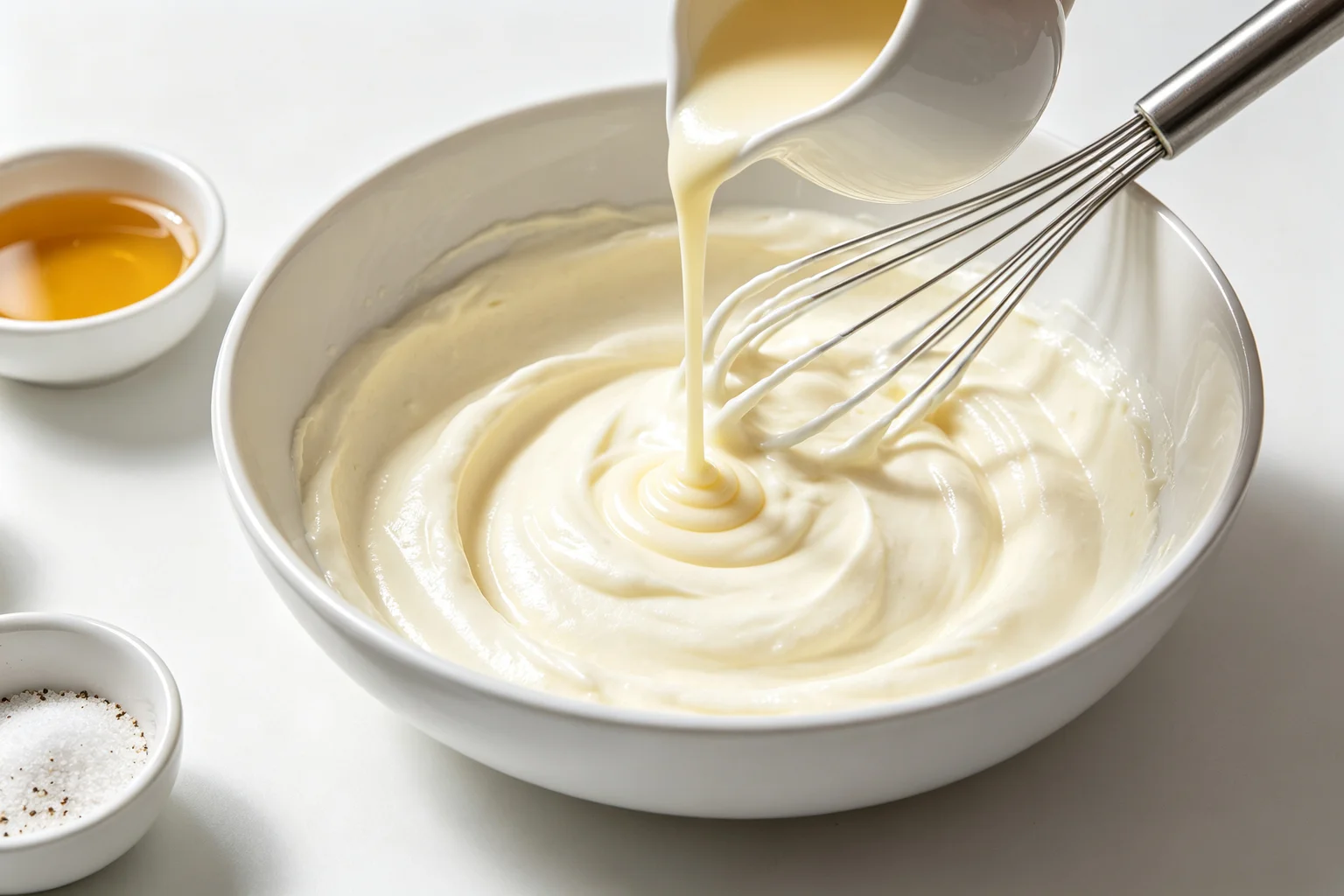
Whisk together mayonnaise, condensed milk, vinegar, salt, and pepper until smooth and fully combined. Add cream if using.
Step 5: Combine everything
In a very large bowl, combine the cooled macaroni, shredded chicken, ham, drained pineapple, cheese, carrots, eggs, raisins, pickle relish, and spring onions. Pour the dressing over the top.
Taste. Adjust salt, condensed milk, or vinegar as needed.
Step 6: Chill overnight
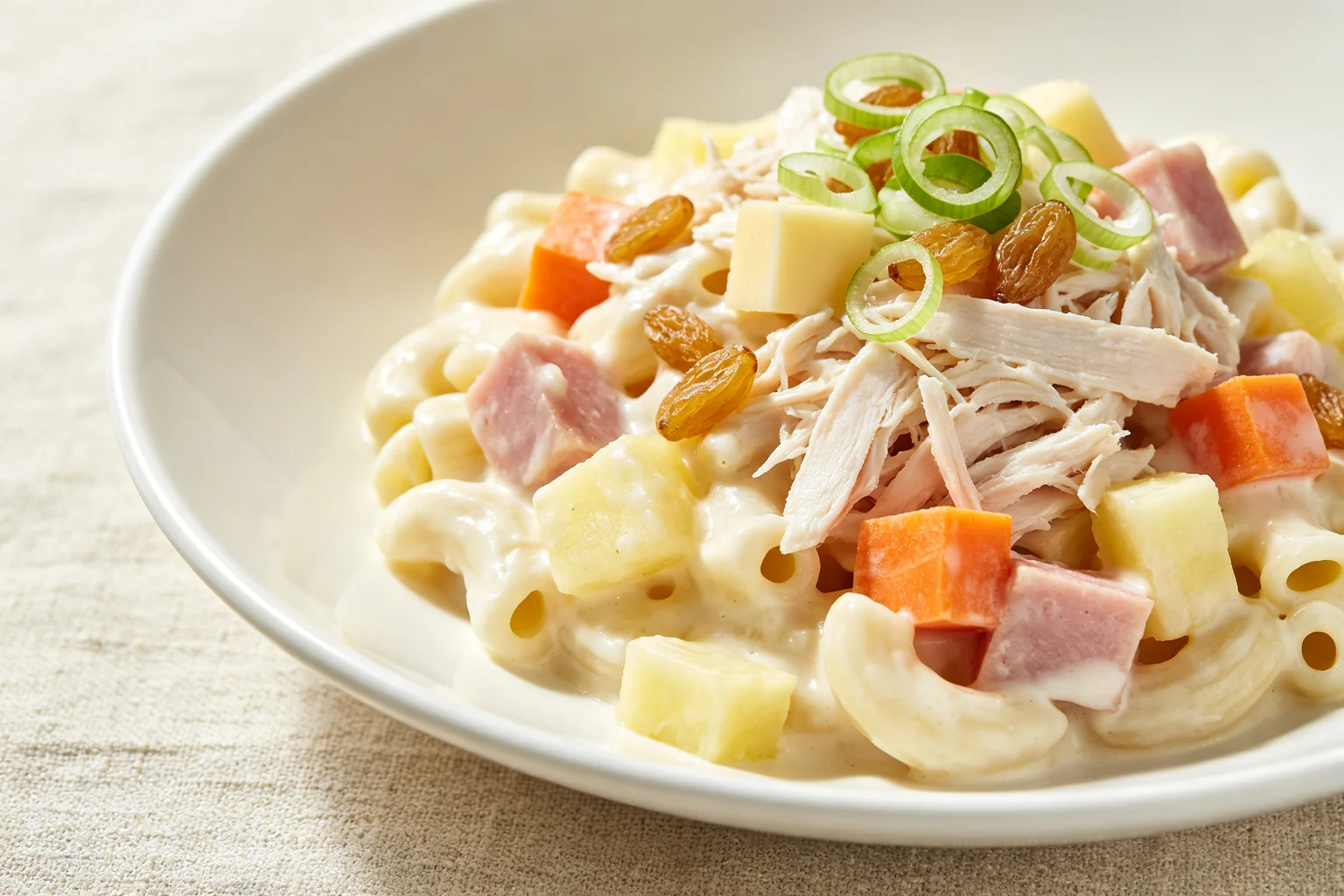
Cover and refrigerate for a minimum of 8 hours. Overnight is correct.
Before serving, taste again, the pasta will have absorbed some of the dressing’s seasoning and the salad may need a small additional amount of salt. If the salad seems thick or dry after overnight chilling, stir in 2-3 tablespoons of additional mayonnaise or cream to loosen.
How do you store Filipino macaroni salad?
Filipino macaroni salad keeps in the refrigerator for 3 days in a sealed container. The flavour continues deepening through day two and day three. The texture may thicken further as the pasta absorbs more dressing, stir in a small amount of mayonnaise before serving if needed.
Do not freeze. Mayonnaise separates when frozen and thawed, producing a grainy, broken dressing. The pasta also becomes waterlogged after freezing and the texture is unpleasant.
For a large gathering: the salad can be made up to 48 hours in advance. This is actually preferable to making it the same day.
Love Filipino food?
Check out my complete guide to Filipino home cooking, pantry essentials, and techniques.
FAQ
Why is my Filipino macaroni salad watery? The pineapple was not drained properly. Pineapple tidbits contain approximately 85% water by weight and release this water into the dressing progressively during refrigeration. Drain in a fine sieve for five minutes, then press with the back of a spoon before adding to the salad. The second most common cause is using overcooked pasta, soft pasta absorbs more dressing liquid during overnight chilling, eventually releasing it back as the structure breaks down further.
Can I use regular sugar instead of condensed milk? Not as a direct substitute. Regular sugar requires water as a solvent, adding liquid volume that dilutes the dressing. Condensed milk adds sweetness without significant added water because most of the water has already been removed during processing. If condensed milk is unavailable, dissolve sugar into the cream component rather than adding it directly, this minimises the additional liquid added.
How long should Filipino macaroni salad chill before serving? Eight hours minimum. Overnight is better. One hour is insufficient, the pasta is still absorbing dressing and the flavours have not integrated. The salad served after one hour tastes like its separate ingredients. After eight hours it tastes like a complete dish. After twelve to twenty-four hours the flavours are fully developed.
Can I make Filipino macaroni salad without ham? Yes. The dish works with chicken only, or with chicken and shrimp, or as a vegetarian version with more fruit and cheese. The ham contributes a smoky, savoury element that deepens the overall flavour profile, without it the salad is slightly sweeter and more fruit-forward, which makes it closer to the dessert version served at Filipino celebrations. Neither version is wrong.
You might also like: Check out our complete Filipino cooking guide for more essential ingredients and techniques.
Filipino Macaroni Salad Recipe
Filipino Recipes, Macaroni Salad, Party Food
PT20M
PT20M
PT8H40M
Nutrition Facts
Ingredients
- 400g (14oz) elbow macaroni
- 2 chicken breasts, poached and shredded
- 200g cooked ham, cut into small cubes
- 1 can (432g / 15oz) pineapple tidbits, drained thoroughly (5 minutes in sieve, then pressed)
- 150g Eden cheese or Velveeta, cubed small
- 2 medium carrots, diced small and blanched 2 minutes
- 3 hard-boiled eggs, roughly chopped
- 100g raisins
- 2 tbsp sweet pickle relish
- 3 spring onions, thinly sliced
- 300g (1¼ cups) good mayonnaise (Lady's Choice, Best Foods, or Kewpie)
- 3 tbsp sweetened condensed milk
- 1 tbsp apple cider vinegar or white vinegar (balances the sweetness)
- ½ tsp salt
- ¼ tsp white pepper
- 3 tbsp heavy cream or all-purpose cream (optional, makes the dressing richer and smoother)
Instructions
- Place chicken breasts in a saucepan. Cover with cold water. Add salt, a few peppercorns, and a bay leaf. Bring to a very gentle simmer. Poach 15-18 minutes until cooked through with no pink in the centre. Remove. Cool completely before shredding along the muscle grain into medium pieces. Do not use boiled chicken, the rapid boil produces stringy, dry meat.
- Bring a large pot of well-salted water to a boil. Cook macaroni for 1-2 minutes less than the package's al dente instruction. The pasta should be slightly firmer than you want in the finished salad, it will soften during overnight chilling. Drain. Do not rinse, rinsing washes off the surface starch that helps the dressing cling. Spread on a tray or large plate to cool completely. Do not mix hot pasta into the dressing or the heat will thin the condensed milk and mayonnaise.
- the pineapple tidbits into a fine mesh sieve over a bowl. Leave to drain for 5 full minutes. Then press the pineapple gently with the back of a large spoon to extract additional liquid. Discard all the drained juice. Set the pineapple aside.
- Whisk together mayonnaise, condensed milk, vinegar, salt, and pepper until smooth and fully combined. Add cream if using. Taste, it should be sweet, creamy, and slightly tangy from the vinegar. The vinegar prevents the sweetness from being flat; it does not make the dressing sour. Adjust condensed milk for more sweetness or vinegar for more balance.
- In a very large bowl, combine the cooled macaroni, shredded chicken, ham, drained pineapple, cheese, carrots, eggs, raisins, pickle relish, and spring onions. Pour the dressing over the top. Fold gently with a large spatula until everything is evenly coated. Do not stir vigorously, this breaks up the chicken and eggs into small pieces. The folding motion keeps the components distinct. Taste. Adjust salt, condensed milk, or vinegar as needed.
- Cover and refrigerate for a minimum of 8 hours. Overnight is correct. After this time the flavours will have integrated and the dressing will have thickened to its final consistency. Before serving, taste again, the pasta will have absorbed some of the dressing's seasoning and the salad may need a small additional amount of salt. If the salad seems thick or dry after overnight chilling, stir in 2-3 tablespoons of additional mayonnaise or cream to loosen. ## How do you store Filipino macaroni salad? Filipino macaroni salad keeps in the refrigerator for 3 days in a sealed container. The flavour continues deepening through day two and day three. The texture may thicken further as the pasta absorbs more dressing, stir in a small amount of mayonnaise before serving if needed. Do not freeze. Mayonnaise separates when frozen and thawed, producing a grainy, broken dressing. The pasta also becomes waterlogged after freezing and the texture is unpleasant. For a large gathering: the salad can be made up to 48 hours in advance. This is actually preferable to making it the same day.
Did you make this recipe?
Tag @asianfoodsdaily on Instagram or leave a comment below!
Testing Notes
Tested in Asha's kitchen. Last reviewed November 24, 2025.
Ingredient Substitutions
Substitution notes coming soon.
About Asha
Half Asian, half African cook raised between two food-obsessed cultures. I've spent 10 years learning Asian cooking traditions through family, friends, and thousands of hours at the stove — testing every dish until it works in a standard home kitchen.
Read my full storyRelated Recipes
More delicious dishes you might enjoy


Loading comments...