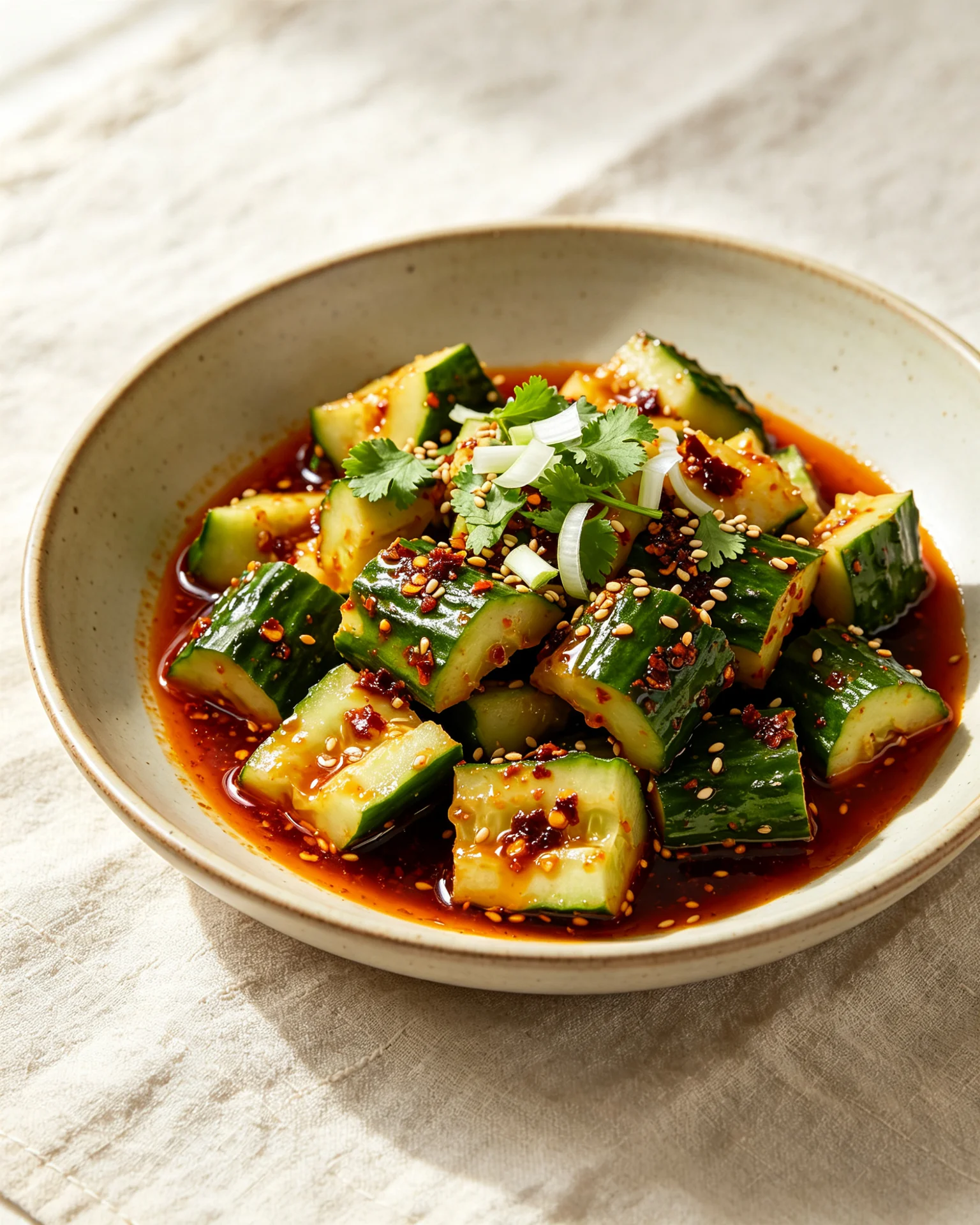
Smashed Cucumber Salad (Pai Huang Gua / 拍黄瓜)
Jump to Section
I made this first with sliced cucumber and then with smashed cucumber and the difference was immediately obvious. The sliced version tasted like cucumber with dressing on it. The smashed version tasted like the dressing had become part of the cucumber. Same ingredients, same proportions, different technique.
The reason is surface area. Smashing the cucumber with the flat side of a knife or a rolling pin ruptures the cell walls along irregular fracture lines rather than cutting along a clean plane. The resulting surfaces are jagged and irregular rather than smooth. Irregular surfaces have dramatically more total surface area than a clean cut of equivalent volume, more points of contact between the cucumber and the dressing, more dressing absorption per bite. The cucumber does not just carry the dressing. It absorbs it.
What is pai huang gua and how does it differ from other Asian cucumber salads?
Pai huang gua (拍黄瓜, pāi huáng guā) means smashed cucumber, pāi is to smash or pat, huáng guā is cucumber. It is a Chinese cold dish (liang cai) eaten as a starter or side throughout China, from family dinner tables to Sichuan restaurant menus to Beijing street vendors who sell whole chilled cucumbers to eat on the go.
The smashing technique is what defines it as a category. Other Asian cucumber dishes are genuinely different preparations:
Korean oi muchim (오이무침) uses gochugaru (Korean dried chilli flakes), sesame oil, scallions, and sugar. No black vinegar, no chilli oil, much more sesame-forward. The cucumbers are typically sliced, not smashed.
Japanese sunomono (酢の物) uses rice vinegar and mirin with occasional addition of sesame or dashi. Clean, sweet-acidic, no chilli, no garlic. The flavour profile is delicate rather than assertive.
This recipe is pai huang gua, the Chinese version. Bold garlic, black vinegar, chilli oil, sesame. Serve it cold alongside grilled meat, noodles, or rice. It takes 25 minutes including the salting time and most of that is waiting.
Why smash the cucumber instead of slicing it?
Cucumber flesh is composed of large, water-filled parenchyma cells held together by pectin in the layer between cell walls. A knife blade cuts along a clean plane, severing cells and producing smooth surfaces where the opened cells are exposed.
A blunt smashing force, the flat side of a heavy knife, the bottom of a pan, a rolling pin, ruptures the cells in multiple directions simultaneously. The fracture follows the cell boundaries and internal weak points rather than a predetermined plane. The result is jagged, irregular surfaces with significantly more total area than a clean cut of equivalent volume.
More surface area means more contact between cucumber and dressing. Dressing applied to irregular surfaces has more points of entry and more exposed cell interior to penetrate. The dressing gets into the cucumber rather than coating the surface. The cucumber flavour and the dressing flavour integrate rather than sitting alongside each other.
The craggy texture also creates mechanical variation in eating. No two pieces are exactly the same size or shape. Some have more skin, some more interior, some more dressing concentrated in a hollow. This variation is part of what makes smashed cucumber more interesting to eat than sliced cucumber in the same dressing.
Why do you salt the cucumber and what is actually happening?
Salt draws water out of the cucumber cells through osmosis and the mechanism explains why the step produces better results than skipping it.
When salt is applied to the exterior of the smashed cucumber pieces, it creates a solute concentration gradient: high solute concentration in the salty exterior environment, lower concentration in the cell fluid inside. Water moves through the semi-permeable cell membranes from the region of lower concentration (inside the cells) to higher concentration (outside), osmosis. The visible result after 15-20 minutes is liquid pooling in the bowl around the cucumber.
Discarding this liquid serves two simultaneous functions. First, it removes the water that would dilute the dressing if left in. A salted-and-drained cucumber dressed with the recipe’s black vinegar and sesame oil tastes significantly more intense than unsalted cucumber dressed with the same quantity of dressing. The dressing is not competing with the cucumber’s own released water.
Second, the partial dehydration of the cells concentrates the cucumber’s flavour compounds within the remaining cell fluid. The cucumber tastes slightly more of cucumber. The texture also firms slightly, partially dehydrated cells are stiffer than fully hydrated ones.
15-20 minutes of salting is enough. Beyond 30 minutes the cucumber becomes over-dehydrated and the texture turns from crisp to soft.
Why do you soak the garlic in vinegar before making the dressing?
Raw garlic produces its sharp, aggressive bite through a specific enzymatic reaction.
Garlic contains two key compounds stored separately in different parts of each cell: alliin (a sulphur-containing amino acid) and alliinase (an enzyme that converts alliin to allicin). While the cell is intact, they do not interact. When garlic is minced or crushed, the cell compartments rupture and the compounds meet. Alliinase immediately begins converting alliin to allicin, the primary compound responsible for the aggressive raw garlic bite.
Acetic acid (the primary acid in black vinegar) partially inhibits alliinase. At the lower pH of an acidic environment, the enzyme’s active site becomes less efficient at catalysing the alliin-to-allicin conversion. Garlic soaked in black vinegar for 15 minutes before the dressing is assembled produces less allicin than garlic added directly to the dressing. The garlic flavour is present, the alliin and other garlic compounds are still there, but the aggressive sharpness is reduced.
The practical result: you can use more garlic with less risk of the raw garlic bite overwhelming everything else. The garlic integrates into the dressing rather than dominating it.
Mince the garlic first, then add to the black vinegar, then leave while the cucumber salts. By the time the cucumber is drained the garlic has been soaking for 15-20 minutes and is ready.
Why use black vinegar and not rice vinegar?
Chinese black vinegar (Chinkiang, 镇江香醋) is aged from glutinous rice, wheat bran, and sometimes other grains. The ageing process produces a complex range of organic acids, esters, and aromatic compounds beyond the acetic acid that rice vinegar contains primarily.
The character of black vinegar is smoky, slightly fruity, with a mild sweetness from the ageing, similar in function to how balsamic vinegar differs from white wine vinegar in Italian cooking. It provides background depth alongside the acidity rather than clean sharp acid alone.
Rice vinegar works as a substitute and produces good results. The character is cleaner and more immediately acidic, the cucumber tastes tangy. Black vinegar produces a cucumber that tastes tangy with something behind the tang that rice vinegar does not provide.
If you cannot find black vinegar, rice vinegar with a small addition of Worcestershire sauce (half a teaspoon per two tablespoons of rice vinegar) approximates the complexity. Do not use regular white vinegar, the acetic acid concentration is higher and the flavour is harsh without the other organic acids that soften it.
Why does chilli oil dress the cucumber differently from mixing chilli into the dressing?
The aromatic compounds in chilli oil that produce its flavour and heat are fat-soluble, not water-soluble. They dissolve in fat and are carried by fat to wherever the fat contacts the food.
When chilli oil is drizzled over the dressed cucumber at serving rather than stirred into the dressing, the oil droplets coat each cucumber piece individually on contact. The fat-soluble aromatic compounds deposit on the surface of each piece at the point of contact. Different pieces get different concentrations of the oil depending on where the drizzle lands.
This produces variation across the bowl, some pieces are more intensely chilli-flavoured, some less. The variation is more interesting to eat than a uniform chilli distribution from stirred-in chilli.
Stirring chilli oil into the dressing emulsifies it partially with the black vinegar and soy sauce, distributing the fat-soluble aromatics more evenly across all pieces. Both approaches work. Drizzling at serving produces more variation. Stirring in produces more uniformity. This recipe drizzles at serving.
Why do you serve this immediately after dressing?
The salting step removed most of the excess water from the cucumber cells. The dressing step introduces a new threat to crispness: acetic acid from the black vinegar.
Acetic acid breaks down pectin, the polysaccharide in the middle lamella between cucumber cells that holds the cells together. As the acid contacts the cucumber, it progressively dissolves the pectin, loosening the structure that gives the cucumber its crispness and releasing additional moisture from between cells into the dressing.
The process is time-dependent and visible. Five minutes after dressing: negligible additional softening. Fifteen minutes: the cucumber is noticeably less crisp and there is more liquid in the bowl. Thirty minutes: significantly softer cucumber, visibly diluted dressing pooling at the bottom.
Serve within 5 minutes of dressing. If you are making this for a dinner party, salt and drain the cucumber and make the dressing separately up to an hour ahead. Dress and serve at the table, not in the kitchen.
Ingredients
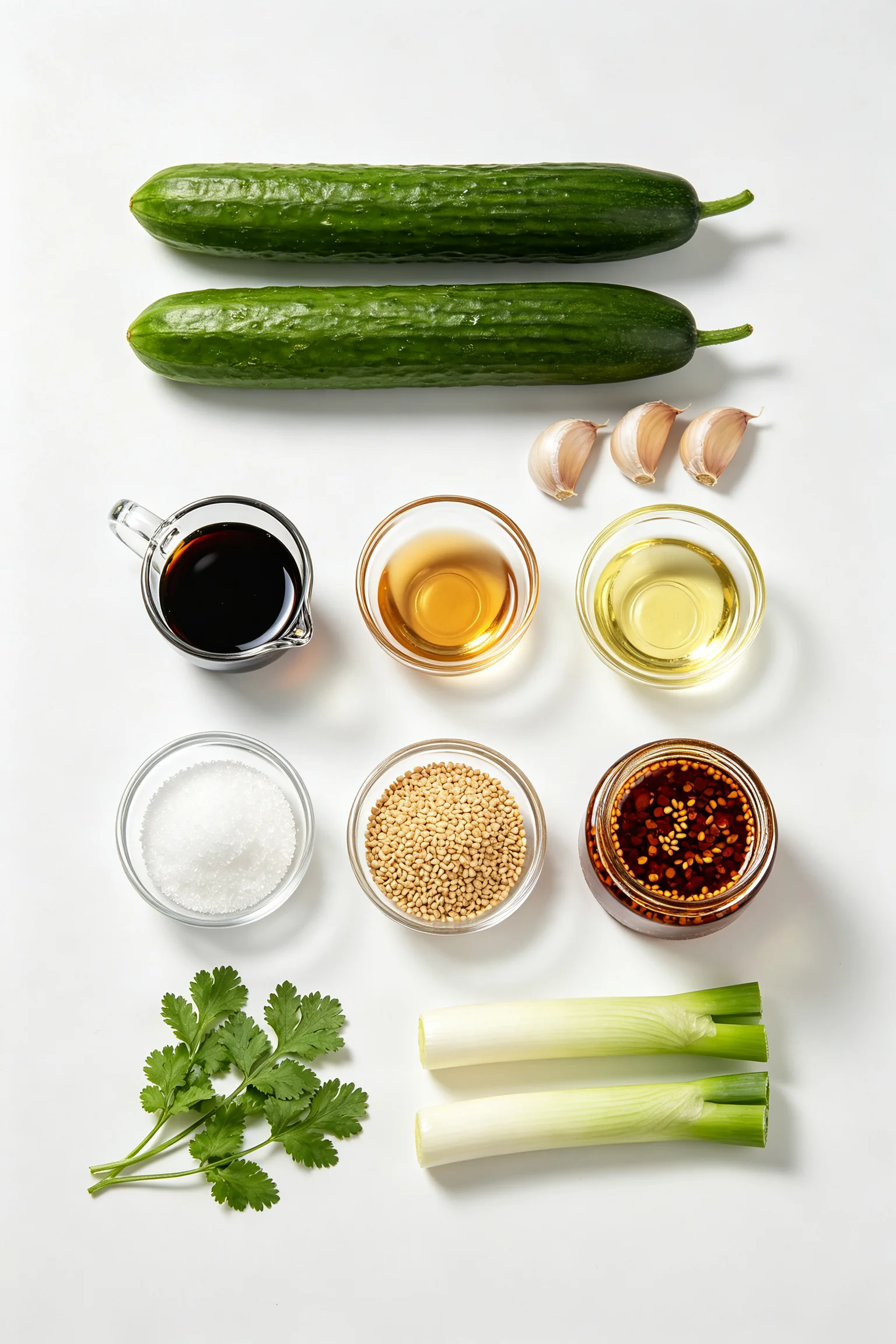
Serves 2-3 as a side
Cucumber:
- 2 English or Persian cucumbers (approximately 400g)
- 1 tsp salt (for salting)
Dressing (assemble while cucumber salts):
- 3 cloves garlic, finely minced
- 2 tbsp Chinese black vinegar (Chinkiang)
- 1½ tbsp light soy sauce
- 1 tsp sesame oil
- 1 tsp sugar
- ½ tsp toasted sesame seeds
To finish:
- 1-2 tbsp chilli oil or chilli crisp (Lao Gan Ma recommended)
- Extra sesame seeds
- 2 spring onions, thinly sliced (optional)
- Small handful of coriander (optional)
Instructions
Prepare everything while the cucumber salts. The active work is about 5 minutes.
Step 1: Smash and cut the cucumber
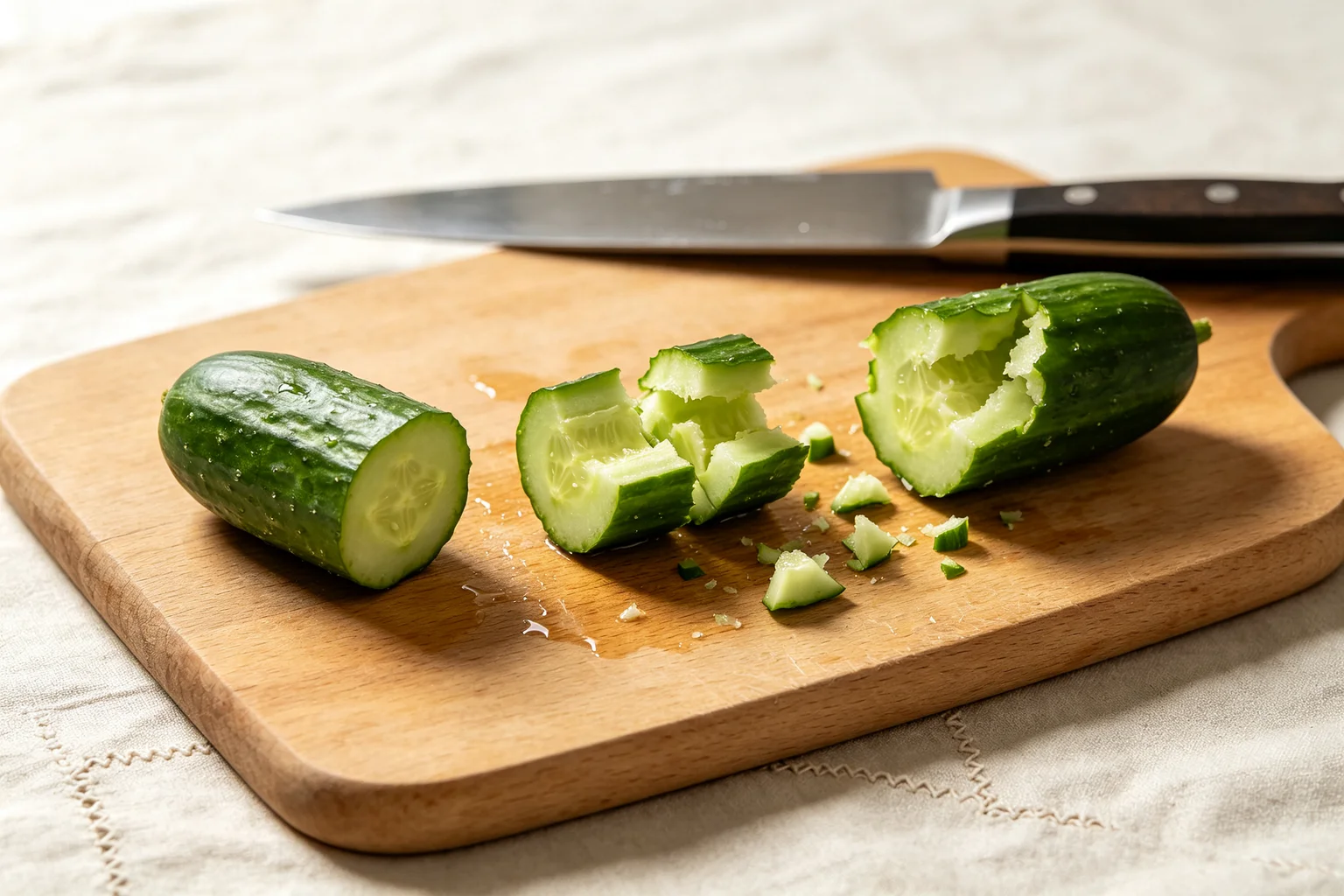
Trim the ends from each cucumber. Cut into 4-5cm sections.
Step 2: Salt and drain
Place the smashed cucumber pieces in a colander set over a bowl. Toss with 1 teaspoon of salt.
Step 3: Soak the garlic and make the dressing
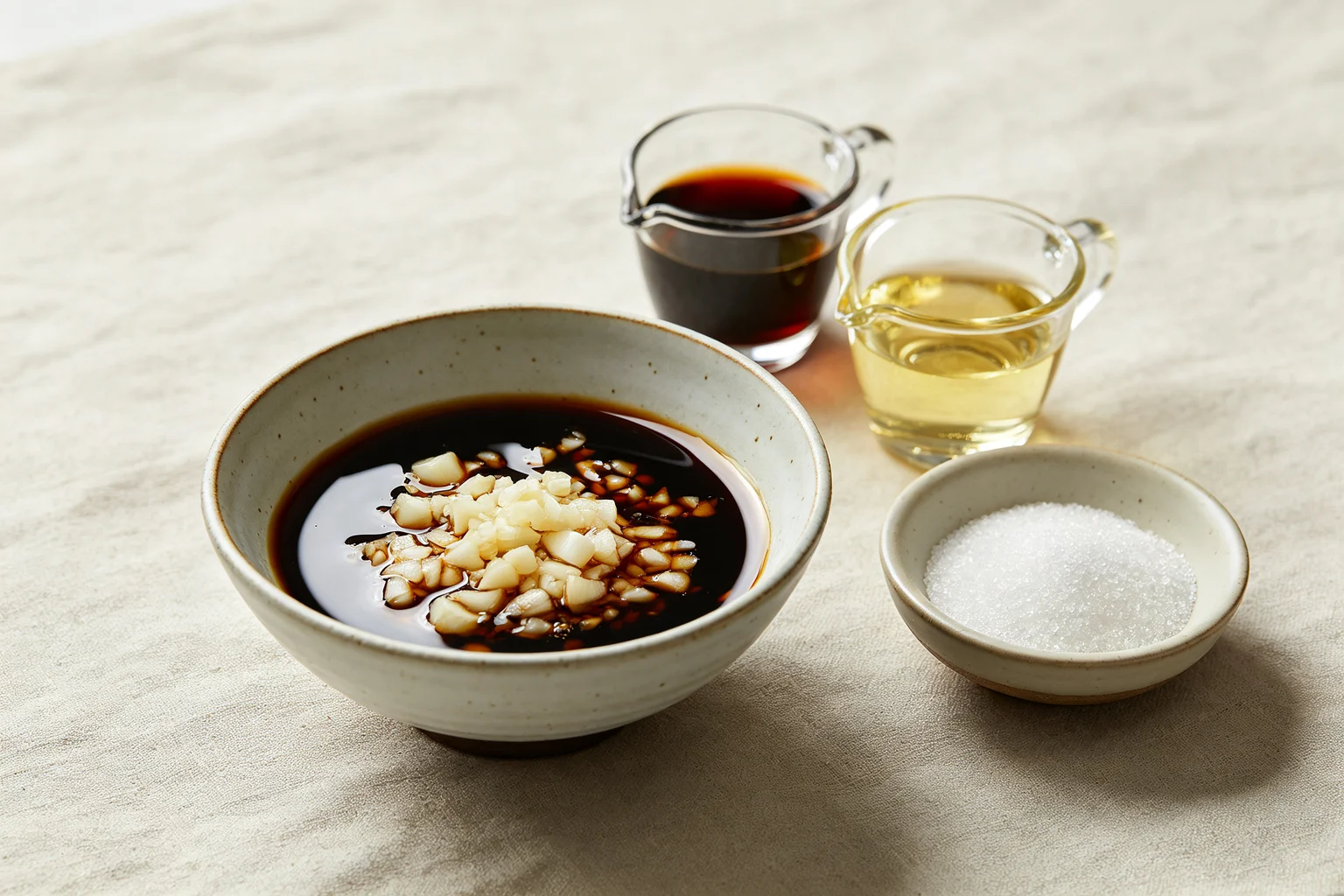
Add the minced garlic to the black vinegar immediately after mincing. Leave for 15 minutes while the cucumber salts.
Step 4: Dress and serve immediately
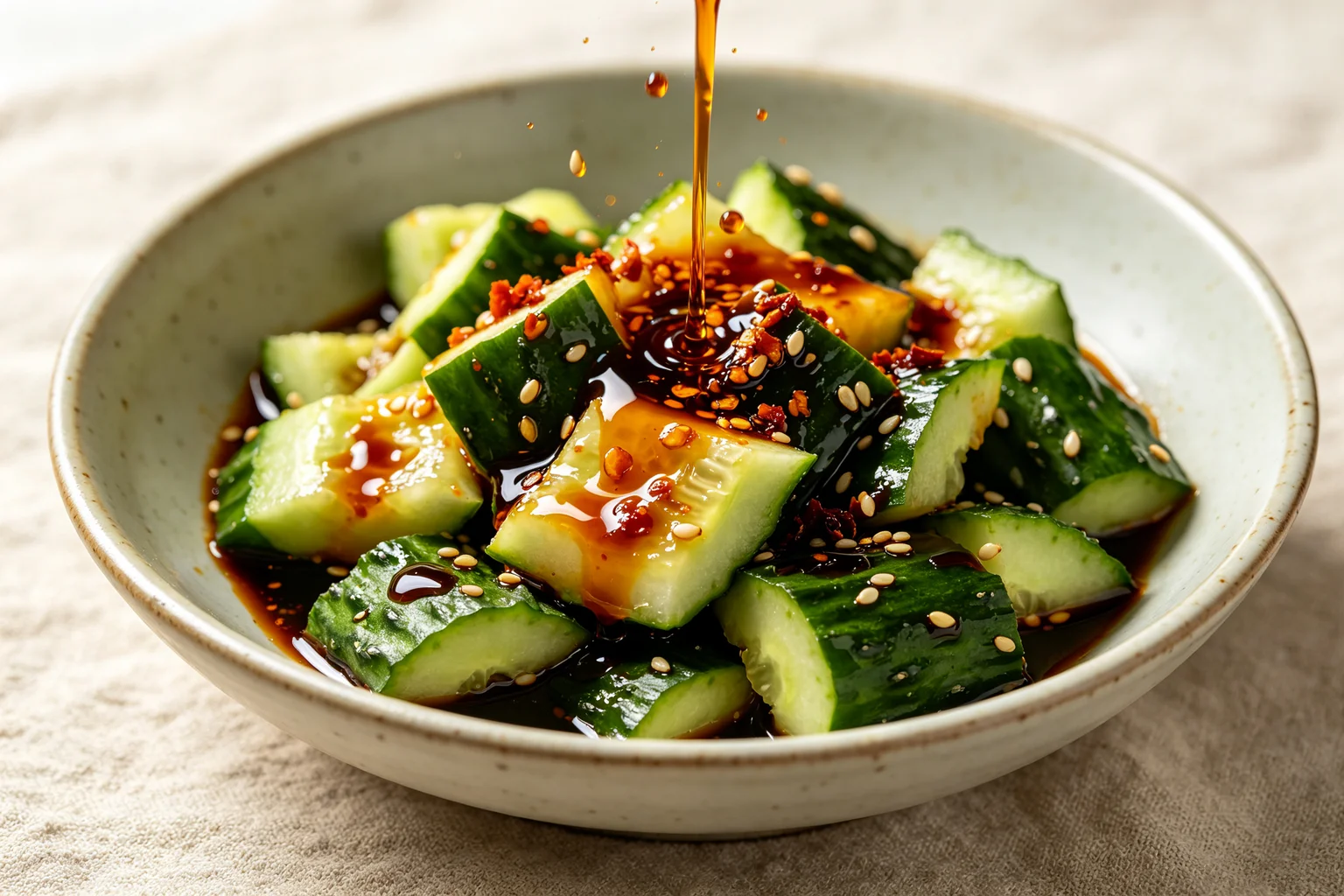
Pour the dressing over the drained cucumber. Toss to coat every piece.
Variations: Korean oi muchim and Japanese sunomono
Korean oi muchim (오이무침): Slice the cucumber rather than smashing. Salt for 10 minutes. Dress with 1 tablespoon gochugaru, 1 tablespoon sesame oil, 1 teaspoon soy sauce, 1 teaspoon sugar, 2 cloves minced garlic, and 2 spring onions cut into pieces. No black vinegar, no chilli oil. Completely different flavour profile, spicy-sweet, intensely sesame, less acidic.
Japanese sunomono (酢の物): Slice the cucumber thinly. Salt for 10 minutes. Dress with 3 tablespoons rice vinegar, 1 tablespoon mirin, 1 teaspoon sugar, pinch of salt. No garlic, no chilli. Garnish with sesame seeds and optional thin strips of wakame seaweed. Clean, sweet-acidic, delicate.
Both are excellent. Neither is pai huang gua. They are distinct dishes that happen to share a vegetable.
How do you store smashed cucumber salad?
This dish is specifically designed not to be stored after dressing. The acid continues breaking down the pectin and the cucumber becomes soft and the dressing becomes diluted.
Store the components separately: drained salted cucumber refrigerated for up to 4 hours, dressing refrigerated for up to 2 days. Dress at serving.
If you have leftover dressed cucumber, it keeps for one day in the refrigerator. It will be softer and the dressing will have become more diluted. Still edible but noticeably different from freshly dressed. Do not freeze.
Love Chinese food?
Check out my complete guide to Chinese home cooking, pantry essentials, and techniques.
FAQ
Why is my smashed cucumber salad watery? Two causes. First, the cucumber was not salted and drained before dressing, the osmosis step is essential for removing the water that would dilute the dressing. Second, the salad was dressed too far in advance, acetic acid from the black vinegar continues breaking down the pectin between cucumber cells, releasing additional moisture over time. Salt and drain first, then dress immediately before serving.
Can I make this ahead of time? The components can be prepared ahead separately. Salt and drain the cucumber up to 4 hours before serving, keep in the refrigerator uncovered so it continues to firm. Make the dressing (with the garlic soaked in vinegar) up to 2 days ahead. Store separately. Combine and dress immediately before serving. Do not combine and refrigerate the dressed salad expecting it to improve, it will not.
What is the best cucumber to use? English or Persian cucumbers are both excellent. English cucumbers are longer, have thin edible skin, and small seeds that do not need removing. Persian cucumbers are smaller, similarly thin-skinned, and very crisp. Both are ideal for this preparation. Avoid regular large garden cucumbers, the skin is thick and bitter, the seeds large and watery, and the flesh less crisp. If using garden cucumbers, peel, halve lengthwise, and scoop out the seeds before smashing.
Can I substitute rice vinegar for black vinegar? Yes. Rice vinegar produces a cleaner, more immediately acidic result, the cucumber will taste tangy without the smoky, slightly fruity depth of black vinegar. Use the same quantity. If you want to approximate the character of black vinegar using rice vinegar, add half a teaspoon of Worcestershire sauce per two tablespoons of rice vinegar, it adds some of the complexity without the exact black vinegar character. Do not use white vinegar, the acetic acid concentration is higher and the flavour is harsh.
You might also like: Check out our complete Korean cooking guide for more essential ingredients and techniques.
Smashed Cucumber Salad (Pai Huang Gua / 拍黄瓜)
Chinese, Korean, Japanese
PT25M
PT0M
PT25M
Nutrition Facts
Ingredients
- 2 English or Persian cucumbers (approximately 400g)
- 1 tsp salt (for salting)
- 3 cloves garlic, finely minced
- 2 tbsp Chinese black vinegar (Chinkiang)
- 1½ tbsp light soy sauce
- 1 tsp sesame oil
- 1 tsp sugar
- ½ tsp toasted sesame seeds
- 1-2 tbsp chilli oil or chilli crisp (Lao Gan Ma recommended)
- Extra sesame seeds
- 2 spring onions, thinly sliced (optional)
- Small handful of coriander (optional)
Instructions
- *Prepare everything while the cucumber salts. The active work is about 5 minutes.*
- Trim the ends from each cucumber. Cut into 4-5cm sections. Place each section on a stable cutting board. Using the flat side of a heavy knife or a rolling pin, smash each section firmly once or twice until it splits open, the cucumber should crack and flatten slightly but not completely disintegrate. Tear or cut each smashed section into rough bite-sized pieces. The irregular, jagged surfaces are correct.
- Place the smashed cucumber pieces in a colander set over a bowl. Toss with 1 teaspoon of salt. Leave for 15-20 minutes. Do not rinse after salting, just drain the liquid that has pooled and shake the colander to remove remaining surface moisture. Transfer to a serving bowl.
- Add the minced garlic to the black vinegar immediately after mincing. Leave for 15 minutes while the cucumber salts. After 15 minutes, add the soy sauce, sesame oil, and sugar to the garlic-vinegar mixture. Stir until the sugar dissolves completely. Taste, it should be tangy, savoury, faintly sweet, and smell intensely of garlic.
- Pour the dressing over the drained cucumber. Toss to coat every piece. Taste and adjust with more soy sauce for salt or more vinegar for tang. Transfer to the final serving bowl if not already serving in it. Drizzle chilli oil over the top. Scatter sesame seeds and spring onion if using. Serve within 5 minutes.
Did you make this recipe?
Tag @asianfoodsdaily on Instagram or leave a comment below!
Testing Notes
Tested in Asha's kitchen. Last reviewed April 17, 2025.
Ingredient Substitutions
Substitution notes coming soon.
About Asha
Half Asian, half African cook raised between two food-obsessed cultures. I've spent 10 years learning Asian cooking traditions through family, friends, and thousands of hours at the stove — testing every dish until it works in a standard home kitchen.
Read my full storyRelated Recipes
More delicious dishes you might enjoy


Loading comments...