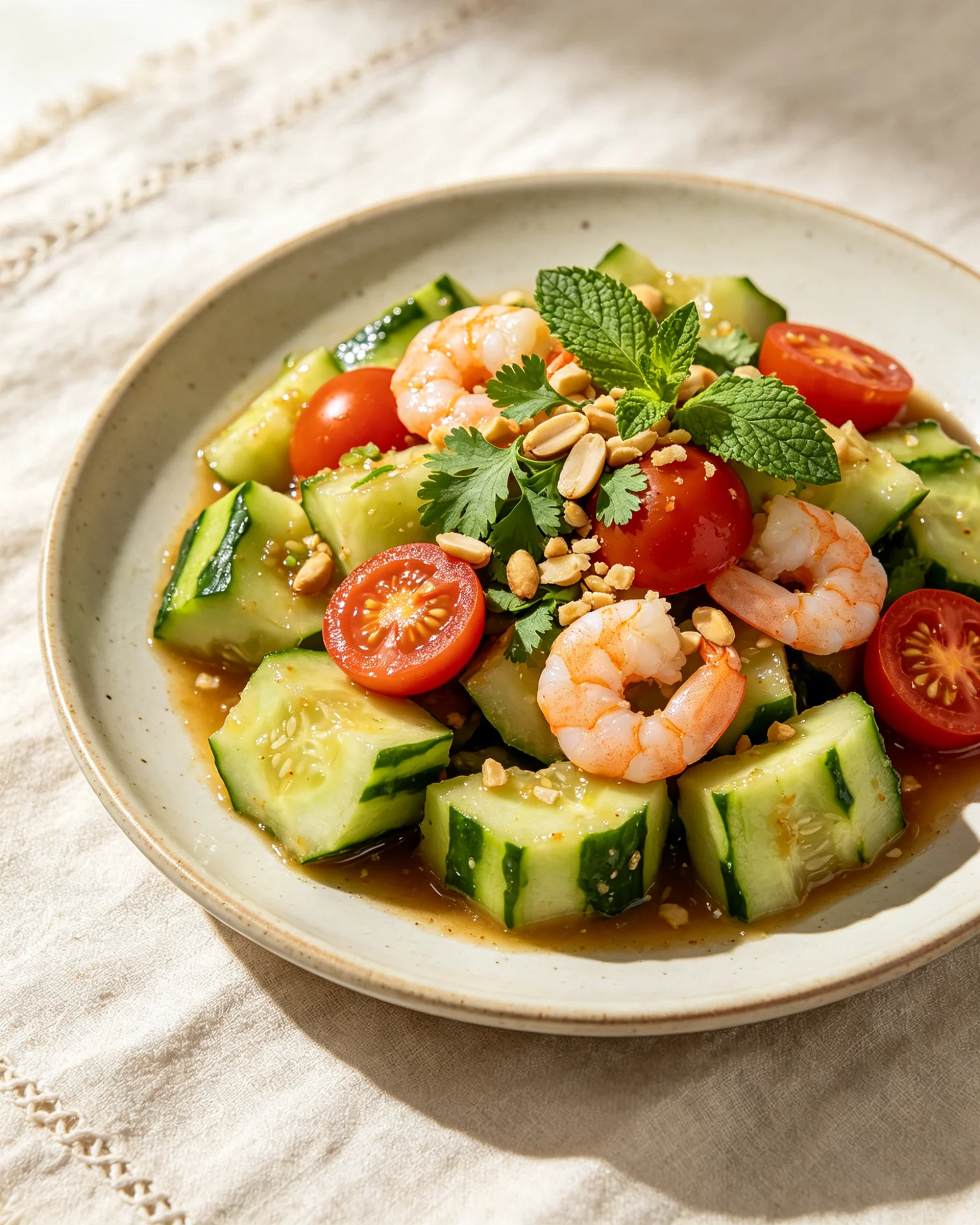
Thai Cucumber and Shrimp Salad (Tam Taeng)
Jump to Section
The first time I got the dressing balance right on this salad I was tasting as I added each ingredient in sequence. Added fish sauce and the dressing tasted flat but savoury. Added lime and it brightened immediately. Added palm sugar and everything settled into something that tasted complete. Then added chilli and the heat arrived without overwhelming any of the other three. That sequence, salt, sour, sweet, heat, each tasted separately before the next goes in, is how you calibrate the four-flavour balance that makes Thai dressing work. Add everything at once and you cannot tell what is missing. Taste in sequence and each lever is identifiable.
I dressed the salad 30 minutes before a dinner once. By the time it reached the table it was cucumber soup, the lime juice had continued breaking down the cucumber cells long after I thought the salting step had handled that. Thai cucumber salad must be dressed immediately before serving.
What is tam taeng and how does it differ from som tam?
Tam taeng (ตำแตง) means pounded cucumber, tam is the pounding technique, taeng is cucumber. It belongs to the tam family of Thai pounded salads that also includes som tam (ส้มตำ, shredded green papaya), tam khanun (jackfruit), and various regional variations throughout Isaan and northern Thailand.
Som tam is the version most widely known outside Thailand. It uses shredded unripe green papaya, firm, slightly starchy, with minimal water content and an earthy, complex flavour that comes from the papaya’s natural compounds and the long fermentation-adjacent process of pounding.
Tam taeng uses cucumber, significantly higher water content, lighter and more refreshing in character, with a cleaner immediate flavour profile. The cucumber’s water content changes the dressing dynamic: as the cucumber bruises and as it sits in the dressing, it releases liquid that blends into the dressing, producing a slightly thinner, more integrated sauce than the drier papaya version. This is why tam taeng must be served more immediately than som tam, the cucumber releases water faster.
Both use the same four-flavour dressing system. The difference is the vehicle.
What is the four-flavour balance and how do you achieve it?
Thai cooking is built around the simultaneous presence of four flavours in a single dish: sweet, sour, salty, and spicy. In tam taeng these are provided by palm sugar (sweet), lime juice (sour), fish sauce (salty), and Thai chilli (spicy). They are not sequential, all four should be perceptible in a single bite without any one dominating.
The balance is not a fixed ratio. It is adjusted by taste. Different cooks, different regions, different palates produce different balances that are all correct. What matters is that all four flavours are present at sufficient intensity for each to register.
The tasting sequence matters for adjustment. Check salt first, if the dressing tastes flat or one-dimensional, it needs more fish sauce before anything else is adjusted. A flat dressing usually lacks salt, not lime. Then check sour, the dressing should have a noticeable tang from the lime, not just a background brightness. Then check sweet, the palm sugar should be present but not the dominant note. Adjust chilli last. Heat perception accumulates during tasting and it is easy to over-spice if heat is assessed before the other three flavours are set.
A correctly balanced dressing makes you reach for another bite immediately. No single flavour dominates but all four are present from the first contact to the finish.
Why palm sugar and not granulated sugar?
Palm sugar (น้ำตาลมะพร้าว, nam tan maprao) is made from the sap of coconut or toddy palms. Unlike refined granulated sugar, pure sucrose, palm sugar contains residual molasses compounds, caramelised sugars from the evaporation process during production, and trace minerals including potassium and iron.
These compounds produce a sweetness that is rounded and slightly complex, hints of caramel, a mild warmth, a subtle quality that refined sugar lacks entirely. In the four-flavour balance of Thai dressing, this rounded sweetness integrates as background complexity. It is present in every bite but does not announce itself sharply the way granulated sugar does.
The same palm sugar distinction is covered in the pad thai recipe on this site, the caramelisation section explains how palm sugar’s depth cannot be replicated by granulated sugar even at the same quantity.
Dissolve the palm sugar in the lime juice before adding other ingredients. The acid helps break down the solid palm sugar into the liquid. A small amount of warm water also works if the sugar is not dissolving. Do not add solid palm sugar to the dressing, undissolved pieces produce uneven sweetness in different bites.
Why bruise the cucumber instead of slicing it cleanly?
The bruising technique is the same principle as the smashed cucumber salad recipe on this site, mechanical rupture of the cell walls produces irregular, jagged surfaces with significantly more total surface area than a clean knife cut of equivalent volume.
More surface area means more contact between the cucumber flesh and the dressing. The dressing penetrates the exposed cell interior rather than coating a smooth surface. Every piece absorbs the fish sauce, lime, and palm sugar from within rather than having the dressing sit on the outside.
For tam taeng, the bruising is lighter than the full smashing technique in the Chinese cucumber salad. The goal is to crack the cucumber open slightly, irregular pieces with some broken surfaces, not to completely collapse the structure. The cucumber should still have distinct pieces with some crunch remaining. Full smashing makes the pieces too soft and releases too much water into the dressing.
The technique: place cucumber pieces on a board. Press firmly but briefly with the flat side of a knife or the bottom of a pan. The cucumber should crack and split but not disintegrate. Then cut or tear into rough bite-sized pieces.
Why does fish sauce produce better flavour than soy sauce in this dressing?
This is one of the most commonly asked substitution questions for Thai recipes. The difference is not just flavour profile, it is a specific umami mechanism.
Fish sauce is produced by fermenting anchovies in salt for months to years. The fermentation produces free amino acids from the fish proteins, primarily glutamate. But it also produces inosinate, a nucleotide umami compound from the fish nucleotides. Inosinate is the same compound present in katsuobushi dashi, dried anchovies, and meat stocks.
Cherry tomatoes, which go into the tam taeng, contain significant free glutamate, the amino acid umami compound.
When inosinate and glutamate are present simultaneously, the perceived umami is multiplicative rather than additive. This is the same synergy covered in the tteokbokki recipe on this site (anchovy broth inosinate plus gochujang glutamate) and the gyudon recipe (dashi inosinate plus soy sauce glutamate). The two umami compounds together produce a perception of umami significantly greater than the sum of their individual contributions.
Soy sauce contains glutamate but not inosinate. Soy sauce plus tomato = additive umami. Fish sauce plus tomato = multiplicative umami. The dressing made with fish sauce tastes noticeably more complex and complete than the same dressing made with soy sauce, even at the same quantity and saltiness level.
Why toast the dried shrimp before adding?
Dried shrimp (กุ้งแห้ง, kung haeng), small sun-dried shrimp available at any Asian grocery store, retain some residual moisture even after drying, typically 15-25% by weight.
When raw dried shrimp are added directly to an acidic dressing, this residual moisture releases gradually. The shrimp soften slightly and the released liquid contributes to the dressing. This is not wrong but the texture of raw dried shrimp in dressing is slightly rubbery rather than crunchy.
Dry-toasting in a pan for 3-4 minutes over medium heat drives off the remaining moisture before the shrimp go into the dressing. The dried shrimp become firmer and crunchier, and the dry heat produces a minor Maillard reaction on the surface, the amino acids and sugars in the dried shrimp caramelise slightly, adding a toasty depth to the flavour.
Toasted dried shrimp maintain their crunch even after being dressed in the acidic lime and fish sauce dressing. Raw dried shrimp in the same dressing soften within 5-10 minutes.
Toast in a dry pan over medium heat, stirring constantly, until the shrimp smell intensely savoury and feel completely dry to the touch, 3-4 minutes. Cool before adding to the salad.
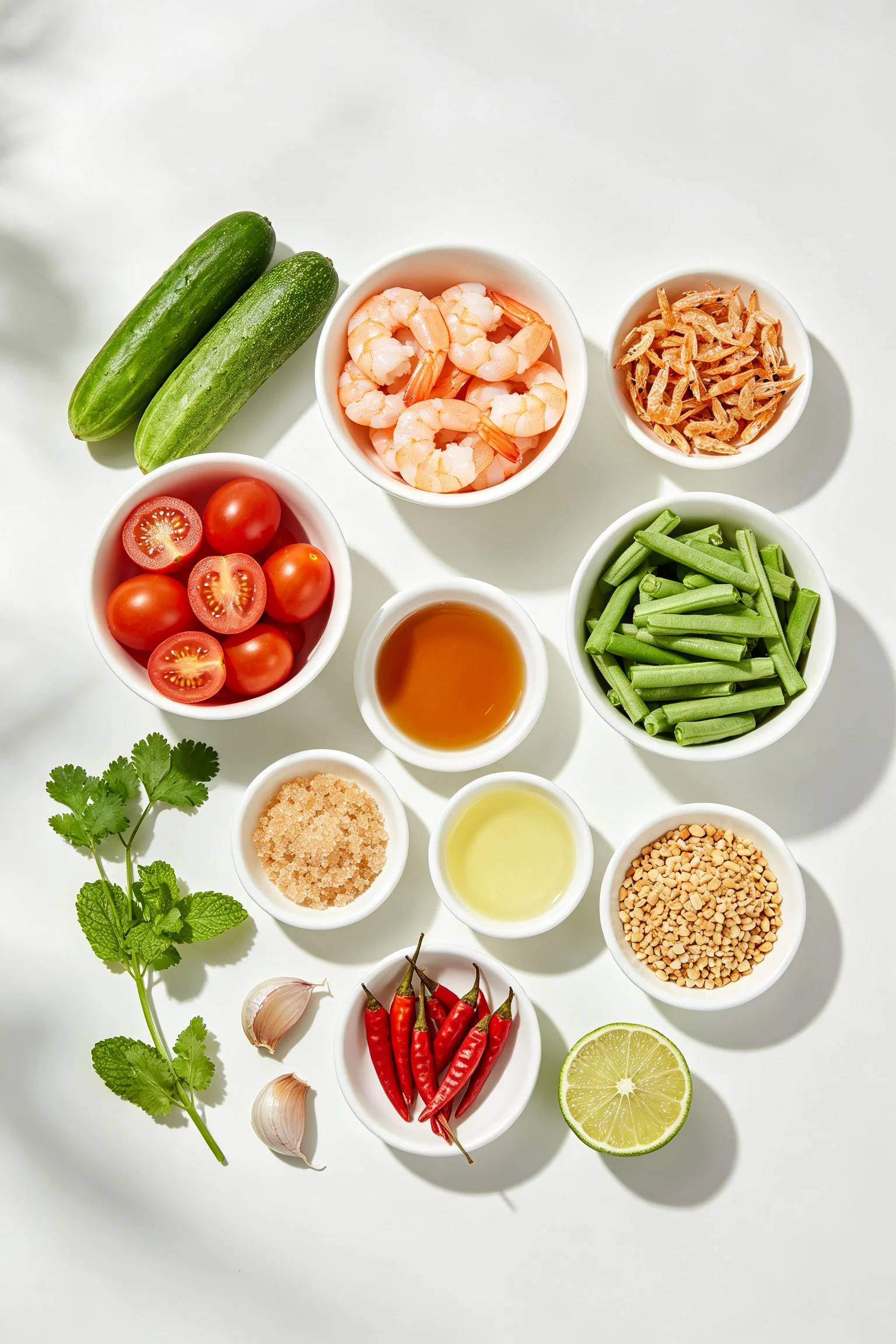
Ingredients
Serves 2
Salad:
- 2 Persian or English cucumbers (approximately 300g), cut into rough 3cm chunks
- 1 tsp salt (for pre-salting)
- 100g (3.5oz) cooked shrimp, peeled and deveined (fresh or defrosted)
- 2 tbsp dried shrimp, toasted (optional but recommended for depth)
- 100g (3.5oz) cherry tomatoes, halved
- 6-8 long beans or green beans, cut into 3cm lengths
- 3 tbsp roasted peanuts, roughly crushed
- Small handful fresh coriander
- Small handful fresh mint leaves
Dressing:
- 2 tbsp fish sauce
- 2 tbsp fresh lime juice (approximately 1.5 limes)
- 1 tbsp palm sugar, dissolved in the lime juice
- 2-4 Thai bird’s eye chillies, depending on heat preference
- 2 cloves garlic
- ½ tsp toasted rice powder (optional, adds subtle nuttiness)
Instructions
Salt the cucumber first. Everything else takes 10 minutes.
Step 1: Salt and drain the cucumber
Place the cucumber chunks in a colander. Toss with 1 teaspoon of salt.
Step 2: Toast the dried shrimp
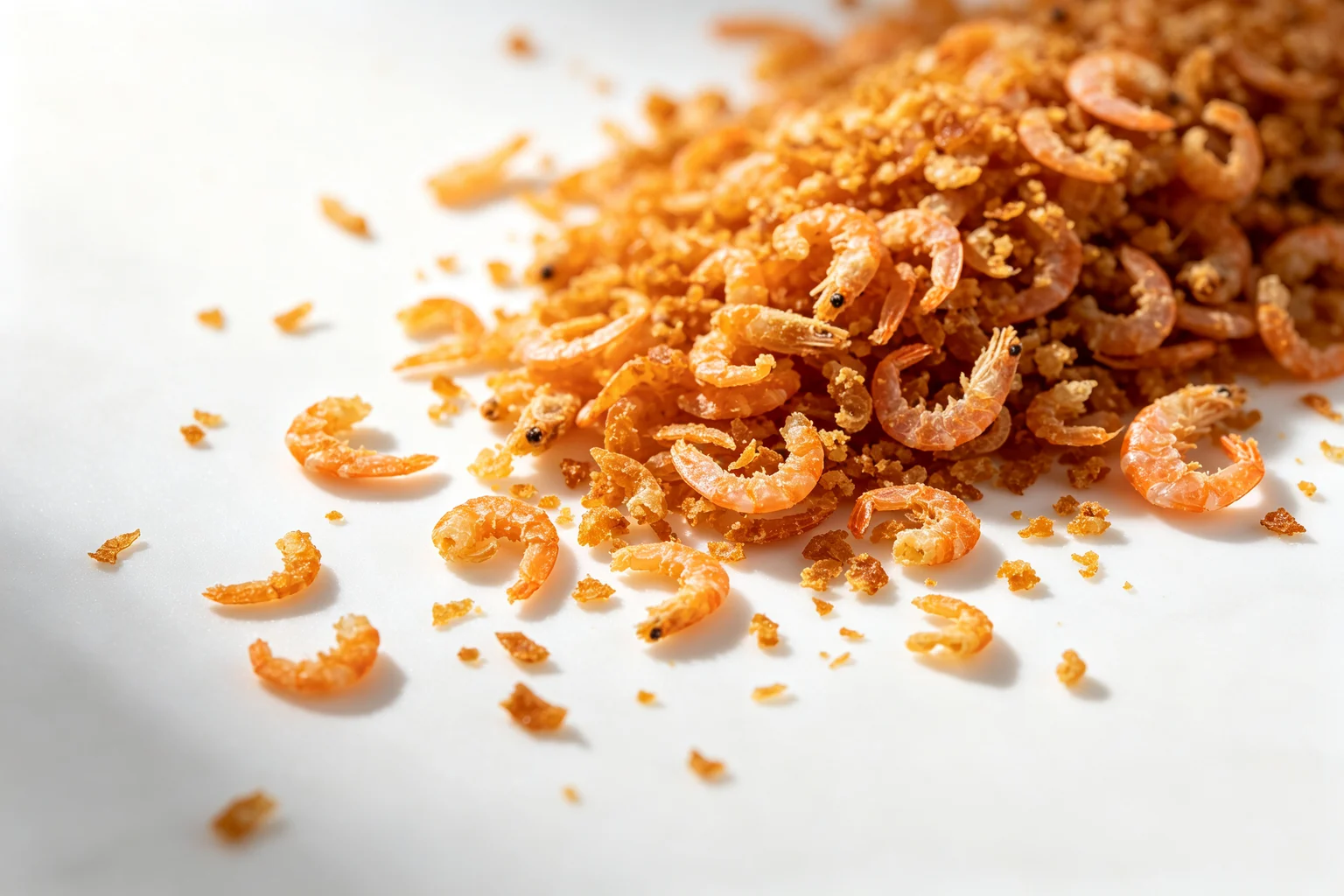
Place dried shrimp in a dry pan over medium heat. Stir constantly for 3-4 minutes until completely dry, intensely fragrant, and slightly darker.
Step 3: Make the dressing
Dissolve the palm sugar in the lime juice first, stir until no solid pieces remain.
In a large mortar, pound the garlic and chillies together until a rough paste forms, not completely smooth, some texture is correct. Add the dissolved palm sugar and lime juice. Stir.
Taste the dressing at this point. It should taste sour and have noticeable garlic and chilli fragrance. Add the fish sauce. Stir. Taste again, it should now be balanced between sour and salty with the sweet palm sugar in the background. Adjust: more fish sauce if flat, more lime if the sour is not registering, more palm sugar if too sharp.
Step 4: Bruise the cucumber
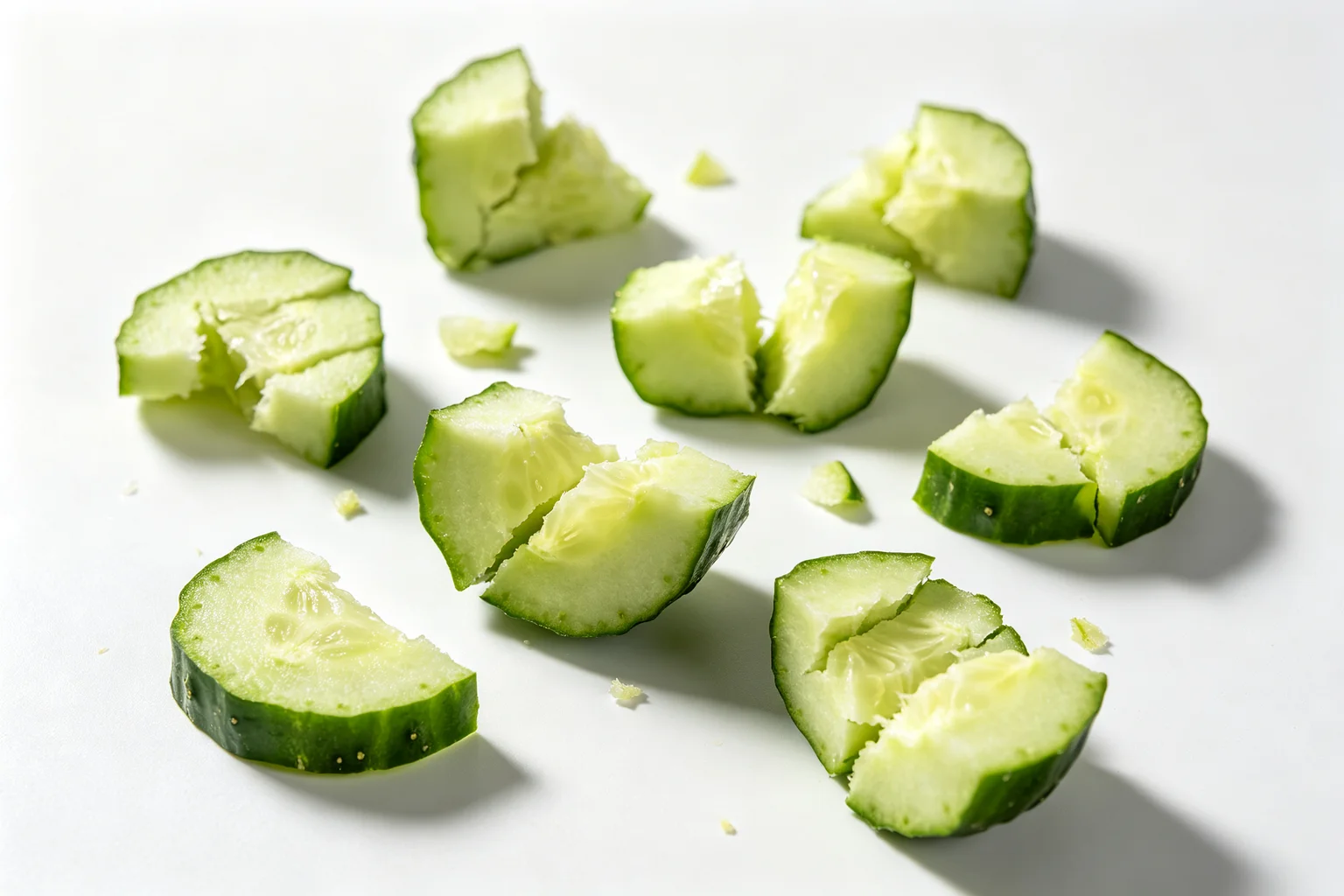
Place the drained cucumber pieces on a board. Press firmly with the flat side of a heavy knife or the bottom of a pan.
Step 5: Assemble
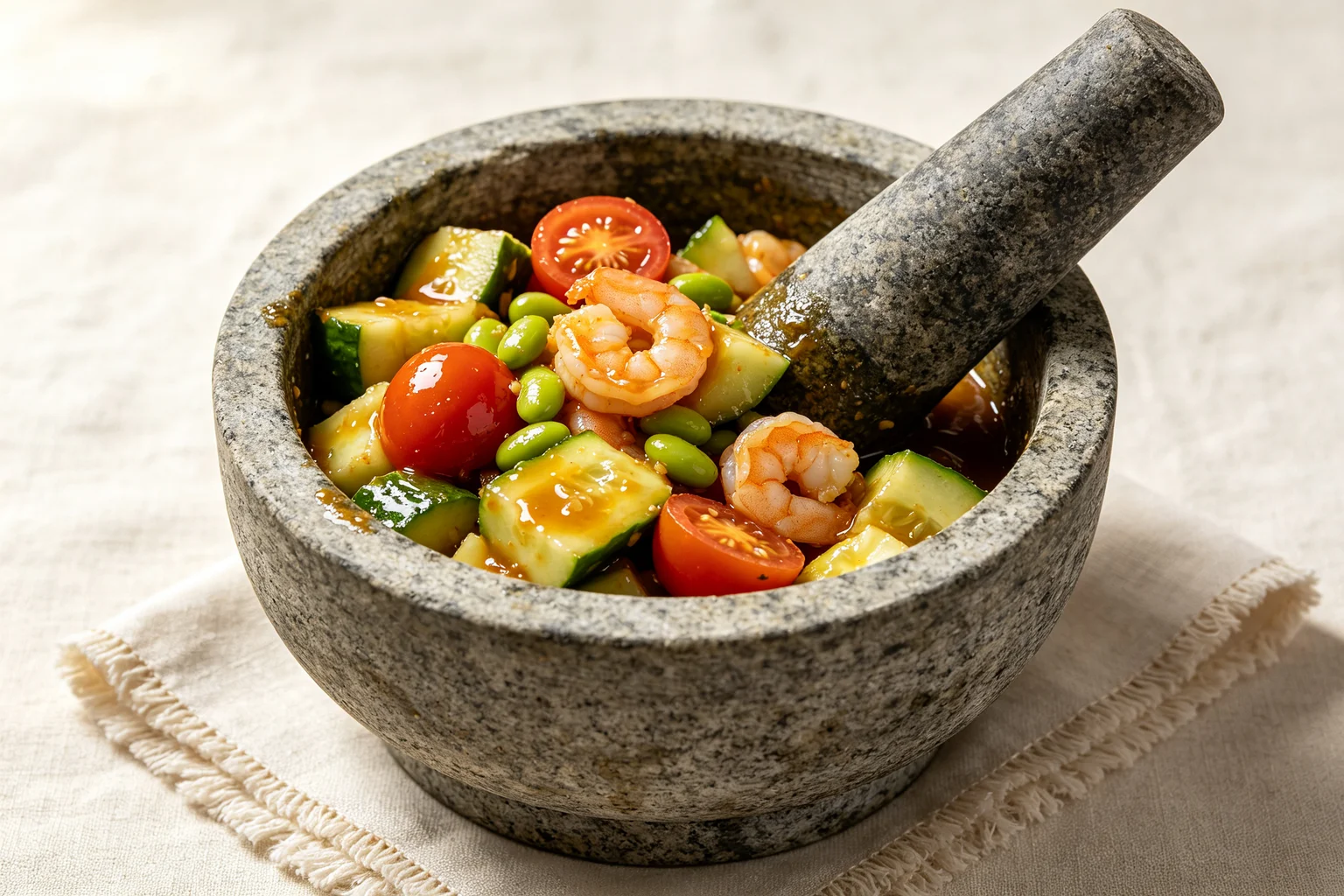
Add the bruised cucumber to the mortar with the dressing. Add the cherry tomatoes.
Add the cooked shrimp and toasted dried shrimp. Fold gently to combine.
Taste one more time. Final adjustment, the balance should be complete. If anything is missing, add it now. Once the shrimp are in, taste assessment becomes harder because the protein mutes the individual flavour notes.
Step 6: Finish and serve immediately
Transfer to a serving plate. Top with crushed peanuts, fresh coriander, and fresh mint.
Love Thai food?
Check out my complete guide to Thai home cooking, pantry essentials, and techniques.
FAQ
Can I make this without a mortar and pestle? Yes. Mince the garlic and chillies finely with a knife instead of pounding. Combine with the dissolved palm sugar, lime juice, and fish sauce in a bowl. The dressing will be slightly less integrated, pounding releases the essential oils from garlic and chilli more completely than cutting, but the flavour difference is small. Use the same cucumber bruising technique with a flat knife. For the assembly stage, use a large bowl and toss vigorously rather than the pound-and-fold mortar technique.
Can I substitute soy sauce for fish sauce? Soy sauce works as a substitute and produces a vegetarian version. The flavour is noticeably different, soy sauce contains glutamate but not inosinate, so the dressing will have less of the complex layered umami that fish sauce produces with the tomato glutamate. Add a small amount of miso (half a teaspoon) to the soy sauce version, miso contains both glutamate and some nucleotide compounds from the fermentation process that partially approximate the fish sauce character.
What is toasted rice powder and how do I make it? Toasted rice powder (ข้าวคั่ว, khao khua) is raw jasmine rice dry-toasted in a pan until golden and ground to a coarse powder. It adds a subtle nutty, slightly smoky flavour and a very slight thickening to Thai salad dressings. To make: dry-toast 2 tablespoons of raw jasmine rice in a pan over medium heat for 5-7 minutes until golden and fragrant. Cool. Grind in a spice grinder or mortar to a coarse powder, not fine flour. Keeps in an airtight container for weeks.
Why does my salad have too much liquid after dressing? The cucumber was either not salted and drained before dressing, or the salad sat dressed for too long before serving. The salt draws water from the cucumber cells via osmosis, covered in the smashed cucumber salad recipe on this site, but lime juice continues this process after dressing. Salt and drain the cucumber for at least 10 minutes, squeeze dry, and dress immediately before serving. If the salad has already become watery, drain off the excess liquid and add a fresh squeeze of lime and a pinch of fish sauce to rebalance what was diluted.
You might also like: Check out our complete Thai cooking guide for more essential ingredients and techniques.
Thai Cucumber and Shrimp Salad (Tam Taeng)
PT20M
PT5M
PT25M
Nutrition Facts
Ingredients
- 2 Persian or English cucumbers (approximately 300g), cut into rough 3cm chunks
- 1 tsp salt (for pre-salting)
- 100g (3.5oz) cooked shrimp, peeled and deveined (fresh or defrosted)
- 2 tbsp dried shrimp, toasted (optional but recommended for depth)
- 100g (3.5oz) cherry tomatoes, halved
- 6-8 long beans or green beans, cut into 3cm lengths
- 3 tbsp roasted peanuts, roughly crushed
- Small handful fresh coriander
- Small handful fresh mint leaves
- 2 tbsp fish sauce
- 2 tbsp fresh lime juice (approximately 1.5 limes)
- 1 tbsp palm sugar, dissolved in the lime juice
- 2-4 Thai bird's eye chillies, depending on heat preference
- 2 cloves garlic
- ½ tsp toasted rice powder (optional, adds subtle nuttiness)
Instructions
- *Salt the cucumber first. Everything else takes 10 minutes.*
- Place the cucumber chunks in a colander. Toss with 1 teaspoon of salt. Leave 10-15 minutes. The cucumber will release water. Rinse thoroughly. Squeeze each piece firmly to remove excess water. Pat dry. The cucumber should feel slightly denser than before salting.
- Place dried shrimp in a dry pan over medium heat. Stir constantly for 3-4 minutes until completely dry, intensely fragrant, and slightly darker. Remove from heat. Cool completely.
- Dissolve the palm sugar in the lime juice first, stir until no solid pieces remain. In a large mortar, pound the garlic and chillies together until a rough paste forms, not completely smooth, some texture is correct. Add the dissolved palm sugar and lime juice. Stir. Taste the dressing at this point. It should taste sour and have noticeable garlic and chilli fragrance. Add the fish sauce. Stir. Taste again, it should now be balanced between sour and salty with the sweet palm sugar in the background. Adjust: more fish sauce if flat, more lime if the sour is not registering, more palm sugar if too sharp.
- Place the drained cucumber pieces on a board. Press firmly with the flat side of a heavy knife or the bottom of a pan. The cucumber should crack and split into irregular pieces but not completely collapse. Some pieces will break more than others, this variation is correct.
- Add the bruised cucumber to the mortar with the dressing. Add the cherry tomatoes. Add the long beans. Using a large spoon and the pestle together, gently fold and lightly pound everything together for 30-45 seconds, the goal is to slightly bruise the tomatoes and beans and coat everything in the dressing, not to pulverise the vegetables. Add the cooked shrimp and toasted dried shrimp. Fold gently to combine. Taste one more time. Final adjustment, the balance should be complete. If anything is missing, add it now. Once the shrimp are in, taste assessment becomes harder because the protein mutes the individual flavour notes.
- Transfer to a serving plate. Top with crushed peanuts, fresh coriander, and fresh mint. Serve within 5 minutes of dressing. The lime juice continues breaking down the cucumber cells, by 20 minutes the salad has significantly more liquid and the cucumber has softened.
Did you make this recipe?
Tag @asianfoodsdaily on Instagram or leave a comment below!
Testing Notes
Tested in Asha's kitchen. Last reviewed January 15, 2026.
Ingredient Substitutions
Substitution notes coming soon.
About Asha
Half Asian, half African cook raised between two food-obsessed cultures. I've spent 10 years learning Asian cooking traditions through family, friends, and thousands of hours at the stove — testing every dish until it works in a standard home kitchen.
Read my full storyRelated Recipes
More delicious dishes you might enjoy


Loading comments...