Nepali Chicken Momo Recipe (मःमः)

Jump to Section
The first batch I made used chicken breast. The filling looked correct before steaming, seasoned, fragrant, the right consistency. After 15 minutes in the steamer, the filling was dry and slightly grainy. Not bad, just noticeably less juicy than the momo I had eaten at Nepali restaurants. The second batch used chicken thigh. The filling came out juicy, cohesive, and completely different in texture.
The difference is fat. Steaming cooks in a 100°C moist environment. In this heat, lean breast muscle proteins contract and squeeze out their intramuscular water, and the steam environment provides no compensation, the filling dries out as it cooks. Chicken thigh contains significantly more intramuscular fat. At steaming temperature that fat melts and flows between the muscle fibres, basting the filling from within and keeping it juicy through the full 12-15 minutes. The fat is doing what the cooking environment cannot.
What is momo and where does it come from?
Momo (मःमः) is Nepal’s most widely eaten street food, a steamed dumpling found at momo bhatti (momo stalls) on every busy street in Kathmandu, in the food courts of shopping centres, in restaurants from basic to upmarket, and at roadside stalls along trekking routes across the Himalayas.
The dish arrived in Nepal from Tibet. Tibetan momo, a simple dumpling with yak or mutton filling, has been documented from at least the 14th century, cooked over wood fires in high-altitude settlements across the Tibetan plateau. The route into Nepal was specific: the Newar people of the Kathmandu Valley were historically the dominant trading community on the trans-Himalayan trade routes between Nepal, Tibet, and China. Newar merchants who regularly crossed the Himalayan passes into Tibet encountered Tibetan momo and brought the concept back to Kathmandu.
The Newar adaptation incorporated local Nepali flavouring traditions that the Tibetan original did not have: more fresh ginger, more garlic, fresh coriander, and the warming numbing character of timur, the Himalayan prickly ash that is Nepal’s version of Sichuan pepper. The defining addition that makes Nepali momo distinct from Tibetan is the tomato achar dipping sauce, a specifically Nepali development using tomatoes introduced to Nepal from the Americas, which became central to Nepali cooking and are not part of the Tibetan momo tradition.
From Kathmandu, momo spread through Nepal and eventually became the country’s most recognisable food internationally. Today buff momo (water buffalo) is the traditional Kathmandu filling, but chicken momo is the most widely eaten version outside Nepal, where buffalo meat is less available.
Why chicken thigh and not breast?
Covered in the opening but worth mapping against the specific cooking environment.
Steaming operates at 100°C with 100% humidity. In this environment, two things happen to lean protein simultaneously. First, the heat causes muscle proteins to denature and contract, the fibres tighten and physically squeeze out the water held between them, the same mechanism that makes overcooked chicken breast dry regardless of cooking method. Second, the humid environment means the surface of the meat is always in contact with moisture, but this steam moisture does not prevent interior drying, it is the interior that loses water as the proteins contract.
Chicken breast contains approximately 1-2% intramuscular fat. Very little melts during steaming to compensate for the moisture loss. The filling becomes dry and slightly mealy, the proteins have lost their water and nothing has replaced it.
Chicken thigh contains approximately 5-8% intramuscular fat distributed between the muscle fibres. At steaming temperature, this fat melts progressively and flows into the spaces between fibres as the proteins contract. The fat lubricates the muscle fibres and prevents the tight protein-to-protein contact that produces dryness. The filling stays juicy throughout the steaming time.
Use ground chicken thigh. If only whole thigh is available, remove the skin and bone and process briefly in a food processor until minced, do not over-process to a paste. Some texture in the filling is correct.
Why do you squeeze the onion dry before adding it to the filling?
This is the step that most momo recipes skip and most people notice the absence of.
Raw onion contains approximately 89% water by weight, held within its cells. When chopped onion is mixed into the momo filling and the momo is sealed and steamed, the heat causes the onion cells to soften and release this water. Inside the sealed wrapper, the released water has nowhere to go, it accumulates in the interior space of the momo.
The result in the finished momo: the filling is wet and loose rather than cohesive. In some cases small pools of water collect inside the wrapper. The filling falls apart when the momo is bitten, and the wrapper becomes wet from the inside.
Squeezing the chopped onion in a clean kitchen cloth or cheesecloth before mixing it into the filling removes most of this cellular water before assembly. Place the chopped onion in the centre of a clean cloth, gather the edges, and twist over a sink, squeeze firmly. The water that comes out is not flavour. The flavour compounds in onion are largely non-volatile aromatics in the cell matter, not in the cellular water. Squeezed onion contributes the same flavour as unsqueezed onion without the water problem.
What makes Nepali momo achar different from other dumpling dipping sauces?
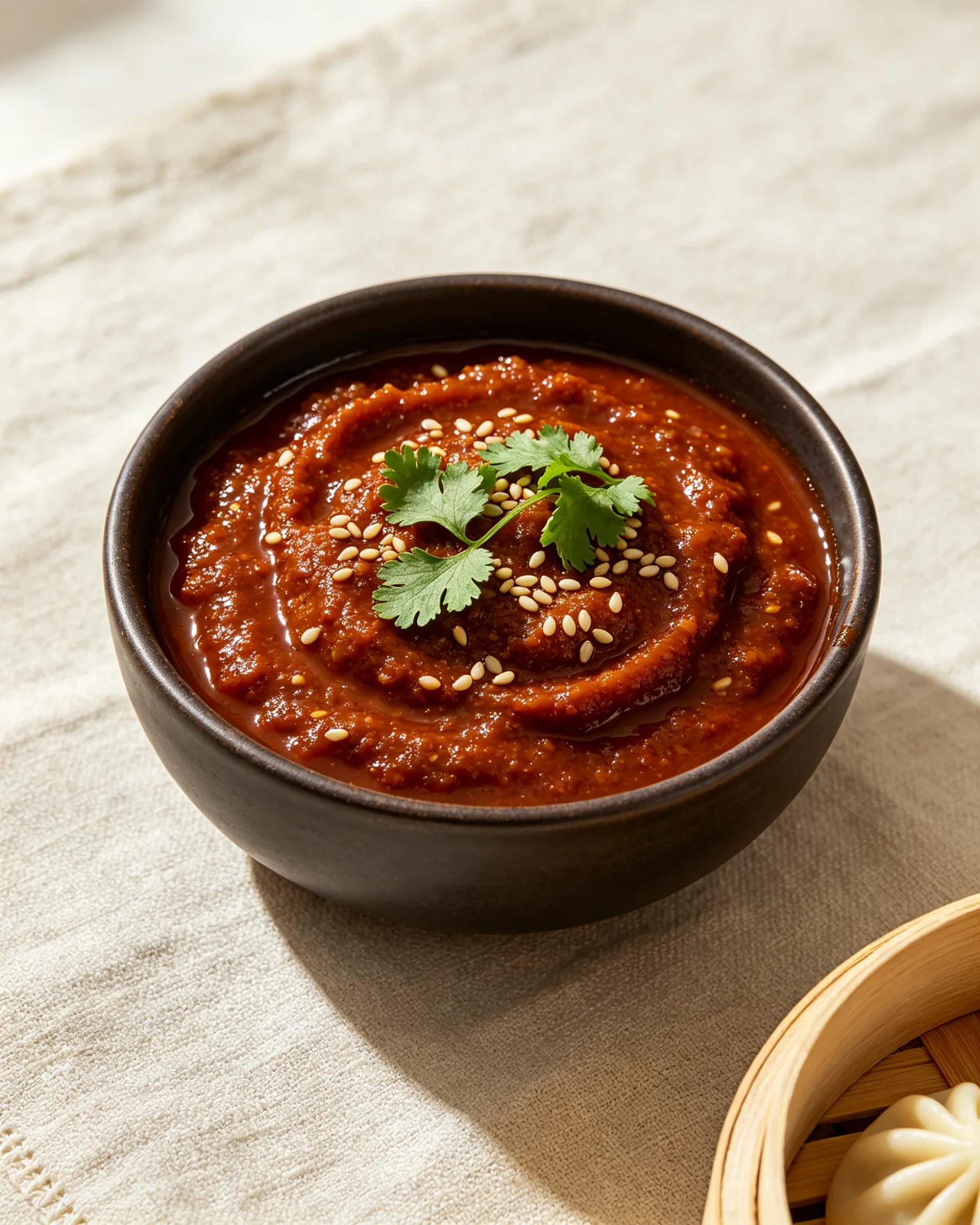
Most dumpling sauces are built on soy sauce and vinegar, the Chinese model. Nepali momo achar is built on roasted tomatoes, dried red chilli, sesame seeds, garlic, and timur. It is a completely different sauce in every dimension: thicker, smokier, with the numbing character of timur running through every bite.
The roasted tomato base is what most distinguishes it. Raw tomato achar, blended without roasting, is thin, bright, and sharp. Roasted tomato achar is thick, complex, and smoky. The difference comes from what roasting does to the tomato, covered in the next section.
The timur is what makes it specifically Nepali. The numbing-tingling sensation on the front of the tongue that arrives with each spoonful of properly made achar is from hydroxy-alpha-sanshool, the same volatile compound in Sichuan peppercorn covered in the Sichuan chicken recipe and the tteokbokki recipe on this site. Timur’s version of this compound produces a slightly different aromatic character than Chinese Sichuan pepper, slightly more citrusy, slightly more woody, but the numbing effect is the same.
Without timur, the achar tastes correct but generic. With timur, it tastes like it could only come from the Himalayas.
Why roast the tomatoes for achar?
Raw tomatoes contain approximately 94-95% water by weight, one of the highest water contents of any cooking ingredient. Blending raw tomatoes produces a sauce that is predominantly water: thin, sharp, and bright from the citric and malic acids, but without body.
Roasting tomatoes at high heat drives off a significant portion of this water through evaporation. A roasted tomato weighs approximately 40-50% less than the raw tomato it came from, that weight is water that has evaporated. The flavour compounds remaining after roasting, glutamate, lycopene, and various aromatic compounds, are now present in a much smaller volume of liquid. The flavour is concentrated.
Simultaneously, the direct high heat of the oven produces Maillard reaction at the tomato’s cut and exposed surfaces. The natural sugars and amino acids react to produce melanoidins and heterocyclic aromatic compounds, the same compound class as the char on Vietnamese pork chops and the caramelisation in pad thai sauce. These compounds give the roasted tomato its characteristic smoky, slightly caramelised depth.
Blend roasted tomatoes and the result is a thick, concentrated, deeply flavoured achar that coats each momo rather than running off it. Blend raw tomatoes and the result is thin soup that needs the momo to swim in.
What does timur do in the achar?
Timur (टिमुर, Zanthoxylum armatum) is the Nepali name for Himalayan prickly ash, the same genus as Chinese Sichuan pepper but a different species with a slightly different character. Like Sichuan peppercorn, it contains hydroxy-alpha-sanshool, the compound that produces the numbing-tingling sensation covered in the Sichuan chicken recipe on this site.
The numbing effect activates on the front of the tongue and lips within 30-60 seconds of contact with the timur compounds. It is not heat, it does not burn. It is a physical sensation produced by the compound activating certain tactile receptors. The sensation amplifies the other flavours in the achar by reducing sensory adaptation, when the tongue is slightly numbed, each subsequent flavour registers more distinctly.
Add the timur to the achar after blending and off heat. Hydroxy-alpha-sanshool is volatile and evaporates rapidly at cooking temperatures, adding timur to a hot sauce loses most of the numbing effect before the sauce reaches the table. Off heat, the compounds are preserved and arrive at full intensity at the moment of eating.
Timur is available at Nepali and some Indian grocery stores. Ground Sichuan peppercorn is the closest substitute, the numbing effect is similar, the aromatic profile is slightly different.
How do you pleat momo?
Two main styles are used in Nepal. Neither is wrong and both seal the filling effectively. The difference is aesthetic and practical.
Crescent fold: Fold the wrapper in half over the filling, pressing the edges together to form a half-moon shape. Then make small pleats along the sealed edge, similar to gyoza pleating. Easier for beginners. The finished momo looks like a semicircle with a ruffled edge.
Round top gather: Hold the filled wrapper in the palm of the non-dominant hand. Using the thumb and index finger of the dominant hand, make small pleats starting at one edge and working around the circumference of the wrapper, gathering all the edges toward the centre top. Twist to seal. The finished momo is round with a gathered top. This is the most common shape in Kathmandu street stalls, 14-18 pleats is the target.
Both styles require one critical element: a complete seal with no gaps. Any opening in the seal allows steam to enter the momo during cooking, which dilutes the filling flavour and can cause the momo to collapse if the steam pressure builds and the wrapper cannot hold. Pinch and press each pleat firmly.
Ingredients

Makes 24 momo
Dough:
- 250g (2 cups) plain flour (all-purpose)
- 120ml (½ cup) warm water
- Pinch of salt
Chicken filling:
- 400g (14oz) ground chicken thigh (or whole thighs, skinned, boned, and minced)
- 1 medium onion, finely chopped and squeezed dry
- 4 cloves garlic, finely minced
- 3cm fresh ginger, finely grated
- 3 spring onions, thinly sliced
- Large handful fresh coriander, finely chopped
- 2 tbsp neutral oil
- 1 tbsp soy sauce
- 1 tsp ground cumin
- ½ tsp ground coriander
- ½ tsp ground timur or Sichuan peppercorn
- ½ tsp salt
- ¼ tsp white pepper
- ¼ tsp turmeric
Momo achar (roasted tomato dipping sauce):
- 4 medium tomatoes, halved
- 4-6 dried red chillies (adjust for heat)
- 4 cloves garlic, unpeeled
- 2 tbsp sesame seeds, toasted
- 1 tbsp neutral oil
- 1 tsp ground timur or Sichuan peppercorn (added off heat after blending)
- 1 tsp salt
- ½ tsp sugar
- Small handful fresh coriander
Instructions
Make the achar first, it takes 30 minutes and can be made days ahead. Make the dough while the tomatoes roast.
Step 1: Roast the tomatoes and make achar

Preheat oven to 220°C. Place tomato halves cut-side up on a baking tray.
Remove from oven. Squeeze the garlic from its skins. Transfer roasted tomatoes, garlic, and chillies to a blender. Add toasted sesame seeds, salt, and sugar. Blend until smooth, or leave slightly chunky if preferred. Taste and adjust salt or chilli.
Remove from blender. Add the ground timur off heat. Stir to combine. The timur is added after blending and off heat to preserve the volatile numbing compounds. Set aside to cool.
Step 2: Make the dough
Combine flour and salt in a bowl. Gradually add warm water while mixing until a rough dough forms.
Step 3: Make the filling
Finely chop the onion. Place in a clean cloth and squeeze firmly over a sink until most of the water is removed.
Add ground chicken thigh, squeezed onion, garlic, ginger, spring onions, fresh coriander, oil, soy sauce, and all the spices. Mix vigorously in one direction for 2-3 minutes until the filling is cohesive and slightly sticky, the same myosin development technique used in the siu mai recipe on this site. Keep refrigerated until ready to use.
Step 4: Roll the wrappers
Divide the rested dough into 24 equal pieces (approximately 15g each). Keep unused pieces covered with a damp cloth.
Roll each piece into a ball, then flatten. Using a small rolling pin, roll each wrapper to approximately 8-9cm in diameter, thin at the edges, slightly thicker in the centre. Work quickly and keep finished wrappers covered.
Step 5: Fill and pleat

Place approximately 1 tablespoon of cold filling in the centre of each wrapper. Use either the crescent fold or round top gather technique.
Place finished momo on a lightly floured surface or parchment-lined tray. Keep covered with a damp cloth.
Step 6: Steam
Line bamboo steamer baskets with parchment paper or lightly oiled banana leaves. Place momo with at least 2cm between each, they must not touch during steaming.
Bring water in the steamer base to a rolling boil. Place the steamer over the boiling water. Steam for 12-15 minutes. The wrappers should be slightly translucent and the filling firm when pressed gently.
Serve immediately in the steamer basket with the momo achar alongside.
How do you freeze and cook momo from frozen?
Freeze uncooked momo, not cooked. Steamed momo do not reheat well, the wrappers become tough and the filling dries out.
Place assembled uncooked momo on a parchment-lined tray without touching. Freeze until solid, approximately 2 hours. Transfer to a freezer bag. Keeps for 3 months.
To cook from frozen: place directly in the lined steamer without thawing. Steam for 18-20 minutes rather than 12-15. The extra time allows the frozen filling to cook through completely. Check that the filling is hot throughout before serving, press one momo gently, it should feel firm and you should be able to feel the heat through the wrapper.
Love Nepali food?
Check out my complete guide to Nepali home cooking, pantry essentials, and techniques.
FAQ
What is the traditional filling for Nepali momo? Traditionally buff (water buffalo) momo is the most authentic Kathmandu preparation, buffalo meat is widely available and inexpensive in Nepal and has a slightly richer, more mineral character than chicken. Outside Nepal, chicken is the most widely available substitute and produces excellent results when made with thigh as described. Pork is also common in certain Nepali communities. Vegetable momo with cabbage, carrot, and tofu is the standard vegetarian version.
What is timur and where do I find it? Timur (Zanthoxylum armatum) is the Nepali Himalayan prickly ash, the same genus as Chinese Sichuan peppercorn but a different species. It produces the same numbing-tingling sensation on the tongue and lips. Find it at Nepali grocery stores, some South Asian grocery stores, and online. Ground Sichuan peppercorn is the closest substitute, the numbing effect is essentially the same, the aromatic character is slightly different. Do not substitute with black pepper or regular chilli, neither produces the numbing sensation that defines the achar.
Why is my momo filling dry after steaming? Chicken breast was used instead of thigh. In the 100°C steam environment, lean breast protein contracts and squeezes out its intramuscular water without the fat compensation that keeps thigh filling juicy. Use ground chicken thigh. If the filling is already made with breast, add 1-2 tablespoons of neutral oil to the mixture before assembling, the additional fat compensates partially for the absence of intramuscular fat.
How many pleats should Nepali momo have? There is no strict standard for home momo the way Din Tai Fung enforces 18 pleats for xiaolongbao. Kathmandu street vendors typically produce 14-18 pleats for round momo. The only requirement is a complete seal, any number of pleats that seals the filling without gaps is correct. Beginners often find the crescent fold with 8-10 pleats along the edge easier to achieve consistently while learning. The number of pleats does not affect the flavour.
You might also like: Check out our complete Nepali cooking guide for more essential ingredients and techniques.
Nepali Chicken Momo Recipe (मःमः)
PT45M
PT15M
PT1H
Nutrition Facts
Ingredients
- 250g (2 cups) plain flour (all-purpose)
- 120ml (½ cup) warm water
- Pinch of salt
- 400g (14oz) ground chicken thigh (or whole thighs, skinned, boned, and minced)
- 1 medium onion, finely chopped and squeezed dry
- 4 cloves garlic, finely minced
- 3cm fresh ginger, finely grated
- 3 spring onions, thinly sliced
- Large handful fresh coriander, finely chopped
- 2 tbsp neutral oil
- 1 tbsp soy sauce
- 1 tsp ground cumin
- ½ tsp ground coriander
- ½ tsp ground timur or Sichuan peppercorn
- ½ tsp salt
- ¼ tsp white pepper
- ¼ tsp turmeric
- 4 medium tomatoes, halved
- 4-6 dried red chillies (adjust for heat)
- 4 cloves garlic, unpeeled
- 2 tbsp sesame seeds, toasted
- 1 tbsp neutral oil
- 1 tsp ground timur or Sichuan peppercorn (added off heat after blending)
- 1 tsp salt
- ½ tsp sugar
- Small handful fresh coriander
Instructions
- *Make the achar first, it takes 30 minutes and can be made days ahead. Make the dough while the tomatoes roast.*
- Preheat oven to 220°C. Place tomato halves cut-side up on a baking tray. Add the unpeeled garlic cloves and dried red chillies. Drizzle with oil. Roast 25-30 minutes until the tomatoes are blistered, slightly collapsed, and darkened at the edges. The skins may have split. This is correct. Remove from oven. Squeeze the garlic from its skins. Transfer roasted tomatoes, garlic, and chillies to a blender. Add toasted sesame seeds, salt, and sugar. Blend until smooth, or leave slightly chunky if preferred. Taste and adjust salt or chilli. Remove from blender. Add the ground timur off heat. Stir to combine. The timur is added after blending and off heat to preserve the volatile numbing compounds. Set aside to cool.
- Combine flour and salt in a bowl. Gradually add warm water while mixing until a rough dough forms. Knead by hand for 8-10 minutes until smooth and elastic. Cover with a damp cloth and rest for 30 minutes minimum.
- Finely chop the onion. Place in a clean cloth and squeeze firmly over a sink until most of the water is removed. Transfer to a mixing bowl. Add ground chicken thigh, squeezed onion, garlic, ginger, spring onions, fresh coriander, oil, soy sauce, and all the spices. Mix vigorously in one direction for 2-3 minutes until the filling is cohesive and slightly sticky, the same myosin development technique used in the siu mai recipe on this site. Keep refrigerated until ready to use.
- Divide the rested dough into 24 equal pieces (approximately 15g each). Keep unused pieces covered with a damp cloth. Roll each piece into a ball, then flatten. Using a small rolling pin, roll each wrapper to approximately 8-9cm in diameter, thin at the edges, slightly thicker in the centre. Work quickly and keep finished wrappers covered.
- Place approximately 1 tablespoon of cold filling in the centre of each wrapper. Use either the crescent fold or round top gather technique. Seal completely with no gaps. Place finished momo on a lightly floured surface or parchment-lined tray. Keep covered with a damp cloth.
- Line bamboo steamer baskets with parchment paper or lightly oiled banana leaves. Place momo with at least 2cm between each, they must not touch during steaming. Bring water in the steamer base to a rolling boil. Place the steamer over the boiling water. Steam for 12-15 minutes. The wrappers should be slightly translucent and the filling firm when pressed gently. Serve immediately in the steamer basket with the momo achar alongside. ## How do you freeze and cook momo from frozen? Freeze uncooked momo, not cooked. Steamed momo do not reheat well, the wrappers become tough and the filling dries out. Place assembled uncooked momo on a parchment-lined tray without touching. Freeze until solid, approximately 2 hours. Transfer to a freezer bag. Keeps for 3 months. To cook from frozen: place directly in the lined steamer without thawing. Steam for 18-20 minutes rather than 12-15. The extra time allows the frozen filling to cook through completely. Check that the filling is hot throughout before serving, press one momo gently, it should feel firm and you should be able to feel the heat through the wrapper.
Did you make this recipe?
Tag @asianfoodsdaily on Instagram or leave a comment below!
Testing Notes
Tested in Asha's kitchen. Last reviewed June 16, 2026.
Ingredient Substitutions
Substitution notes coming soon.
About Asha
Half Asian, half African cook raised between two food-obsessed cultures. I've spent 10 years learning Asian cooking traditions through family, friends, and thousands of hours at the stove — testing every dish until it works in a standard home kitchen.
Read my full storyRelated Recipes
More delicious dishes you might enjoy


Loading comments...