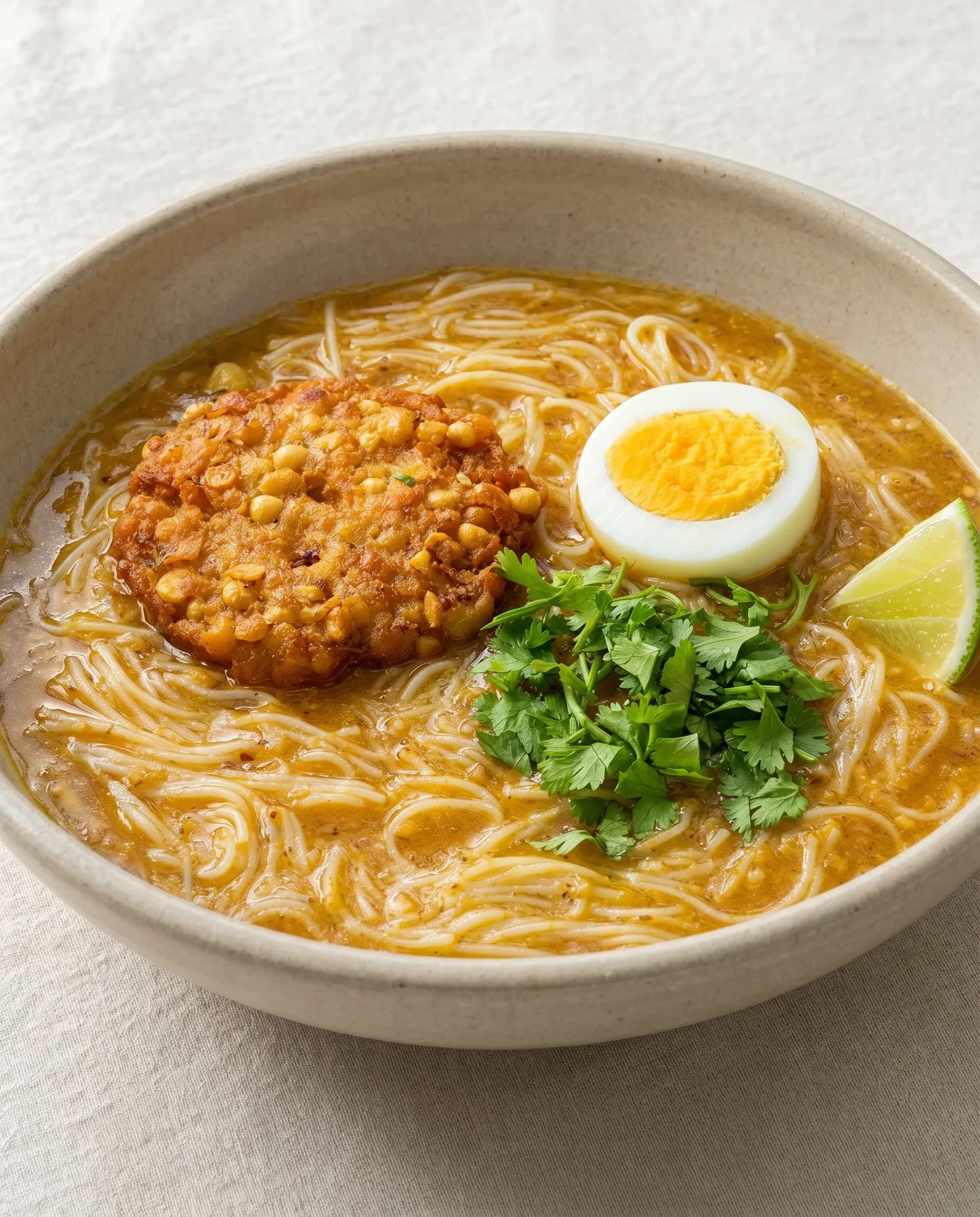
Mohinga Recipe — Burmese Fish Noodle Soup
1 hr 15 min
Burmese food is one of the most misunderstood cuisines in Asia, described by everyone who hasn't cooked it as "like Thai food but milder," which tells you nothing useful. It is its own thing. The curries use no coconut milk and are cooked until the water evaporates and only oil remains, a technique that produces a depth and richness completely different from any Thai or Indian curry. The salads are fermented and funky and unlike anything else in Southeast Asian cooking. And mohinga, the national dish, is a fish noodle soup so particular to Myanmar that there is no comparison dish anywhere in the region. These are the recipes I keep coming back to.
Burmese home cooking is built around a daily meal format of steamed white rice surrounded by a curry, a clear soup, fresh or cooked vegetables, and ngapi, fermented fish or shrimp paste used as a condiment and as a base flavour throughout the meal. The meal is served all at once, not in courses.
What makes Burmese cooking distinct from every other Southeast Asian cuisine is the curry technique. A Burmese curry is not finished with coconut milk. It is cooked using a method called see-byan: simmering the meat or vegetables in a combination of oil and water until the water has completely evaporated and the oil separates and rises to the surface. That separated oil at the top of a Burmese curry is not a sign that something has gone wrong. It is the sign that the curry is done. The oil carries the flavour of the slow-cooked aromatics: onion, garlic, ginger, tomato, turmeric. The final dish is rich, savoury, and slightly dry compared to the saucy curries of Thailand or Sri Lanka.
Burmese food also has one of the most developed salad traditions in Asia. The thoke, the Burmese salad, is not a side dish. It is a complete element of the meal, made from raw or blanched ingredients dressed with fish sauce, lime, toasted chickpea flour, peanut oil, and dried shrimp. The most famous is lahpet thoke, tea leaf salad, made from fermented tea leaves and served with fried garlic, sesame seeds, roasted peanuts, dried shrimp, and sliced tomato. There is no equivalent dish anywhere else in the world.
The see-byan method (oil separation): Every Burmese curry starts with a base of sliced onion, garlic, ginger, tomato, and turmeric cooked in a generous amount of oil over medium heat. Meat or fish is added and the whole thing is simmered with enough water to cover. The key moment is at the end — the heat is maintained until all the water has evaporated and the oil separates and floats to the surface in a clear layer. This takes patience and cannot be rushed. The separation signals that the raw aromatics have fully cooked into the oil and the curry has developed its full depth. Adding coconut milk at this stage would dilute everything the technique has built.
Ngapi preparation: Ngapi — fermented fish paste or shrimp paste — is used two ways in Burmese cooking. As an ingredient it goes directly into curry bases and soups in small quantities, adding an umami depth similar to the role maldive fish plays in Sri Lankan cooking. As a condiment it is mixed with lime juice, chilli, and garlic to make ngapi yay — a dipping sauce served at the table alongside a plate of fresh and blanched vegetables. The paste has a strong, pungent smell when raw that mellows significantly during cooking. Do not taste ngapi raw and judge from that — taste the finished dish.
Toasting chickpea flour: Burmese salads are finished with a spoonful of toasted chickpea flour — besan dry-roasted in a pan until golden and nutty. The toasted flour absorbs the dressing, thickens it slightly, and adds a nuttiness that ties the salad together. This technique is used in lahpet thoke, tomato thoke, and ginger salad. The flour takes about 3 minutes in a dry pan over medium heat — stir constantly and remove the moment it turns golden.
The Burmese mirepoix: Almost every Burmese savoury dish starts with the same base: onion, garlic, ginger, and tomato fried slowly in oil until the tomato breaks down completely and the mixture becomes a thick, dark paste. This base — sometimes called the Burmese mirepoix — is the foundation of curries, soups, and noodle sauces. Getting it right means frying it long enough that the tomato loses all its water and the oil starts to separate slightly before the main ingredients are added.
Check out my complete guide to Burmese home cooking, pantry essentials, and techniques.
Burmese curry is fundamentally different from both Thai and Indian curry in its technique and final texture. Thai curries are built on coconut milk and aromatic pastes; the coconut milk is the sauce. Indian curries vary widely but typically involve spice powders and often tomato or yoghurt bases. Burmese curry uses neither coconut milk nor a spice paste. The base is onion, garlic, ginger, tomato, and turmeric cooked slowly in oil using the see-byan method, simmering until all water evaporates and the oil separates to the surface. The result is a dry, intensely savoury curry with a layer of flavoured oil on top rather than a saucy gravy. It is richer than Thai curry and earthier than Indian curry, with a texture closer to a braise than a sauce.
Ngapi is fermented fish or shrimp paste, the defining condiment and base ingredient of Burmese cooking. In small amounts as a cooking ingredient it adds umami depth that no other single ingredient replicates. As a table condiment mixed with lime juice, chilli, and garlic it becomes ngapi yay, a dipping sauce served alongside fresh and blanched vegetables at almost every Burmese meal. You do not strictly need ngapi to cook Burmese food at home, but without it the dishes taste incomplete in a specific way: savoury but missing a bottom note. Shrimp paste is the closest substitute. For fully vegan cooking, white miso dissolved in a small amount of water provides a partial approximation of the fermented depth.
Tomato thoke, the Burmese tomato salad, is the right starting point. Ripe tomatoes, fish sauce, lime juice, toasted chickpea flour, peanut oil, dried shrimp, and fried shallots. No specialty ingredients, no complex technique, and it teaches the fundamental Burmese flavour balance — savoury, sour, slightly funky from the dried shrimp, with the toasted flour tying everything together. Once you understand that balance, every other Burmese dish makes more sense. After tomato thoke, make a simple chicken curry using the see-byan technique. That single dish teaches the oil separation method that is the foundation of Burmese cooking.
Burmese food is less aggressively spicy than Thai or Sri Lankan cooking but it is not mild. Chilli appears in most dishes but as one of several flavour elements rather than the defining heat. The cuisine is better described as deeply savoury with complex fermented notes — the pungency comes from ngapi and dried shrimp rather than from chilli heat. Heat level is adjustable in every dish by reducing or omitting fresh and dried chilli without losing the characteristic Burmese flavour profile.