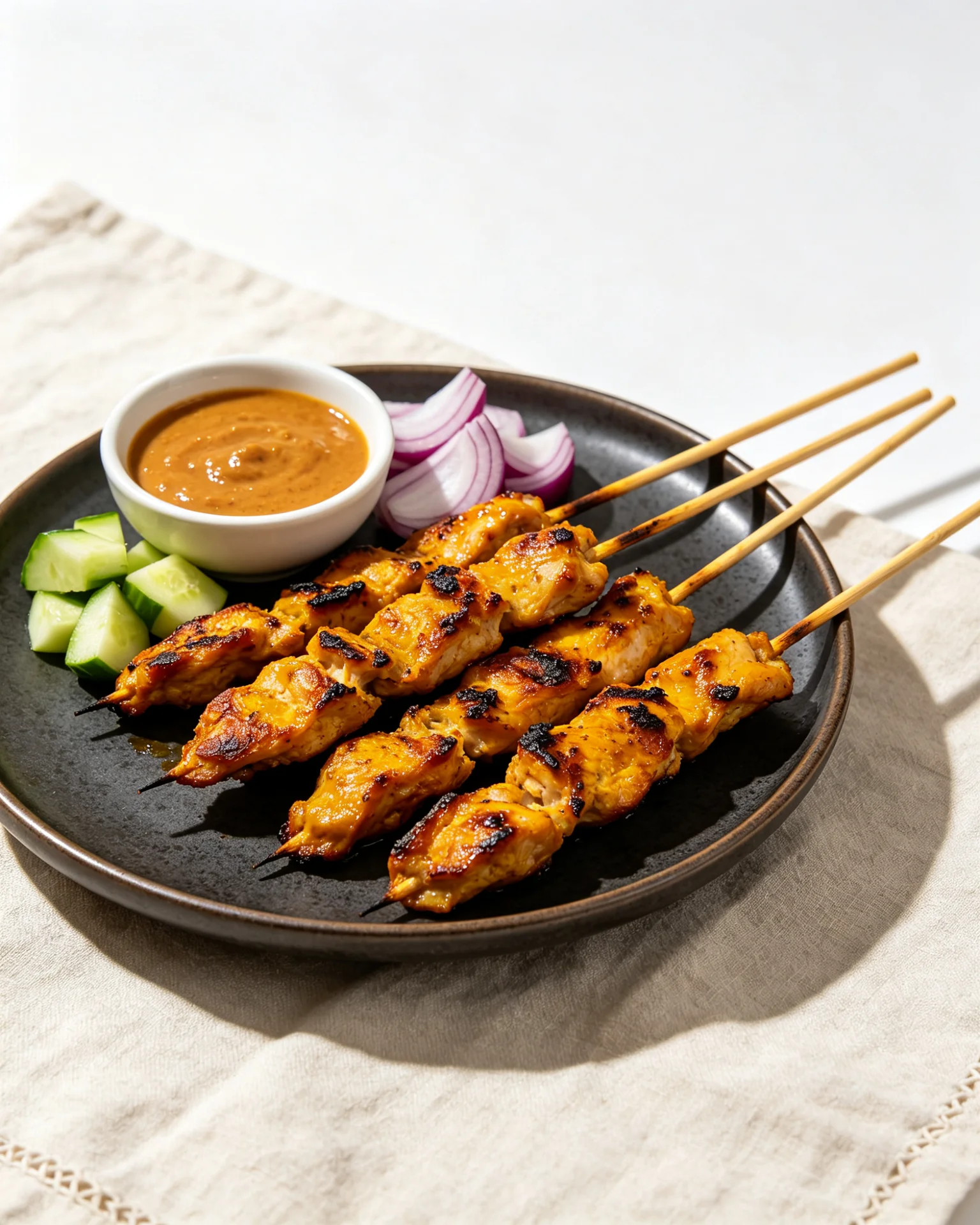
Chicken Satay Recipe (Sate Ayam)
Jump to Section
The first time I made satay at home I used chicken breast, turned the grill to medium, and ended up with dry pale skewers that tasted of nothing in particular. The problem was two things simultaneously: wrong cut and wrong heat. Breast meat at medium grill heat loses moisture before the surface develops any colour. No char means no Maillard reaction, no pyrazines, none of the smoky caramelised depth that defines properly grilled satay. The second batch used chicken thigh and the highest heat the grill could produce. The difference was not subtle.
The char is not cosmetic. When the marinade’s sugars, from the coconut milk, the palm sugar, the natural sugars in the lemongrass, hit a grill surface above 200°C, they react with the amino acids in the chicken through the Maillard reaction, producing the same class of aromatic compounds as properly charred kung pao chicken or Peking duck skin. That smoky, slightly caramelised depth is what separates satay from grilled chicken with spices on it.
What is satay and where does it actually come from?
Satay is not Thai food, despite being commonly described that way in Western recipe blogs. It originated in Java, Indonesia, where it is called sate (pronounced sah-tay), skewered meat grilled over charcoal, served with a peanut sauce. The dish spread through maritime trade routes across Southeast Asia and evolved into distinct regional versions in Malaysia, Thailand, Singapore, and the Philippines.
The word sate likely derives from the Tamil word for meat (சதை, catai) or from the Arabic word for roasted meat (شواء, shawa), the etymology reflects the Arab and Indian trade influences that shaped early Indonesian cooking. What is documented clearly is the dish’s Indonesian origin and its outward spread across the region.
This recipe follows the Malaysian style, the most complex and heavily spiced version of the three main traditions. Understanding the differences helps you understand what you are making.
What is the difference between Indonesian, Malaysian, and Thai satay?
Three distinct versions, genuinely different from each other.
Indonesian sate ayam is the original and the simplest. The marinade is built on kecap manis (Indonesian sweet soy sauce), garlic, and spices. The sauce is peanut-forward and relatively straightforward. The chicken is often smaller pieces, the flavour profile cleaner and less complex than the Malaysian version. The kecap manis gives Indonesian satay a darker, slightly sweeter glaze that Malaysian satay does not have.
Malaysian satay is the most complex. The marinade starts with a pounded or blended spice paste of lemongrass, galangal, shallots, garlic, and chilli, combined with ground spices including coriander, cumin, and turmeric. No kecap manis. The peanut sauce is thicker, more heavily spiced, and often contains tamarind for its sustained sourness. Some Malaysian versions also include belacan (fermented shrimp paste) for additional umami depth. This is this recipe.
Thai satay is the sweetest and most coconut-forward. The marinade often includes coconut milk and a small amount of red curry paste or yellow curry powder. The peanut sauce is lighter and thinner than the Malaysian version, sometimes containing coconut milk. Thai satay tastes noticeably sweeter and has a mild, slightly curry-spiced character rather than the lemongrass-forward intensity of Malaysian satay.
Why does the marinade need turmeric and what does it actually do?
Every satay recipe includes turmeric but almost none explain what it is doing beyond colour.
Turmeric’s primary active compound is curcumin, a polyphenol that is fat-soluble rather than water-soluble. In the satay marinade, the coconut milk (approximately 20-25% fat) provides the fat medium in which the curcumin dissolves. This fat-dissolved curcumin penetrates the surface fat layer of the chicken and bonds to the surface proteins during marinating.
At grill temperatures above 150-160°C, curcumin undergoes thermal degradation reactions that produce a range of smaller aromatic compounds. These contribute to both the characteristic golden-brown colour development on the grill and a slightly earthy, bitter depth in the finished flavour.
The golden colour on properly grilled satay is not just Maillard browning from protein and sugar reactions. It is evidence that the curcumin has bonded to the surface and transformed thermally. This is why turmeric in a water-based marinade without fat produces much less effective colour development and surface penetration. The coconut milk is not just flavour, it is the delivery mechanism for the turmeric.
Why does the peanut sauce use tamarind and not lime?
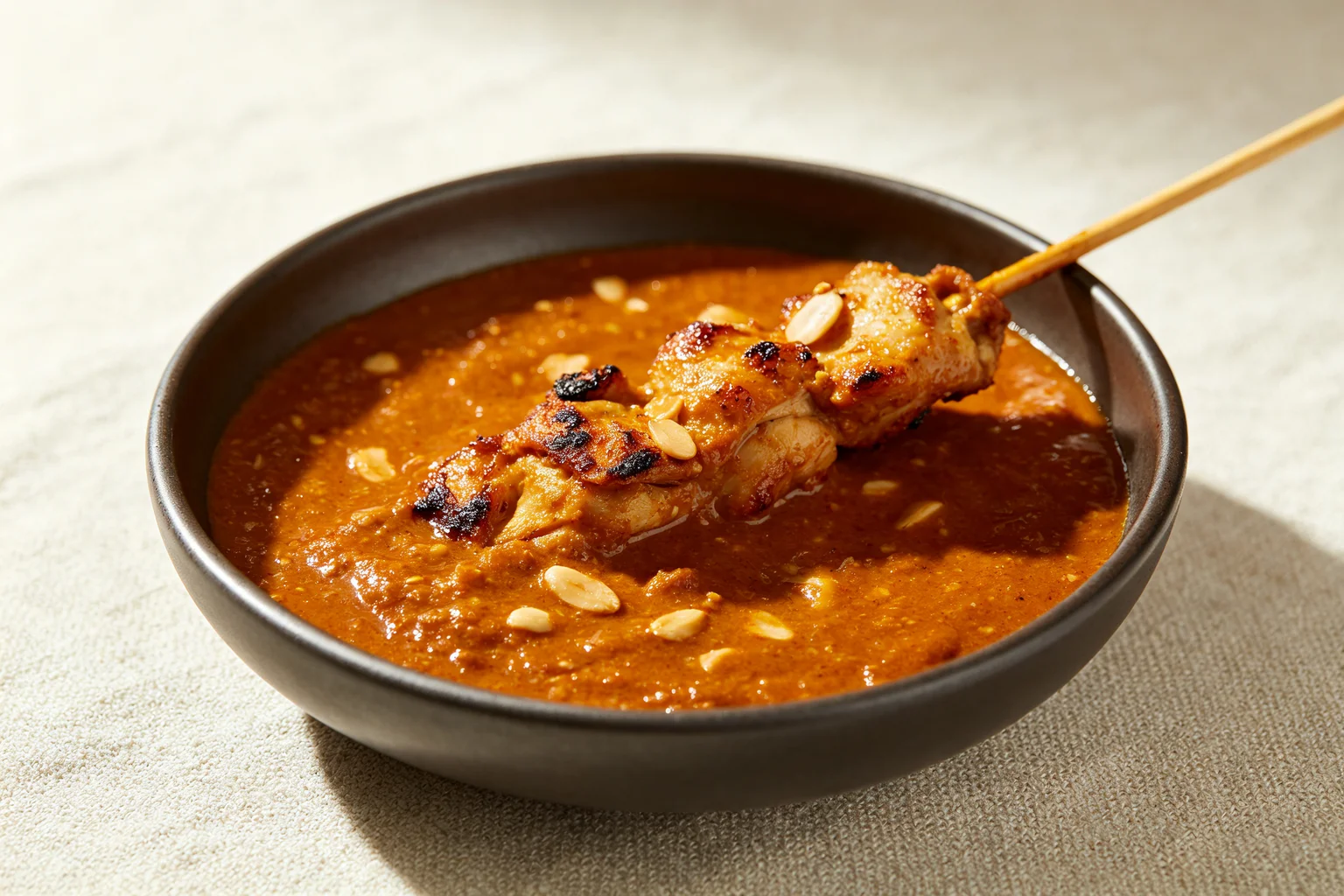
The choice of souring agent changes the flavour architecture of the peanut sauce significantly.
Tamarind pulp contains tartaric acid as its primary acid, at concentrations of approximately 8-23% of the dry weight. Tartaric acid has a significantly lower vapour pressure than citric acid, found in lime juice, which means it is less volatile at cooking temperatures and less volatile in the mouth.
Lime juice citric acid: arrives sharply on the front of the palate, noticeably immediately, fades relatively quickly. The sourness is a featured element, you taste the lime.
Tamarind tartaric acid: arrives more gradually, stays present through the full length of the bite, integrates as background seasoning rather than a distinct flavour note. The sourness is there but you may not identify it as sourness, you just notice the peanut sauce tastes more complete and rounded than it would without it.
This is why traditional Malaysian peanut sauce uses tamarind. The sourness works in the background, preventing the rich peanut and coconut flavours from becoming heavy. Lime juice is an acceptable substitute and the sauce still tastes good. But the character is different, brighter and more acidic rather than rounded and sustained.
Why do you soak bamboo skewers and how long is actually enough?
The standard instruction is “soak for 30 minutes.” The reason is usually given as “so they don’t burn.” The actual mechanism is more specific.
Bamboo is a lignocellulosic material, composed primarily of cellulose, hemicellulose, and lignin. Dry bamboo skewers have a moisture content of approximately 8-12%. At grill temperatures above 250°C, dry bamboo ignites relatively quickly, within 1-2 minutes of direct high heat exposure at the exposed ends.
When bamboo is soaked in water, the cell walls absorb water until they reach saturation at approximately 30-50% moisture content. At this moisture level, the water must evaporate from the saturated cell walls before the bamboo can ignite. This evaporation takes time, adequately soaked skewers at grill temperature provide approximately 3-5 minutes of protection before the exposed ends begin to char and eventually ignite.
30 minutes of soaking: surface saturation of the skewer walls, approximately 3 minutes of protection at high grill heat. 60 minutes of soaking: deeper saturation into the bamboo structure, approximately 4-5 minutes of protection.
Since satay takes 8-12 minutes to cook through at the correct grill temperature, 60 minutes of soaking is the safer choice. The skewer ends may darken and char slightly but will not ignite during the cooking window.
Metal skewers eliminate this consideration entirely. If you grill satay regularly, flat metal skewers are worth buying, the flat profile also prevents the meat from spinning when you turn the skewer, which is a specific practical advantage.
What does the char actually contribute to the flavour?
The marinade for Malaysian satay contains natural sugars from multiple sources: sucrose from the palm sugar, lactose from the coconut milk, and natural sugars released from the lemongrass, shallots, and galangal during blending.
When the marinated chicken hits a grill surface above 200°C, these sugars react with the amino acids in the chicken through the Maillard reaction. The specific compounds produced, pyrazines, furans, and other heterocyclic aromatics, are the same compound class produced during hú là in kung pao chicken and during the high-temperature roasting of Peking duck skin. They produce a smoky, caramelised, slightly bitter depth that cannot be produced at lower grill temperatures where the Maillard reaction does not fully proceed.
This is why the instruction is to grill at maximum heat rather than medium. Medium heat produces cooked, lightly browned satay. Maximum heat produces charred satay. The char is a distinct flavour transformation, not just colour.
The lemongrass stalk basting technique amplifies this further. Traditional Malaysian satay vendors use a bruised lemongrass stalk as a basting brush, they brush a mixture of oil and remaining marinade onto the skewers as they grill. The bruised stalk deposits fresh lemongrass volatile compounds (citral, limonene) onto the hot chicken surface with each stroke, adding a bright, fragrant layer on top of the cooked marinade character. The technique takes 30 seconds and makes a noticeable difference.
Why chicken thigh over breast for satay?
Covered briefly in the opening but worth explaining in full because it matters more for satay than for most other cooking methods.
At grill surface temperatures of 200°C+, the surface of the chicken reaches its target temperature within 30-60 seconds of first contact with the grill. At this temperature, breast meat loses moisture rapidly from the interior, the muscle fibres contract sharply and squeeze out the water they contain. The interior becomes dry while the surface chars. By the time the char has developed properly, the breast interior is overcooked.
Chicken thigh at 15-20% intramuscular fat has fat distributed through the muscle fibres. At grill temperature, this fat melts and bastes the muscle fibres from within as it renders, keeping the interior moist while the surface develops the char. The thigh interior stays juicy through the full cooking process and through the char development.
For satay specifically, where the cooking time is short and the grill heat is high, this difference is more pronounced than in slow-cooked dishes where the cooking method compensates for the cut difference.
Cut the thigh into 2cm pieces, thin enough to cook through quickly at high heat but thick enough to retain interior moisture during char development.
Ingredients
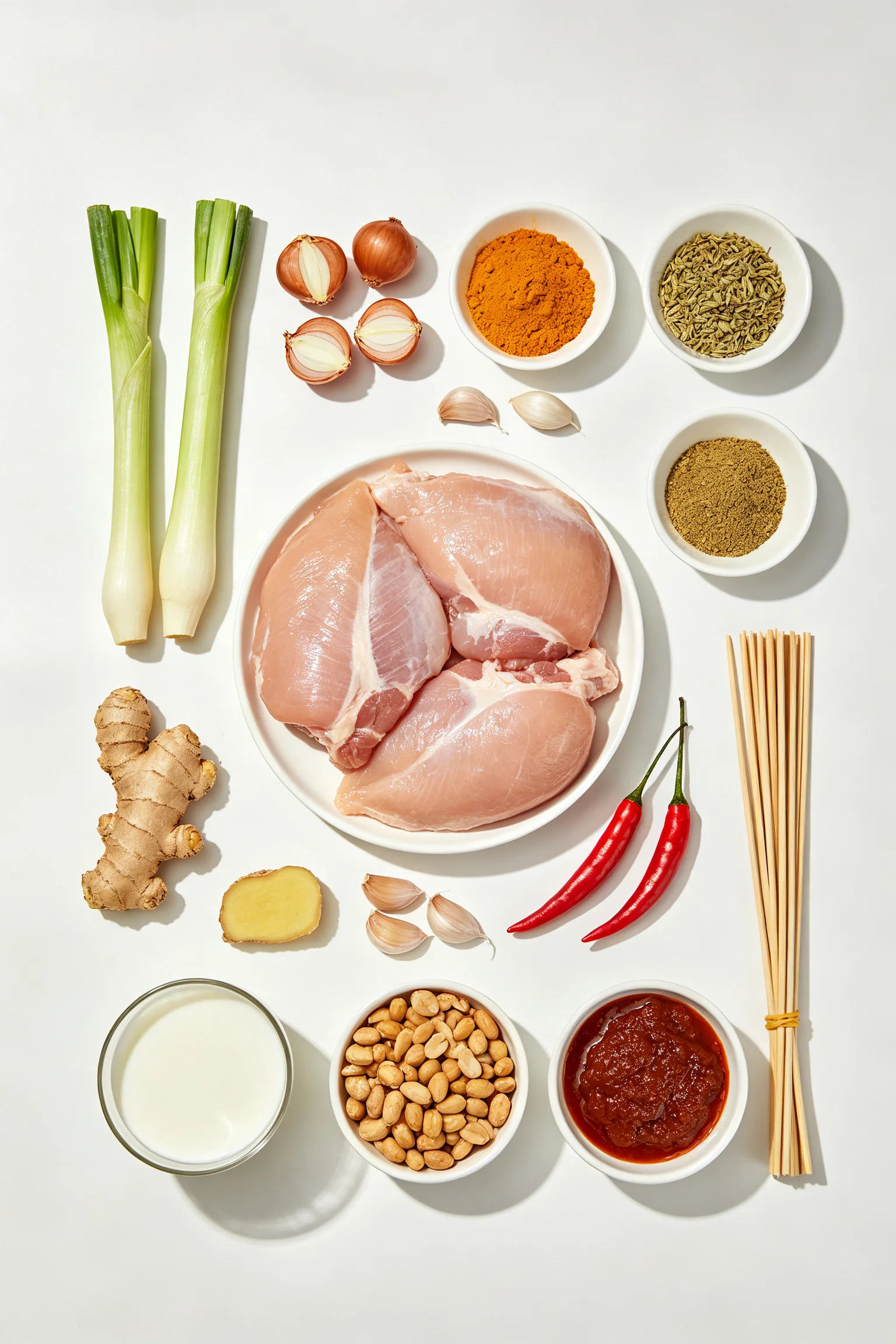
Serves 4 (approximately 20 skewers)
Chicken:
- 700g (1lb 9oz) boneless chicken thighs, cut into 2cm pieces
Spice paste (blend or pound together):
- 3 stalks lemongrass, outer leaves removed, inner stalk roughly chopped
- 4 shallots, roughly chopped
- 4 garlic cloves
- 3cm fresh galangal or ginger (galangal preferred, earthier, slightly piney)
- 2 fresh red chillies, deseeded for mild heat
- 1 tsp belacan (fermented shrimp paste), optional but adds depth
Marinade spices:
- 2 tsp turmeric powder
- 2 tsp ground coriander
- 1 tsp ground cumin
- 1 tsp fennel powder
- 2 tbsp palm sugar or brown sugar
- 3 tbsp coconut milk
- 2 tbsp neutral oil
- 1 tsp salt
For grilling:
- 20 bamboo skewers, soaked in water 60 minutes minimum
- 3 tbsp neutral oil mixed with 2 tbsp remaining marinade (for basting)
- 1 bruised lemongrass stalk (optional basting brush)
Malaysian peanut sauce:
- 200g (1½ cups) dry roasted peanuts, roughly crushed (not peanut butter)
- 3 tbsp tamarind paste (or 2 tbsp lime juice as substitute)
- 3 tbsp palm sugar or brown sugar
- 2 tbsp chilli paste or sambal oelek
- 200ml (¾ cup) coconut milk
- 100ml (⅓ cup) water
- 1 tsp salt
- 2 tbsp neutral oil
To serve:
- Cucumber, cut into chunks
- Red onion, cut into wedges
- Ketupat (compressed rice cakes), optional, available at Asian grocery stores
Instructions
Start the marinade the night before. The overnight marination makes a significant difference to the flavour depth.
Step 1: Make the spice paste
Combine lemongrass, shallots, garlic, galangal, chillies, and belacan in a food processor or blender. Process to a rough paste, small pieces rather than completely smooth.
Step 2: Marinate the chicken
Combine the spice paste with turmeric, coriander, cumin, fennel, palm sugar, coconut milk, oil, and salt. Mix thoroughly.
Remove from the refrigerator 30 minutes before cooking.
Step 3: Soak the skewers
Place bamboo skewers in a tray of cold water. Weigh down if they float.
Step 4: Make the peanut sauce
Heat neutral oil in a small saucepan over medium heat. Add chilli paste and fry 1-2 minutes until fragrant.
Step 5: Skewer the chicken
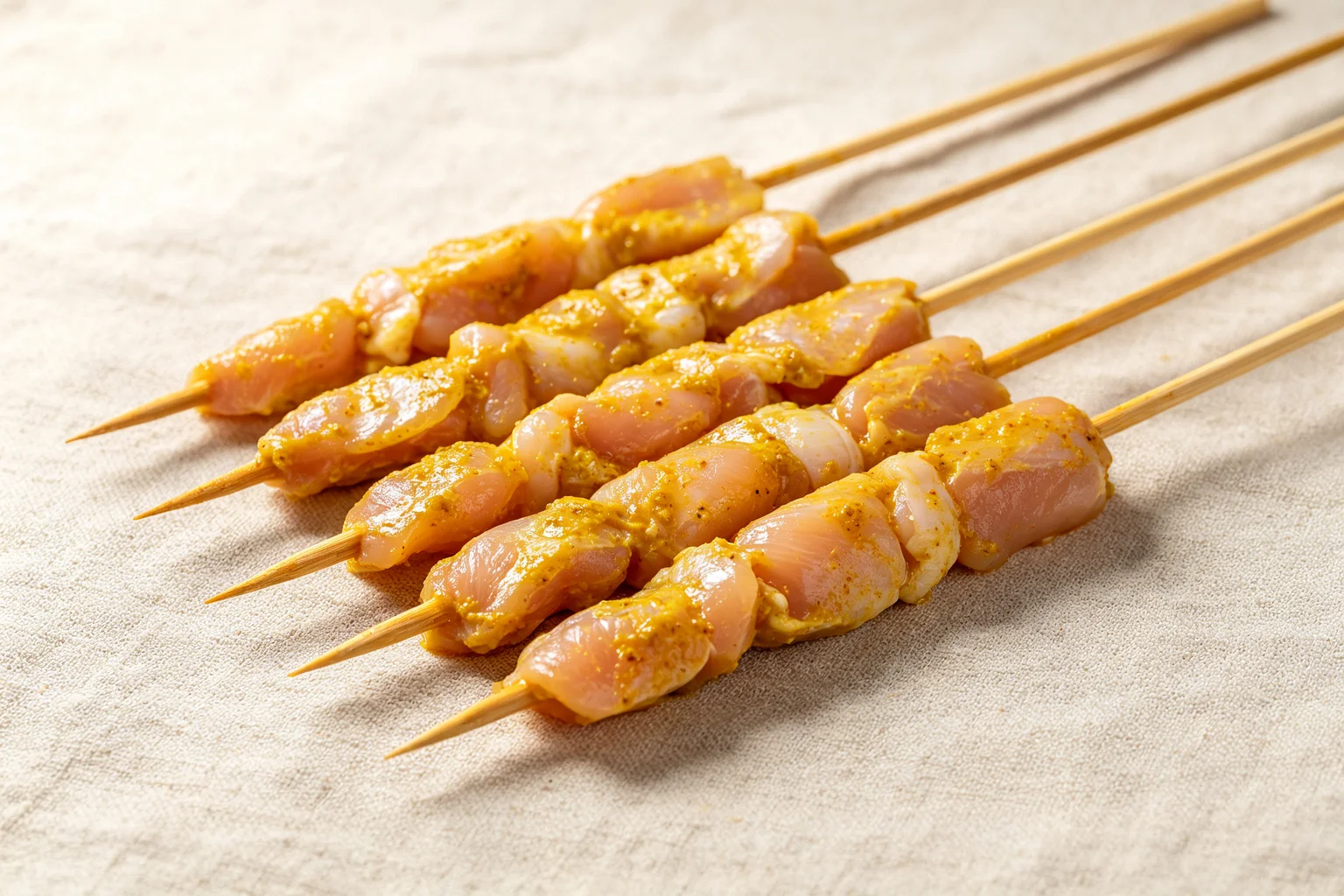
Thread 3-4 pieces of marinated chicken onto each soaked skewer, pressing them flat and compact against the skewer rather than leaving gaps. Flat chicken pieces cook more evenly and present more surface area for char development.
Step 6: Grill to char
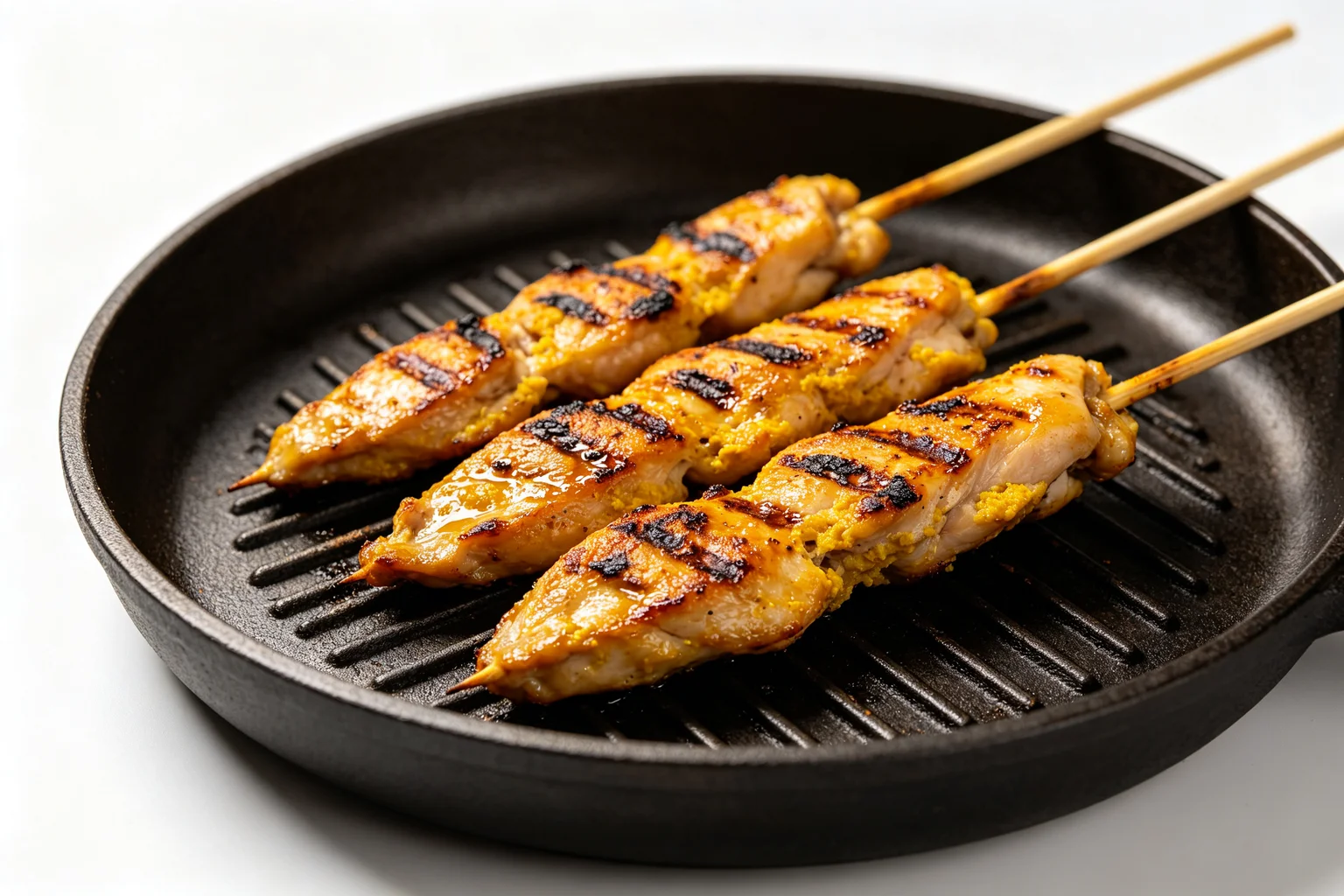
Heat the grill, grill pan, or cast iron pan to maximum heat. Brush with a small amount of oil.
Grill 3-4 minutes without moving on the first side until visible char develops. Flip once. Grill 3-4 minutes more. Baste with the oil-marinade mixture using either a pastry brush or the bruised lemongrass stalk between turns. The chicken is done when charred at the edges, juicy in the centre, and cooked through, juices run clear when pierced at the thickest point.
Step 7: Serve
Arrange the skewers over cucumber chunks and red onion wedges. Serve the warm peanut sauce in a separate bowl for dipping.
How do you store and reheat satay?
Cooked satay keeps in the refrigerator for 3 days. The char softens overnight but the flavour deepens as the spices continue to infuse.
To reheat: a very hot grill pan for 2-3 minutes per side re-develops some char and restores the surface crispness. Do not microwave, it steams the chicken and removes any remaining char texture.
The peanut sauce keeps refrigerated for 5 days. It thickens considerably in the refrigerator, reheat gently with a splash of water or coconut milk and stir until smooth before serving.
Uncooked marinated chicken can be frozen on the skewers for up to 3 months. Thaw overnight in the refrigerator before grilling.
FAQ
Why is my satay dry and not juicy? Two causes. First, chicken breast was used instead of thigh, breast loses moisture rapidly at high grill temperatures before the surface has time to char. Use thigh. Second, the grill temperature was too low, medium heat produces cooked chicken but not charred satay, and the longer cooking time needed at lower heat dries the interior. Grill at maximum heat for 3-4 minutes per side with char as the target.
Can I make satay without a grill? A cast iron grill pan over maximum stovetop heat is the best substitute. Heat until smoking before adding the skewers. The grill ridges allow fat to drain and produce grill marks, and the very high pan temperature enables char development. A regular flat pan produces cooked satay without the grill character. An oven at 220°C with the broiler on for the final 2-3 minutes can also produce some char if a grill is unavailable.
What is galangal and can I substitute ginger? Galangal (Alpinia galanga) is in the same botanical family as ginger but has a distinct character, pinier, more medicinal, slightly citrusy, less sweet than ginger. In Malaysian cooking it is not interchangeable with ginger by flavour, though ginger produces an acceptable substitute in terms of the aromatic function. Fresh galangal is available in the frozen section of most Asian grocery stores. The difference in the finished satay is real but the dish is still very good with fresh ginger.
Why does my peanut sauce separate or look oily? The oil from the crushed peanuts has separated from the water-based coconut milk. This happens if the sauce is cooked at too high a heat, which breaks the emulsion before it can form, or if the sauce is cooled and reheated without sufficient stirring. To fix: add a small amount of hot water and stir vigorously over low heat. The sauce should re-emulsify as it warms. For prevention: simmer on the lowest possible heat and stir constantly during the cooking process.
Chicken Satay Recipe (Sate Ayam)
PT8H15M (includes overnight marinade)
PT15M
PT8H30M
Nutrition Facts
Ingredients
- 700g (1lb 9oz) boneless chicken thighs, cut into 2cm pieces
- 3 stalks lemongrass, outer leaves removed, inner stalk roughly chopped
- 4 shallots, roughly chopped
- 4 garlic cloves
- 3cm fresh galangal or ginger (galangal preferred, earthier, slightly piney)
- 2 fresh red chillies, deseeded for mild heat
- 1 tsp belacan (fermented shrimp paste), optional but adds depth
- 2 tsp turmeric powder
- 2 tsp ground coriander
- 1 tsp ground cumin
- 1 tsp fennel powder
- 2 tbsp palm sugar or brown sugar
- 3 tbsp coconut milk
- 2 tbsp neutral oil
- 1 tsp salt
- 20 bamboo skewers, soaked in water 60 minutes minimum
- 3 tbsp neutral oil mixed with 2 tbsp remaining marinade (for basting)
- 1 bruised lemongrass stalk (optional basting brush)
- 200g (1½ cups) dry roasted peanuts, roughly crushed (not peanut butter)
- 3 tbsp tamarind paste (or 2 tbsp lime juice as substitute)
- 3 tbsp palm sugar or brown sugar
- 2 tbsp chilli paste or sambal oelek
- 200ml (¾ cup) coconut milk
- 100ml (⅓ cup) water
- 1 tsp salt
- 2 tbsp neutral oil
- Cucumber, cut into chunks
- Red onion, cut into wedges
- Ketupat (compressed rice cakes), optional, available at Asian grocery stores
Instructions
- *Start the marinade the night before. The overnight marination makes a significant difference to the flavour depth.*
- Combine lemongrass, shallots, garlic, galangal, chillies, and belacan in a food processor or blender. Process to a rough paste, small pieces rather than completely smooth. Alternatively pound in a mortar for a more textured result with more distinct aromatic pockets.
- Combine the spice paste with turmeric, coriander, cumin, fennel, palm sugar, coconut milk, oil, and salt. Mix thoroughly. Add the chicken pieces and work the marinade into every piece. Cover and refrigerate overnight, minimum 4 hours, 8-12 hours optimal. Remove from the refrigerator 30 minutes before cooking.
- Place bamboo skewers in a tray of cold water. Weigh down if they float. Soak for 60 minutes minimum.
- Heat neutral oil in a small saucepan over medium heat. Add chilli paste and fry 1-2 minutes until fragrant. Add crushed peanuts and stir to coat. Add coconut milk, water, tamarind paste, palm sugar, and salt. Simmer over low heat for 8-10 minutes, stirring occasionally, until the sauce thickens to a consistency that coats the back of a spoon. Taste and adjust, it should be rich, slightly spicy, sour in the background, and noticeably sweet from the palm sugar. Keep warm.
- Thread 3-4 pieces of marinated chicken onto each soaked skewer, pressing them flat and compact against the skewer rather than leaving gaps. Flat chicken pieces cook more evenly and present more surface area for char development.
- Heat the grill, grill pan, or cast iron pan to maximum heat. Brush with a small amount of oil. Place the skewers in a single layer, do not crowd. Grill 3-4 minutes without moving on the first side until visible char develops. Flip once. Grill 3-4 minutes more. Baste with the oil-marinade mixture using either a pastry brush or the bruised lemongrass stalk between turns. The chicken is done when charred at the edges, juicy in the centre, and cooked through, juices run clear when pierced at the thickest point.
- Arrange the skewers over cucumber chunks and red onion wedges. Serve the warm peanut sauce in a separate bowl for dipping. Ketupat alongside if available. ## How do you store and reheat satay? Cooked satay keeps in the refrigerator for 3 days. The char softens overnight but the flavour deepens as the spices continue to infuse. To reheat: a very hot grill pan for 2-3 minutes per side re-develops some char and restores the surface crispness. Do not microwave, it steams the chicken and removes any remaining char texture. The peanut sauce keeps refrigerated for 5 days. It thickens considerably in the refrigerator, reheat gently with a splash of water or coconut milk and stir until smooth before serving. Uncooked marinated chicken can be frozen on the skewers for up to 3 months. Thaw overnight in the refrigerator before grilling.
Did you make this recipe?
Tag @asianfoodsdaily on Instagram or leave a comment below!
Testing Notes
Tested in Asha's kitchen. Last reviewed July 14, 2025.
Ingredient Substitutions
Substitution notes coming soon.
About Asha
Half Asian, half African cook raised between two food-obsessed cultures. I've spent 10 years learning Asian cooking traditions through family, friends, and thousands of hours at the stove — testing every dish until it works in a standard home kitchen.
Read my full storyRelated Recipes
More delicious dishes you might enjoy


Loading comments...