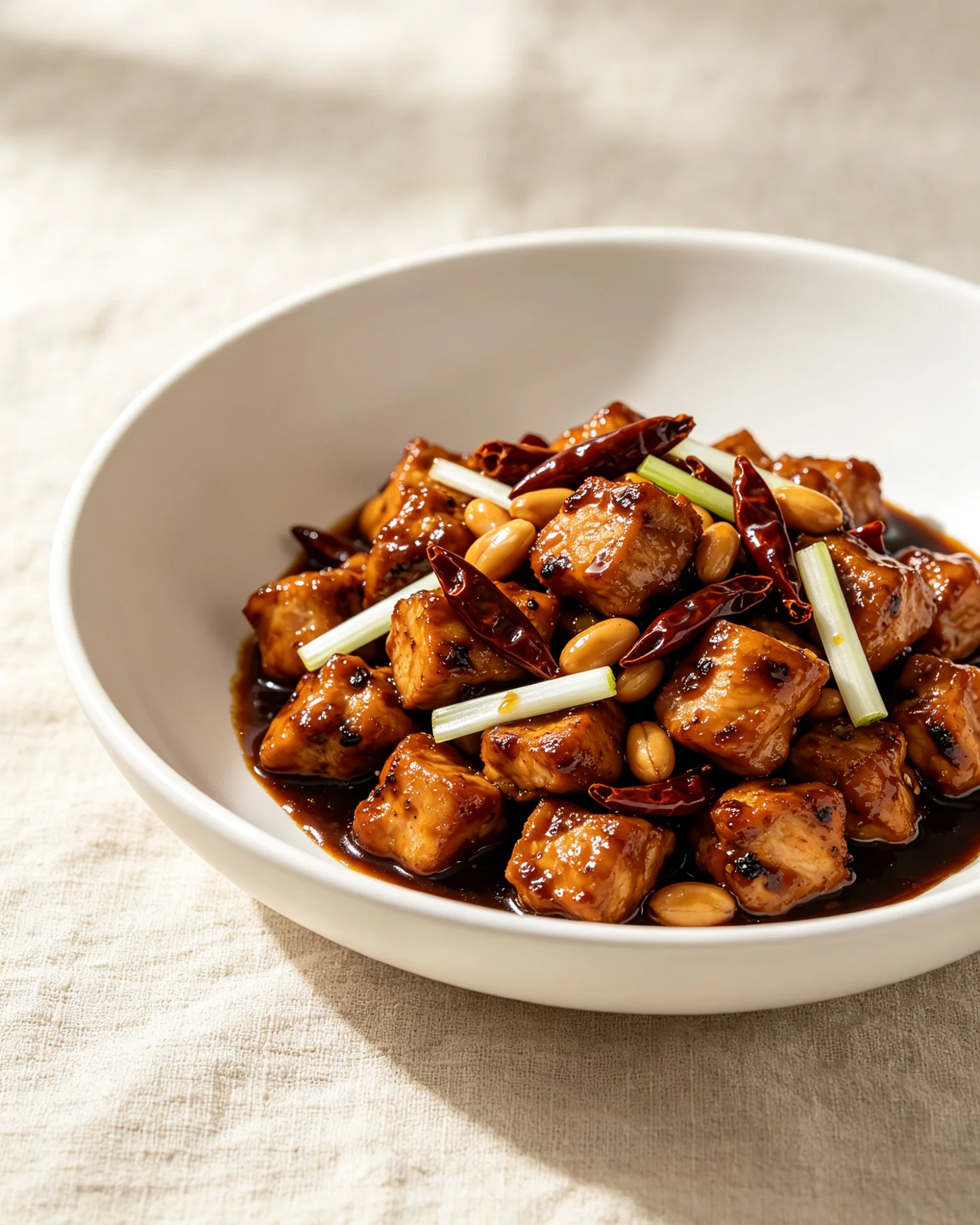
Kung Pao Chicken Recipe (Gong Bao Ji Ding)
Jump to Section
The first time I made kung pao at home, the dried chillies stayed bright red. I fried them for about 30 seconds in the oil, they looked vivid, and I moved on. The dish came out spicy but flat, the heat was there but the smoky, complex depth I expected was not. It tasted like chicken in chilli oil, not like the kung pao I had eaten at a proper Sichuan restaurant.
The problem was the oil was not hot enough and I did not fry the chillies long enough. Authentic kung pao uses a technique called hú là (糊辣), burnt chilli flavour. The dried chillies are flash-fried in very hot oil, around 190°C, until they darken to a brownish-red. Bright red means undercooked. Brownish-red means the Maillard reaction has converted the chilli’s sugars and proteins into pyrazines and furans, the same aromatic compounds that give roasted coffee its depth. The heat is still there. The smokiness is now there too.
What is kung pao chicken and what does the name mean?
Gong Bao Ji Ding (宫保鸡丁) translates directly: gong bao (宫保) was the honorary title of Ding Baozhen, a Qing dynasty governor of Sichuan Province who lived from 1820 to 1886. Ji ding (鸡丁) means chicken cubes, ding specifically refers to small cubes of a specific size. The name is both a dedication and a cooking instruction.
The dish was created in Ding Baozhen’s private kitchen, a combination of Sichuan flavours he apparently favoured, and spread through the province’s restaurant culture after his death. After 1949 it became one of the most widely eaten dishes in China, partly because its simple ingredients were accessible during periods of food scarcity, and partly because the combination of sweet, sour, spicy, and numbing is genuinely difficult to tire of. From China it spread globally, acquired a Western-adapted version with bell peppers and gloopy sauce, and became one of the most recognisable Chinese dishes in the world.
The Americanised version and the authentic version share a name and some ingredients. They are not the same dish.
What is hú là and why should the chillies be darkened?
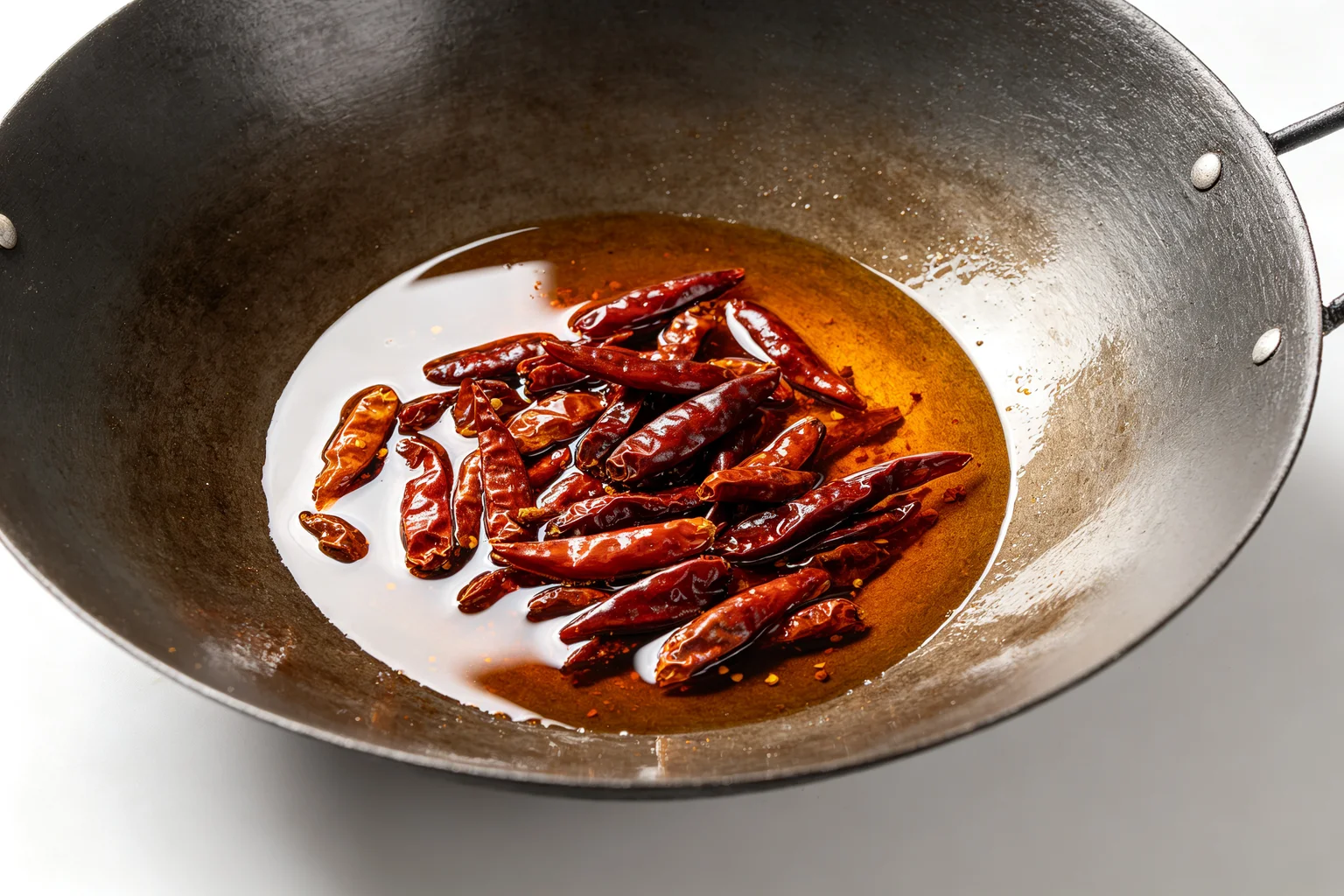
Hú là (糊辣) means paste-spicy or burnt-spicy, and it is the flavour principle that gives kung pao its distinctive smoky depth.
When dried chillies are flash-fried in oil at around 190°C, the heat drives a Maillard reaction in the natural sugars and proteins of the dried chilli. The same reaction that produces the complex aromatics of roasted coffee, toasted bread, and browned meat. The specific compounds produced, pyrazines, furans, and other heterocyclic molecules, create a smoky, slightly bitter fragrance that sits underneath the capsaicin heat and transforms the dish from simply spicy to complex.
The correct colour is brownish-red, not bright red. Bright red means the chilli fried at too low a temperature or for too short a time, the Maillard reaction has not begun and the flavour is just raw chilli heat. Brownish-red means the reaction is complete and the hú là character is there.
The window is narrow. Above 200°C or held too long, the chillies blacken and the Maillard compounds convert to acrolein and other bitter breakdown products. The smell shifts from fragrant and smoky to acrid. The batch is lost. The technique is: very hot oil, chillies in, 20-30 seconds of constant attention, out the moment they reach brownish-red.
What is the lychee flavour in kung pao chicken?
Most people think of kung pao as a spicy dish. That is the Americanised version. The authentic Sichuan version is primarily a sweet-sour dish with Sichuan spice in the background.
In classical Sichuan cooking, there are 23 recognised compound flavour profiles. One of them is lìzhī wèi (荔枝味), the lychee flavour. It is named after lychee fruit because the combined sensation, sweet, lightly sour, fragrant, resembles the fruit’s flavour balance rather than any of its ingredients. Kung pao chicken is one of the defining dishes of this profile.
The sauce achieves lìzhī wèi through balance: the sugar and the vinegar should both be clearly present and in rough equilibrium, with the soy sauce providing salt and the chilli-peppercorn mala arriving as a background layer rather than the foreground. When the sauce is correct, you taste sweetness and tartness simultaneously, and the heat arrives a beat later rather than leading.
This is what separates a proper kung pao from a dish that uses the same ingredients. If the sauce tastes primarily hot, the mala is too dominant. If it tastes primarily sweet, the vinegar needs more presence. The lychee flavour is a balance point, not a fixed formula.
Why does kung pao use Chinkiang black vinegar and can you substitute it?
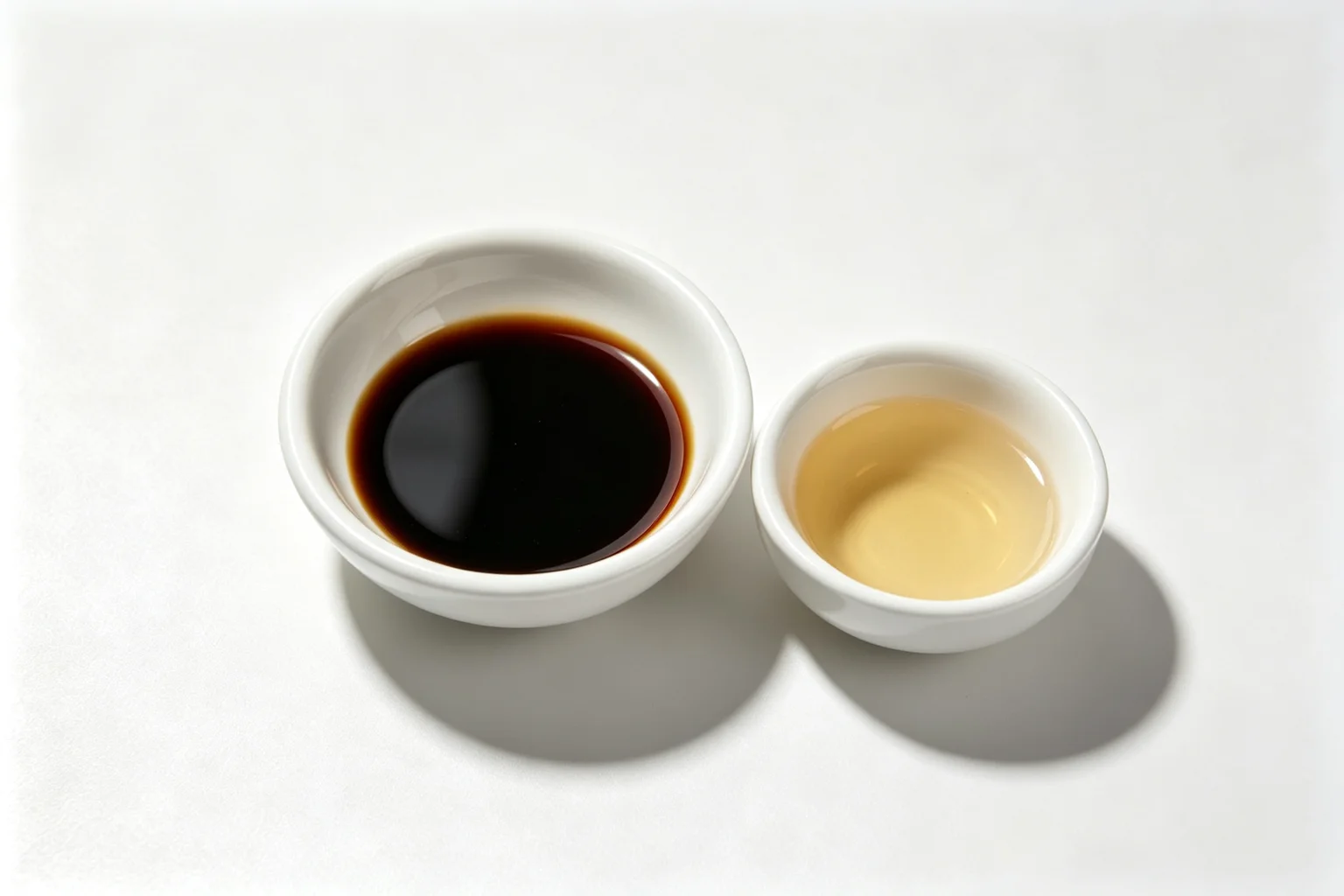
Chinkiang vinegar (镇江香醋), produced in Zhenjiang, Jiangsu Province, is not standard vinegar with colour added. It is made from glutinous rice, bran, and husks through an extended fermentation that produces three distinct components.
The first is acetic acid, the standard component of all vinegar, providing sharpness. The second is lactic acid from bacterial fermentation, which produces a softer, rounder sourness that acetic acid alone does not. The third is a significant concentration of free amino acids including glutamate, produced as the glutinous rice proteins break down during fermentation. That glutamate contribution gives Chinkiang a savoury depth, almost an umami presence, that no other vinegar produces.
White vinegar provides acidity without depth or roundness. The sauce tastes sharp and thin. Rice vinegar is closer but misses the lactic acid complexity and the glutamate. Balsamic vinegar used at half quantity is the closest Western substitute, sharing the complex fermentation profile though the specific character is still different.
Use Chinkiang. It is available at almost every Asian grocery store and online, and the difference in the finished sauce is significant.
Why are the chicken pieces 2cm and does the size matter?
Ji ding (鸡丁) means chicken cubes, and ding specifically refers to small cubes. The name contains the size instruction. 2cm per side is not arbitrary.
At 2cm, a chicken cube sears on the exterior in 45-60 seconds at wok heat and cooks through to the centre without the outside overcooking. Every face of the cube has surface area that can develop colour. In the brief final toss with the sauce, every surface picks up full glaze coating. The ratio of sauce to chicken per bite is correct.
At 3-4cm, the exterior sears correctly but the centre is still raw by the time the outside is done. Finishing it means overcooking the outside. At 1cm, the cube overcooks before it develops any colour, it just steams through. The 2cm size is the specific solution to the physical problem of cooking small pieces of chicken in a very hot wok for under 2 minutes.
Use chicken breast for this dish. The authentic version specifies breast, not thigh. Breast at 2cm cubes, properly velveted, produces a clean, slightly firm bite that contrasts with the crispy peanuts and the glossy sauce. Thigh is more forgiving but produces a richer, slightly fattier bite that changes the character of the dish.
What is the wǎn qiàn technique and why does it matter?
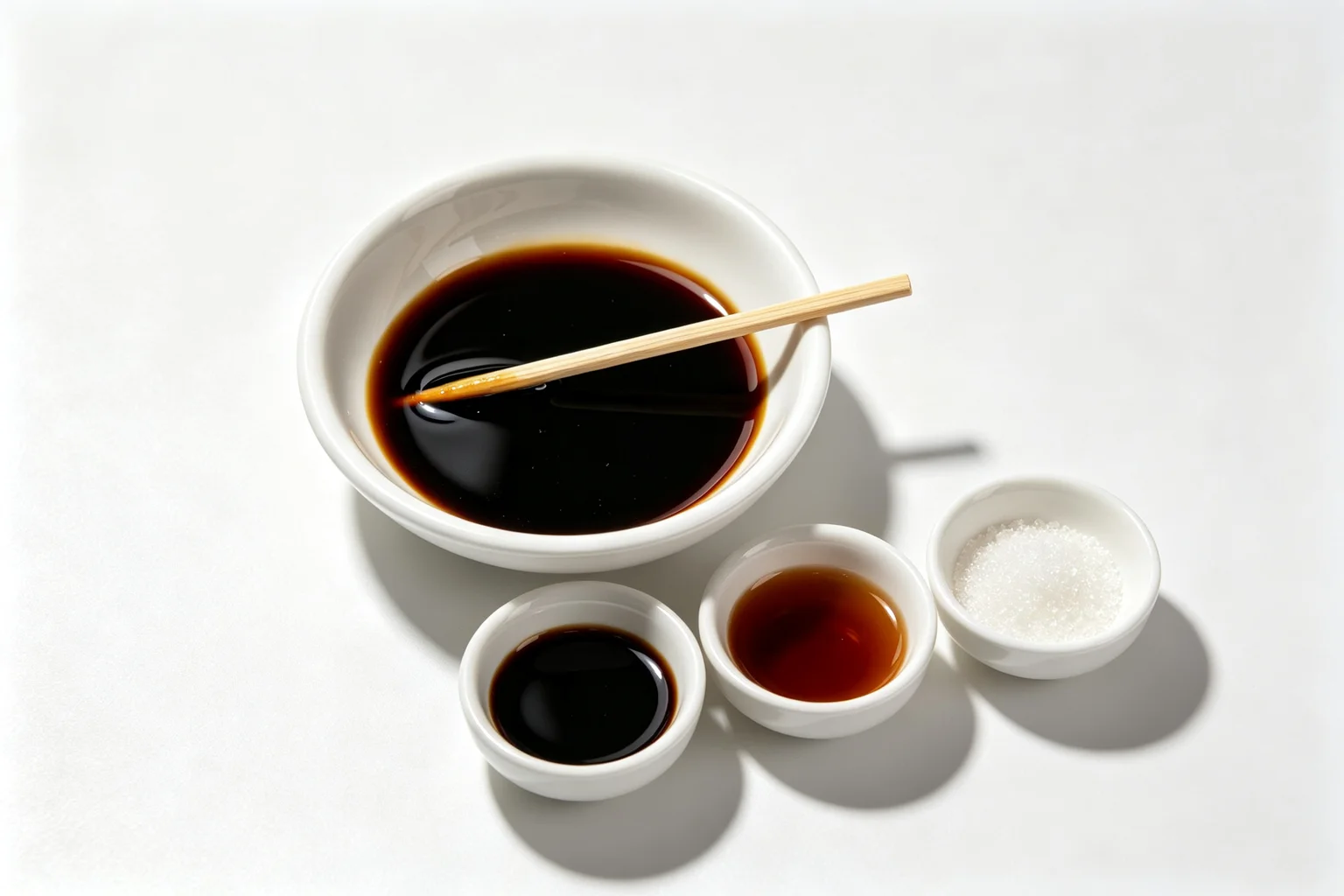
Wǎn qiàn (碗芡) means bowl sauce, mixing all the sauce ingredients in a small bowl in advance of cooking. It is a classical Chinese cooking technique and one of the most practical things you can do for any fast stir-fry.
The final stage of kung pao cooking takes approximately 60-90 seconds. At this point everything is in the wok: the seared chicken, the darkened chillies and peppercorns, the peanuts and scallion. Adding the sauce is a single motion, pour the bowl in, toss, watch it thicken, done.
Without wǎn qiàn: reaching for soy sauce, then vinegar, then sugar, then cornstarch slurry separately takes 30-60 seconds. During those seconds the wok temperature drops, the chicken continues cooking, and the dish loses the snap of high-heat cooking. The sauce ingredients do not integrate properly because they are added at different times to a wok that is losing heat.
Mix the sauce bowl first. Every time. It takes 2 minutes before you light the wok and it changes how the dish cooks.
Ingredients
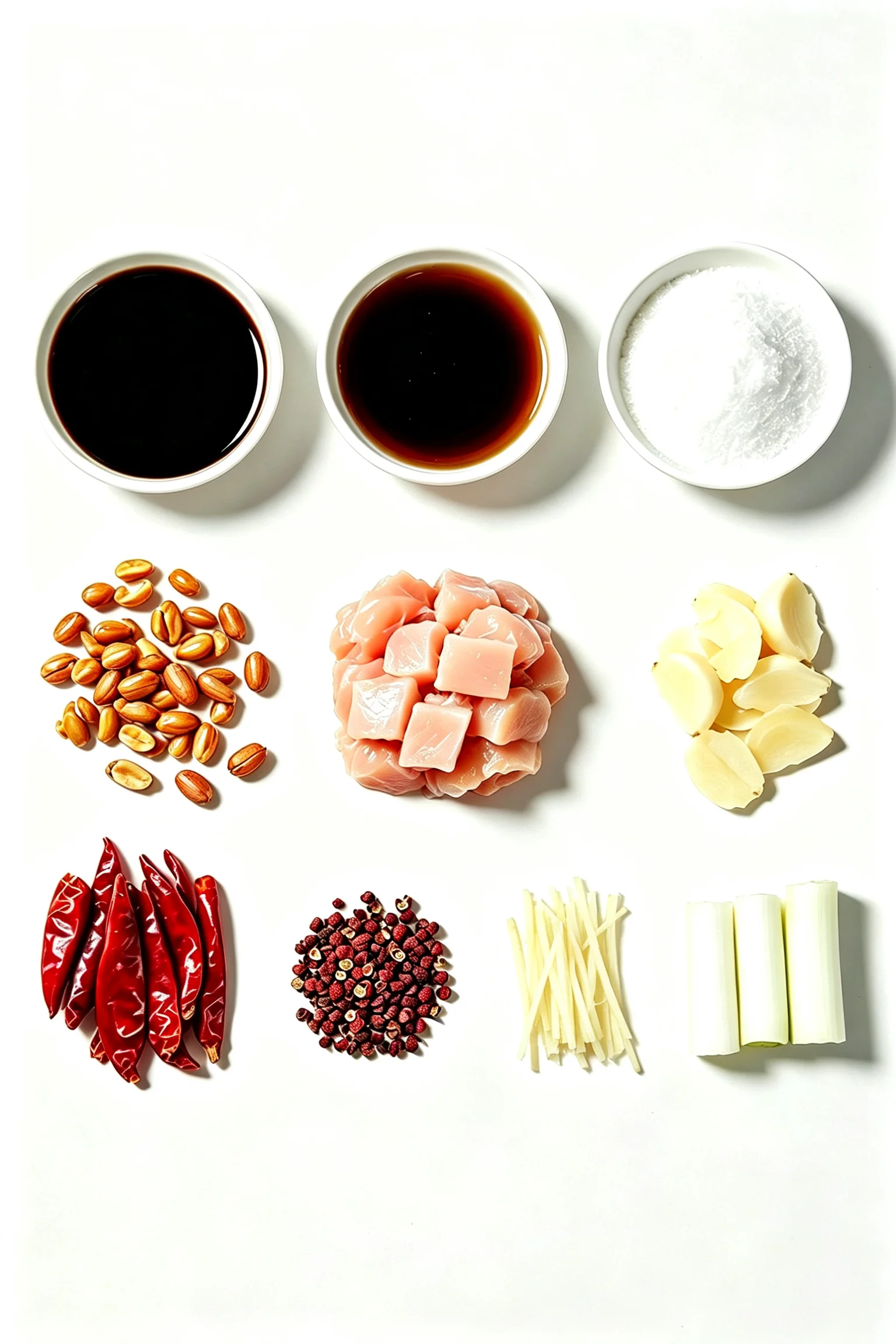
Serves 4
Chicken and velveting:
- 600g (1lb 5oz) boneless, skinless chicken breast, cut into 2cm cubes
- ¼ tsp baking soda
- 3 tbsp cold water
- 1 tbsp cornstarch
- 1 tbsp neutral oil
- 1 tsp light soy sauce
- 1 tsp Shaoxing wine
Wǎn qiàn sauce bowl (mix before cooking):
- 3 tbsp light soy sauce
- 2 tbsp Chinkiang black vinegar
- 1½ tbsp sugar
- 1 tsp dark soy sauce
- 1 tsp Shaoxing wine
- 1 tsp cornstarch
- 3 tbsp water or chicken stock
For cooking:
- 4 tbsp neutral oil, divided
- 12-15 dried red chillies, whole
- 1 tsp Sichuan peppercorns, toasted and ground
- 5 garlic cloves, thinly sliced
- 2cm fresh ginger, julienned
- 6 scallion whites, cut into 2cm pieces
- 80g roasted unsalted peanuts
Instructions
Toast and grind the Sichuan peppercorns first. Mix the sauce bowl. Velvet the chicken. Then light the wok.
Step 1: Velvet the chicken
Mix chicken cubes with baking soda and cold water. Leave 25 minutes at room temperature.
Step 2: Mix the wǎn qiàn
Combine all sauce ingredients in a small bowl. Stir until sugar and cornstarch dissolve completely.
Step 3: Sear the chicken in batches
Heat wok over maximum heat until smoking. Add 2 tablespoons oil.
Step 4: Hú là, flash-fry the chillies and peppercorns
Reduce to medium-high. Add remaining oil.
Add the ground Sichuan peppercorn. Toss 10 seconds.
Step 5: Aromatics
Add garlic, ginger, and scallion whites. Stir 20-30 seconds until fragrant.
Step 6: Combine and sauce
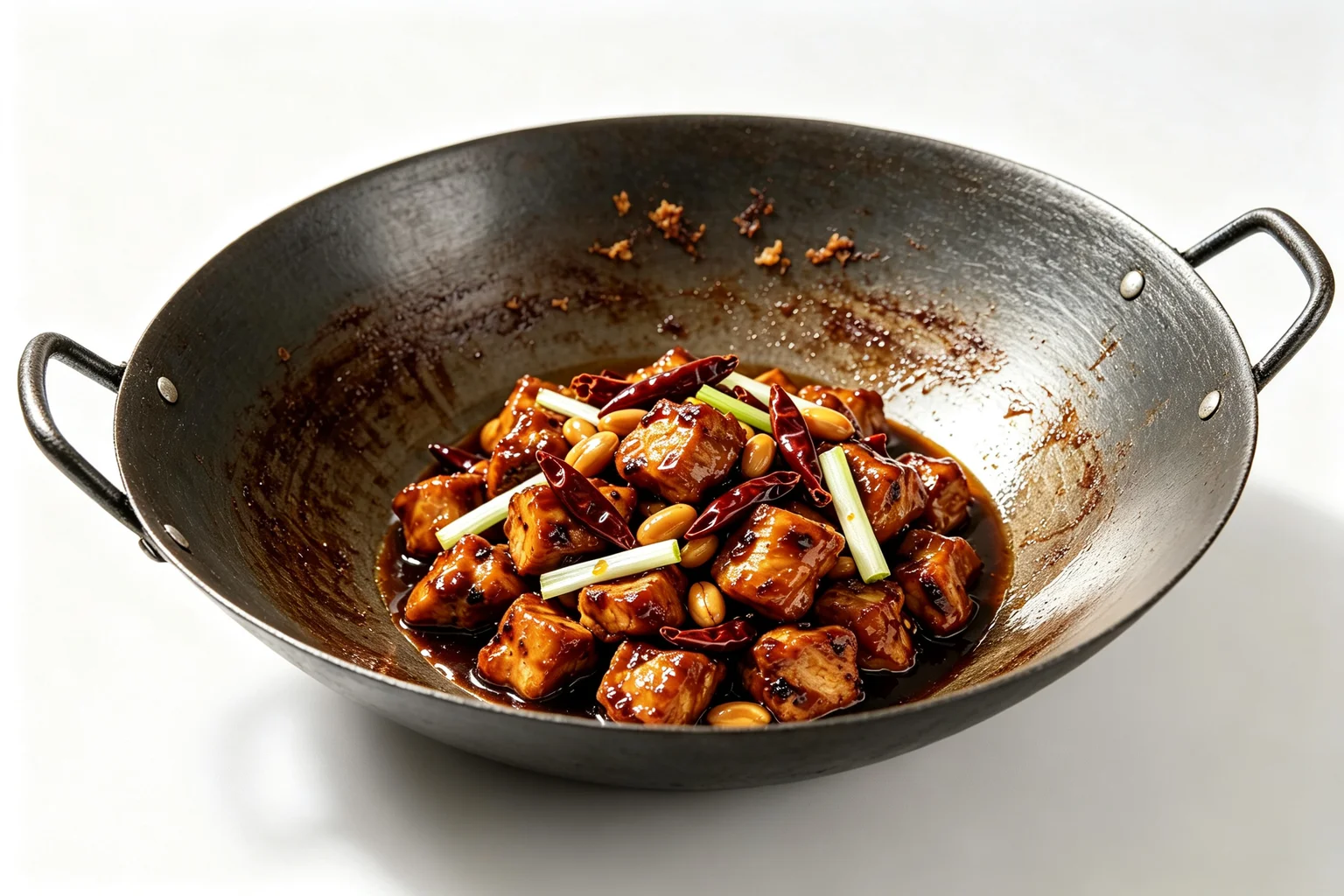
Return all the seared chicken to the wok. Add the peanuts.
Taste. The lychee flavour balance should be clear: sweet and sour simultaneously, with the mala arriving behind it. If it tastes primarily hot, the sweet-sour ratio needs adjustment. Serve immediately over steamed rice.
How is authentic kung pao chicken different from the takeout version?
The Americanised version adds vegetables, bell peppers, zucchini, broccoli, uses significantly more cornstarch for a thicker sauce, and keeps the chillies bright red rather than darkening them to hú là. The result is sweeter, heavier, and primarily spicy rather than sweet-sour-spicy.
Authentic Gong Bao Ji Ding has no added vegetables beyond the scallion whites. The sauce is lighter and glossier, not gloopy. The chillies are brownish-red and contribute smoky depth as well as heat. The lychee flavour balance is the point of the dish, not an afterthought.
Neither version is better in an absolute sense, they serve different expectations. If you grew up with the Americanised version and love it, that is a completely valid version to make. This recipe is the Sichuan original, which is a more complex and less immediately accessible dish. They are genuinely different eating experiences.
How do you store and reheat kung pao chicken?
Keeps in the refrigerator for 2 days. The sauce absorbs into the chicken overnight and the flavour deepens. The hú là smoky character fades slightly but the sweet-sour profile strengthens.
To reheat: add a small amount of oil to a very hot wok. Toss over high heat for 60-90 seconds. Add a small splash of water or chicken stock if the sauce has thickened too much overnight. The peanuts soften in storage, if texture matters, add freshly roasted peanuts when reheating. Do not microwave, it steams the chicken and produces a flat, watery sauce.
Love Chinese food?
Check out my complete guide to Chinese home cooking, pantry essentials, and techniques.
FAQ
What is the difference between kung pao chicken and General Tso’s chicken? Kung pao chicken is an authentic Sichuan dish with a defined history and a specific flavour profile, the lychee sweet-sour balance, hú là darkened chillies, Sichuan peppercorn numbing, and peanuts. General Tso’s chicken is a Chinese-American invention with no direct Chinese equivalent, deep-fried chicken in a sweet, slightly spicy, glossy sauce without the mala character or the lychee balance. They share some surface similarities but are structurally different dishes made with different techniques for different flavour outcomes.
Can I use rice vinegar instead of Chinkiang black vinegar? Rice vinegar works as a substitute but the sauce will taste simpler and slightly sharper. Chinkiang produces a softer, rounder sourness from its lactic acid content and has a savoury depth from amino acids that rice vinegar lacks. If substituting rice vinegar, reduce the quantity by about 25% since it is sharper, and add a small pinch of sugar to compensate for the missing roundness. Balsamic vinegar at half the quantity is a closer substitute in terms of complexity.
Why does my kung pao sauce taste flat? The lychee flavour balance is off. Flat usually means either the chillies were not darkened to hú là (smoky depth is missing), the vinegar ratio is too low (sweet is dominating without the sour counterbalance), or the Sichuan peppercorn quantity is too small (the mala background is absent). Start with the chillies, if they stayed bright red, the hú là is missing and no adjustment to the sauce will compensate for it.
Can I use cashews instead of peanuts? Yes. Cashews are a common substitute and produce a slightly sweeter, creamier result. Toast them in a dry pan first until golden, raw cashews are soft and do not provide the textural contrast that roasted peanuts do. The dish still reads as kung pao. Walnuts work similarly. Avoid almonds, the texture does not contrast well with the sauce.
You might also like: Check out our complete Chinese cooking guide for more essential ingredients and techniques.
Kung Pao Chicken Recipe (Gong Bao Ji Ding)
PT20M
PT15M
PT35M
Nutrition Facts
Ingredients
- 600g (1lb 5oz) boneless, skinless chicken breast, cut into 2cm cubes
- ¼ tsp baking soda
- 3 tbsp cold water
- 1 tbsp cornstarch
- 1 tbsp neutral oil
- 1 tsp light soy sauce
- 1 tsp Shaoxing wine
- 3 tbsp light soy sauce
- 2 tbsp Chinkiang black vinegar
- 1½ tbsp sugar
- 1 tsp dark soy sauce
- 1 tsp Shaoxing wine
- 1 tsp cornstarch
- 3 tbsp water or chicken stock
- 4 tbsp neutral oil, divided
- 12-15 dried red chillies, whole
- 1 tsp Sichuan peppercorns, toasted and ground
- 5 garlic cloves, thinly sliced
- 2cm fresh ginger, julienned
- 6 scallion whites, cut into 2cm pieces
- 80g roasted unsalted peanuts
Instructions
- *Toast and grind the Sichuan peppercorns first. Mix the sauce bowl. Velvet the chicken. Then light the wok.*
- Mix chicken cubes with baking soda and cold water. Leave 25 minutes at room temperature. Rinse under cold running water for 60-90 seconds until clear. Pat completely dry. Add cornstarch, oil, soy sauce, Shaoxing wine. Mix well. Leave 10 minutes.
- Combine all sauce ingredients in a small bowl. Stir until sugar and cornstarch dissolve completely. Set next to the wok within arm's reach.
- Heat wok over maximum heat until smoking. Add 2 tablespoons oil. Add half the chicken in a single layer. Leave 45-60 seconds until golden on the contact side. Flip. 30 seconds more. Remove. Wipe wok, reheat, repeat with second batch. Chicken should be just cooked through and golden, not fully done, it finishes in the sauce.
- Reduce to medium-high. Add remaining oil. When the oil reaches approximately 190°C (a dried chilli dropped in should sizzle immediately and vigorously), add the whole dried chillies. Fry 20-30 seconds, turning, until they darken to brownish-red and smell smoky-fragrant. Watch closely. The window between hú là and burnt is narrow. Add the ground Sichuan peppercorn. Toss 10 seconds.
- Add garlic, ginger, and scallion whites. Stir 20-30 seconds until fragrant.
- Return all the seared chicken to the wok. Add the peanuts. Pour the wǎn qiàn sauce bowl in one motion over everything. Toss quickly. The sauce thickens in 20-30 seconds as the cornstarch gelatinises and the vinegar and sugar caramelise against the hot wok surface. Every piece should be coated in a glossy, dark sauce. Taste. The lychee flavour balance should be clear: sweet and sour simultaneously, with the mala arriving behind it. If it tastes primarily hot, the sweet-sour ratio needs adjustment. Serve immediately over steamed rice. ## How is authentic kung pao chicken different from the takeout version? The Americanised version adds vegetables, bell peppers, zucchini, broccoli, uses significantly more cornstarch for a thicker sauce, and keeps the chillies bright red rather than darkening them to hú là. The result is sweeter, heavier, and primarily spicy rather than sweet-sour-spicy. Authentic Gong Bao Ji Ding has no added vegetables beyond the scallion whites. The sauce is lighter and glossier, not gloopy. The chillies are brownish-red and contribute smoky depth as well as heat. The lychee flavour balance is the point of the dish, not an afterthought. Neither version is better in an absolute sense, they serve different expectations. If you grew up with the Americanised version and love it, that is a completely valid version to make. This recipe is the Sichuan original, which is a more complex and less immediately accessible dish. They are genuinely different eating experiences. ## How do you store and reheat kung pao chicken? Keeps in the refrigerator for 2 days. The sauce absorbs into the chicken overnight and the flavour deepens. The hú là smoky character fades slightly but the sweet-sour profile strengthens. To reheat: add a small amount of oil to a very hot wok. Toss over high heat for 60-90 seconds. Add a small splash of water or chicken stock if the sauce has thickened too much overnight. The peanuts soften in storage, if texture matters, add freshly roasted peanuts when reheating. Do not microwave, it steams the chicken and produces a flat, watery sauce.
Did you make this recipe?
Tag @asianfoodsdaily on Instagram or leave a comment below!
Testing Notes
Tested in Asha's kitchen. Last reviewed April 16, 2025.
Ingredient Substitutions
Substitution notes coming soon.
About Asha
Half Asian, half African cook raised between two food-obsessed cultures. I've spent 10 years learning Asian cooking traditions through family, friends, and thousands of hours at the stove — testing every dish until it works in a standard home kitchen.
Read my full storyRelated Recipes
More delicious dishes you might enjoy


Loading comments...