Pork and Shrimp Siu Mai Recipe (烧卖)
Jump to Section
The first batch I made at home had a soft, slightly crumbly filling that fell apart when bitten. Not bad. Just not what I expected from a dish defined by its springy, almost elastic resistance. I had mixed everything together until combined and moved on to shaping. What I had not done was mix in one direction consistently, or slam the filling against the bowl, or refrigerate it before shaping. Those three steps are not optional extra effort. They are where the texture is built.
Siu mai filling gets its springy character from myosin, the same structural protein that makes velveted beef tender in a stir fry. In this dish, you are doing the opposite: you are developing the myosin network as far as possible rather than breaking it down. Directional mixing aligns the protein fibres in parallel. Slamming compresses and densifies the network. Refrigerating firms the fat and sets the structure before the dumplings are shaped. The steaming is the easy part. The filling is where all the work happens.
What is siu mai and what makes the Cantonese version different?
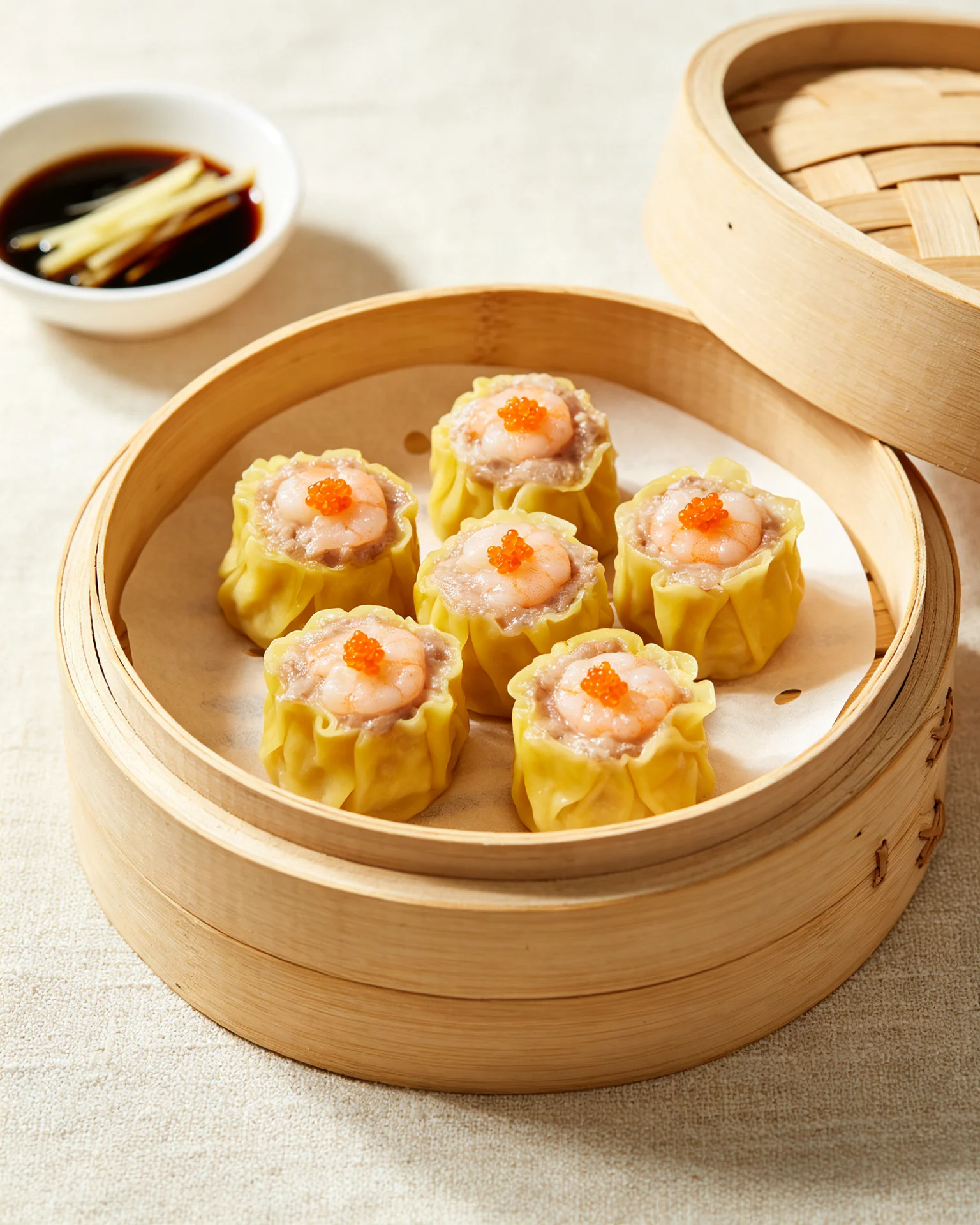
Siu mai (烧卖, shāo mài in Mandarin, siu mai in Cantonese) is an open-topped steamed dumpling, one of the most recognisable dishes at any dim sum table. The filling sits exposed at the top rather than sealed inside, which is part of what makes it visually distinctive: the yellow wrapper gathers around the filling like a cup, and the top shows the pork, the chunks of shrimp, and usually a small orange garnish of roe or carrot.
The Cantonese version, the one served at dim sum restaurants across Hong Kong, Guangdong, Singapore, and wherever Cantonese immigrants settled, is defined by a specific texture called qing (靚). The word means beautiful or excellent in Cantonese, but applied to dim sum filling it describes something more specific: springy, bouncy, elastic. A siu mai with qing filling has resistance when bitten and then releases cleanly. A siu mai without it is soft and slightly loose, cooked correctly but missing the defining character.
This is different from Japanese shumai, which uses pork and onion and is topped with a green pea. Japanese shumai has a softer texture and a milder flavour. Filipino siomai is the adapted version with water chestnuts, carrots, and sometimes prawns, chunkier and less focused on the springy texture that defines the Cantonese original.
What is qing texture and how do you develop it in the filling?
Qing is produced through three sequential steps: directional mixing, slamming, and refrigerating. Each step builds on the previous one.
Ground pork contains myosin, a structural protein that forms elastic networks when worked mechanically. When you stir the pork filling in one consistent direction for 5-7 minutes, the myosin filaments begin to orient in parallel alignment, like threads being combed in the same direction. This parallel arrangement produces a stronger, more elastic network than randomly oriented myosin.
Switching directions while mixing breaks the alignment as it forms. The myosin filaments that were beginning to orient together get disrupted and must start re-aligning from the beginning. Five minutes of mixed-direction stirring produces a looser result than three minutes of consistent one-direction stirring.
After mixing, slamming, picking up the filling mass and throwing it firmly against the bowl, forces out air pockets distributed through the network and compresses the myosin fibres more tightly together. Each slam makes the filling denser and more cohesive. Ten to fifteen slams is standard. The filling should feel noticeably different after slamming than before: denser, more cohesive, with a slight spring when pressed.
Refrigerating for 30 minutes after mixing and slamming allows the fat in the pork to firm. Cold fat holds the filling’s shape during portioning and prevents the filling from spreading across the wrapper before the dumpling is shaped.
Why do you stir in one direction only?
The reason is protein fibre orientation.
Myosin molecules are long filaments. In ground raw pork they are distributed randomly in every direction. When you apply mechanical force by stirring, these filaments can be encouraged to align. Consistent movement in one direction, always clockwise, or always counter-clockwise, causes the filaments to orient progressively more parallel with each pass of the spatula or chopstick.
Parallel-oriented myosin forms bonds with adjacent parallel filaments, creating a dense, interconnected network. This network is what produces the elastic quality in the cooked filling, when you bite through it, the network stretches slightly before releasing, producing the springy sensation.
Random-direction stirring creates a tangled, less ordered network. The myosin bonds that form are shorter and less aligned. The cooked filling is softer and breaks apart more readily when bitten.
The visual check for correct development: after 5-7 minutes of one-direction stirring, the filling should pull away from the bowl sides in a clean sheet rather than in sticky bits. It should have a slightly glossy, almost paste-like appearance. At that point the network is developed enough to proceed to slamming.
What does slamming the filling do?
After directional mixing, the filling contains air pockets distributed throughout the protein network. These air pockets expand during steaming as the trapped air heats, creating small voids in the cooked filling that produce a loose, slightly spongy texture.
Slamming removes them. Pick up the filling mass with one hand and throw it firmly against the bowl. The impact forces the air pockets out through the surface of the filling and further compresses the myosin network. Repeat 10-15 times. Between slams, use a spatula to scrape the filling back into a compact mass.
After the final slam, the filling should feel noticeably denser. Press a finger into it, it should spring back rather than leaving a lasting indentation. That spring is the qing developing.
Transfer the filling to a covered container and refrigerate for at least 30 minutes. The cold does two things: it firms the pork fat, which holds the filling’s shape during portioning; and it allows the myosin network to relax slightly from the mechanical stress of mixing and slamming, which produces a more even texture in the finished dumpling.
Why is the shrimp left in chunks and not minced?
Siu mai filling is ground pork with shrimp added as a secondary component. If the shrimp is minced to the same particle size as the pork, the two proteins cook to similar textures and the filling becomes uniform throughout. This is technically correct but misses the point.
Keeping the shrimp in rough chunks of approximately 1cm produces visible pockets of different texture inside the filling. When bitten, each chunk delivers a burst of the shrimp’s natural sweetness and a slightly firmer, more elastic chew that is distinctly different from the pork surrounding it. This contrast is the defining sensory experience of properly made Cantonese siu mai. The shrimp is not just flavour, it is texture and structure.
Rough-chop the shrimp with a knife rather than processing it, about 3-4 cuts per shrimp. Some pieces will be larger, some smaller. That variation is correct. A perfectly uniform chop produces a more homogeneous texture than the original.
Why are siu mai wrappers yellow and what is lye water?
The yellow colour of Cantonese siu mai wrappers is not food colouring and not egg yolk, it comes from lye water (枧水, jiǎn shuǐ), an alkaline solution of potassium carbonate and sodium bicarbonate used in Cantonese noodle and dumpling making.
Lye water is highly alkaline at pH 10-12. When added to wheat flour dough, the alkaline environment causes the gluten proteins to cross-link differently than they do in neutral dough. The bonds that form in alkaline conditions produce a more extensible, springier dough, one that stretches before tearing rather than tearing immediately under tension. The wrapper contributes its own qing character: the slight spring and chew of a well-made siu mai wrapper comes partly from the lye water, not just from the filling.
The yellow colour is a natural side effect of the alkaline environment. Wheat flour contains flavonoid compounds called flavones that are naturally off-white but turn yellow when exposed to alkaline conditions. This is the same reaction that turns alkaline ramen noodles yellow.
Pre-made Hong Kong style round wrappers (sold in Chinese or Asian grocery stores, refrigerated section, thin, yellow, slightly translucent) already contain lye water. Buying the correct wrapper is the only action required. Do not substitute with regular dumpling wrappers or wonton wrappers, they are made with neutral dough and will be softer and stickier after steaming.
Ingredients
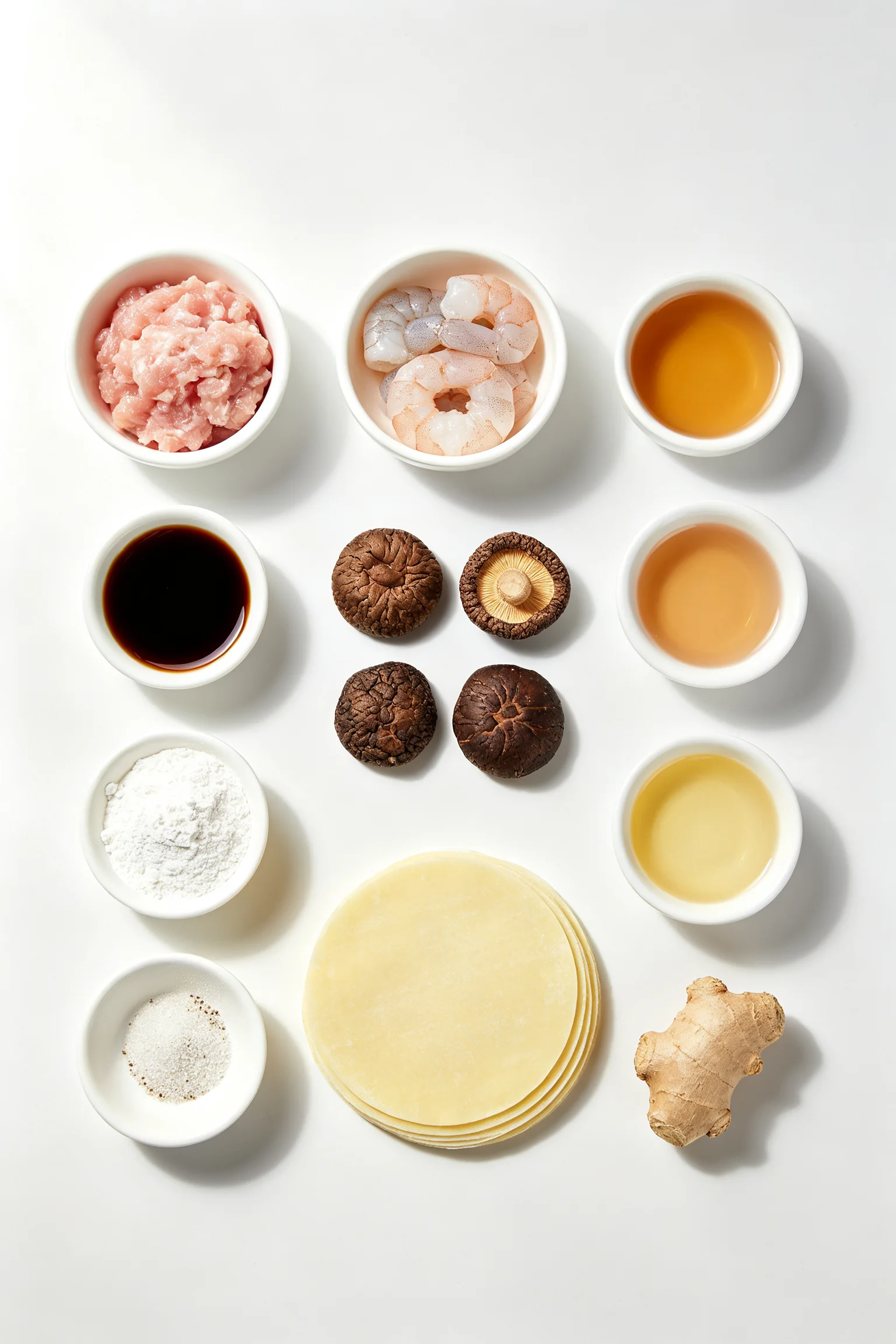
Makes 24 pieces
Filling:
- 300g (10.5oz) ground pork, 80/20 lean to fat
- 150g (5oz) raw shrimp, peeled and deveined, rough-chopped into 1cm pieces
- 4 dried shiitake mushrooms, soaked 30 min, squeezed dry, finely diced
- 2 tbsp ice-cold water (added gradually during mixing)
- 1 tbsp oyster sauce
- 1 tbsp light soy sauce
- 1 tsp Shaoxing wine
- 1 tsp sesame oil
- 1 tsp sugar
- ½ tsp white pepper
- ½ tsp salt
- 1 tbsp cornstarch
- 2cm fresh ginger, finely grated
For assembly:
- 24 Hong Kong style round dumpling wrappers (thin, yellow, lye water type)
- Small bowl of cold water for sealing
Garnish:
- Flying fish roe (tobiko), orange or red, placed on top of each dumpling
- Or: finely diced carrot, briefly blanched
Dipping sauce:
- 2 tbsp light soy sauce
- 1 tbsp Chinese black vinegar (Chinkiang)
- 1 tsp sesame oil
- 2cm fresh ginger, julienned
- Chilli oil to taste
Instructions
The filling requires 30 minutes refrigeration before shaping. Start the filling first.
Step 1: Prepare and mix the filling
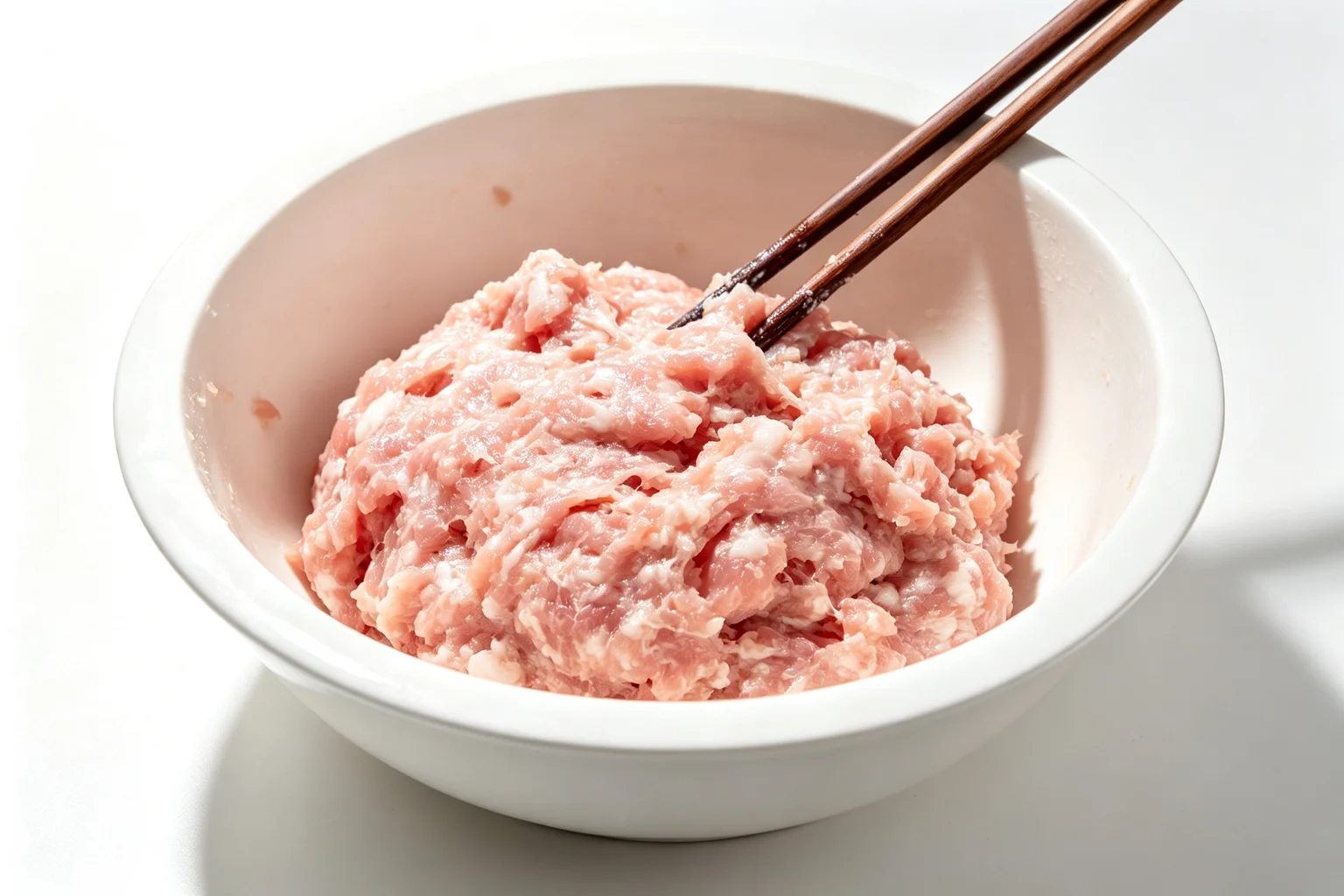
Combine ground pork, oyster sauce, light soy sauce, Shaoxing wine, sesame oil, sugar, white pepper, salt, cornstarch, and grated ginger in a large bowl. Begin stirring in one direction only, always clockwise, or always counter-clockwise. Do not switch direction.
Stir consistently for 5-7 minutes. Add the ice-cold water one tablespoon at a time after 2-3 minutes, waiting for each addition to be fully absorbed before adding the next. Continue stirring in the same direction until the filling pulls away from the bowl sides cleanly and looks slightly glossy.
Add the diced shiitake mushrooms and the rough-chopped shrimp. Fold in gently, distributing evenly without vigorous stirring so the shrimp pieces don’t break down.
Step 2: Slam the filling
Pick up the filling mass and throw it firmly against the bowl. Scrape back into a compact pile and repeat 10-15 times. Cover and refrigerate for 30 minutes minimum once the filling feels denser and springs back when pressed.
Step 3: Prepare the wrappers
Remove wrappers from packaging. Keep covered under a slightly damp kitchen towel while working, as the thin wrappers dry and become brittle quickly in open air.
Step 4: Shape the siu mai
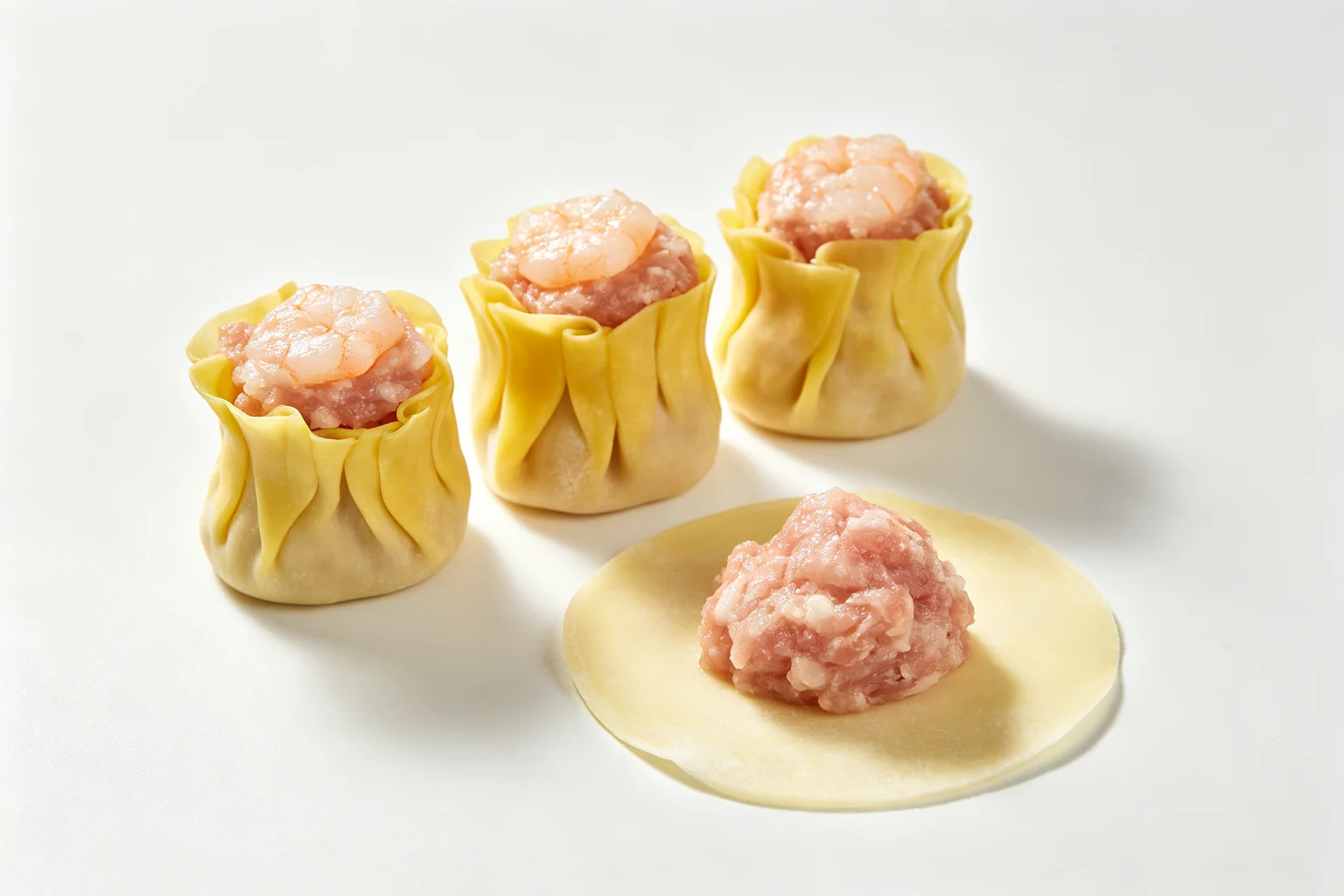
Hold one wrapper flat in your non-dominant hand and place approximately 1.5-2 tablespoons of cold filling in the centre. Use a butter knife or small spoon to mound the filling slightly above the wrapper level.
Bring the wrapper up around the filling, gathering the edges into pleats as you go. Use your thumb and index finger to form a ring and gently squeeze the middle of the dumpling to give it its characteristic cylindrical shape. Press the flat base against the counter lightly to flatten the bottom.
Use a small spoon to tap the filling surface flat and smooth. Top with a small amount of flying fish roe or diced carrot.
Step 5: Steam
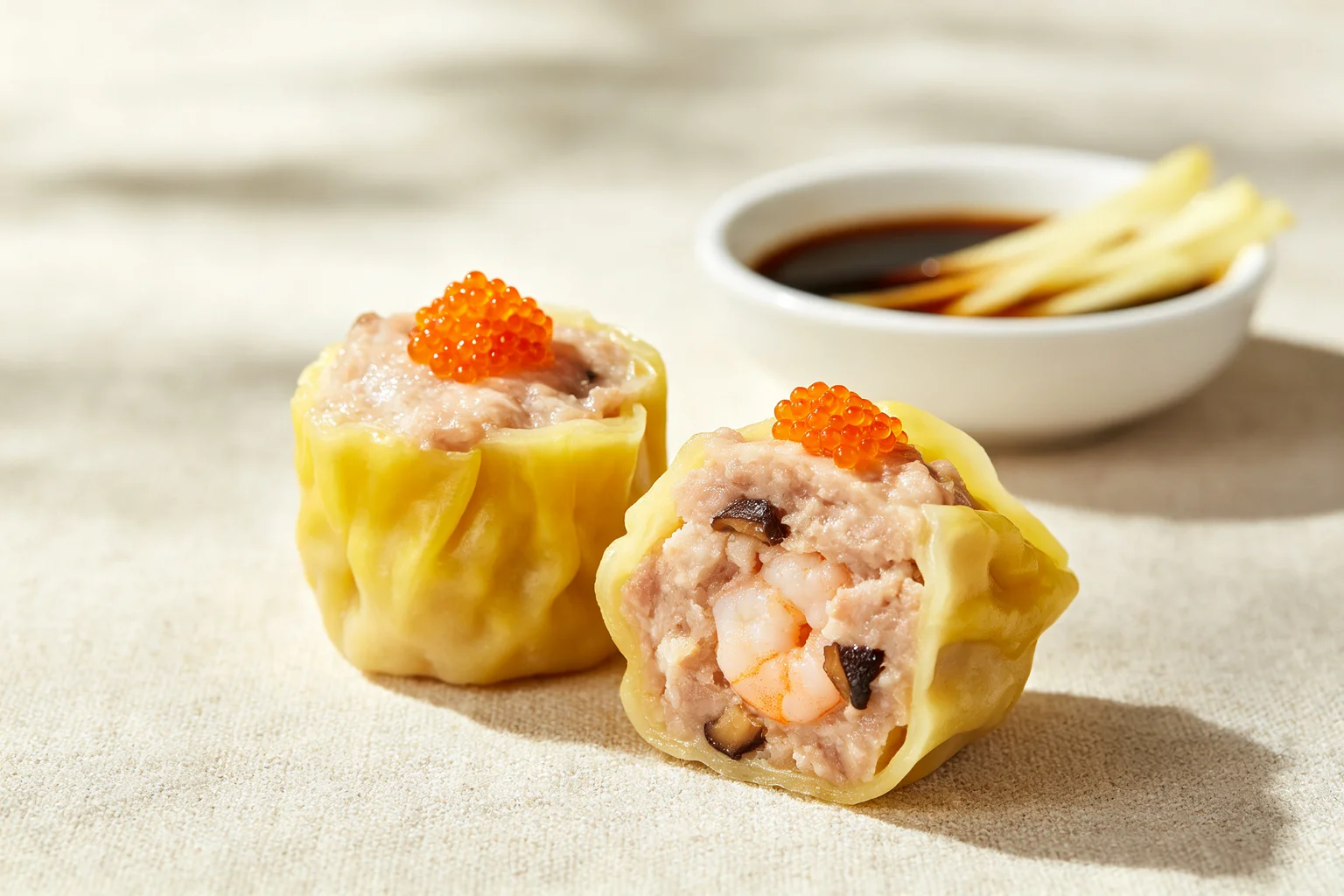
Line a bamboo steamer basket with parchment paper or perforated baking paper. Place siu mai at least 2cm apart to allow for expansion.
Bring water in the steamer base to a full rolling boil before placing the basket over it. Cover and steam over high heat for 8-10 minutes until wrappers are slightly translucent and filling is firm. Serve immediately with the dipping sauce alongside.
How do you freeze and cook siu mai from frozen?
Freeze before steaming, not after. Shaped uncooked siu mai freeze significantly better than cooked ones, the filling texture is preserved and the wrapper does not become waterlogged.
Place shaped uncooked siu mai on a parchment-lined tray with pieces not touching. Freeze 2-3 hours until completely solid. Transfer to a freezer bag. Frozen solid pieces do not stick together. They keep for up to 3 months.
To cook from frozen: place directly in the bamboo steamer without thawing. Steam over a full rolling boil for 12-14 minutes rather than 8-10. The extra 4 minutes accounts for the time needed to defrost the filling before it can cook through. Do not thaw before steaming, condensation from thawing makes the wrapper wet and it loses its characteristic slightly firm texture.
Love Chinese food?
Check out my complete guide to Chinese home cooking, pantry essentials, and techniques.
FAQ
What are the best wrappers for siu mai? Hong Kong style round dumpling wrappers, thin, yellow, slightly translucent, made with lye water. Sold refrigerated at Chinese and Asian grocery stores. Spring Home and Double Happiness are widely available brands. Do not substitute with regular dumpling wrappers (thicker, neutral dough, white) or gyoza wrappers (also neutral dough, thicker edge). The lye water in Hong Kong style wrappers produces a springier texture that complements the qing filling. Regular wrappers become soft and slightly sticky after steaming.
Why is my siu mai filling soft and crumbly instead of springy? The myosin network was not fully developed. Three causes: the filling was not stirred long enough in one direction (needs 5-7 minutes minimum), the direction was switched during mixing which disrupts fibre alignment, or the slamming step was skipped. All three contribute to qing texture development. The filling also needs 30 minutes refrigeration after mixing, unrefrigerated filling is too soft to hold its shape during the vigorous shaping and the pork fat has not had time to firm.
Can I make siu mai without a bamboo steamer? Yes. Any steaming setup works, a metal steamer basket, a heatproof plate elevated on a trivet inside a wok with a lid, or an Instant Pot on the steam setting. The critical requirement is that the water is at a full rolling boil before the dumplings go in and the lid seals completely. A loose lid lets steam escape and the filling at the top of each dumpling cooks slower than the bottom. The bamboo basket is preferred because the wood absorbs excess condensation and prevents water droplets from falling onto the dumplings.
What is the orange topping on dim sum siu mai? Flying fish roe (tobiko), typically orange or red, placed on the top of each siu mai as garnish. It adds a mild briny flavour and a visual colour contrast against the yellow wrapper. It is traditional at Cantonese dim sum restaurants but not required for the flavour of the dumpling. Finely diced and briefly blanched carrot is the common home substitute, it provides the same orange colour spot without requiring a specialty ingredient.
You might also like: Check out our complete Chinese cooking guide for more essential ingredients and techniques.
Pork and Shrimp Siu Mai Recipe (烧卖)
PT45M (includes 30 min filling refrigeration)
PT10M
PT55M
Nutrition Facts
Ingredients
- 300g (10.5oz) ground pork, 80/20 lean to fat
- 150g (5oz) raw shrimp, peeled and deveined, rough-chopped into 1cm pieces
- 4 dried shiitake mushrooms, soaked 30 min, squeezed dry, finely diced
- 2 tbsp ice-cold water (added gradually during mixing)
- 1 tbsp oyster sauce
- 1 tbsp light soy sauce
- 1 tsp Shaoxing wine
- 1 tsp sesame oil
- 1 tsp sugar
- ½ tsp white pepper
- ½ tsp salt
- 1 tbsp cornstarch
- 2cm fresh ginger, finely grated
- 24 Hong Kong style round dumpling wrappers (thin, yellow, lye water type)
- Small bowl of cold water for sealing
- Flying fish roe (tobiko), orange or red, placed on top of each dumpling
- Or: finely diced carrot, briefly blanched
- 2 tbsp light soy sauce
- 1 tbsp Chinese black vinegar (Chinkiang)
- 1 tsp sesame oil
- 2cm fresh ginger, julienned
- Chilli oil to taste
Instructions
- *The filling requires 30 minutes refrigeration before shaping. Start the filling first.*
- Combine ground pork, oyster sauce, light soy sauce, Shaoxing wine, sesame oil, sugar, white pepper, salt, cornstarch, and grated ginger in a large bowl. Begin stirring in one direction only, always clockwise, or always counter-clockwise. Do not switch direction. Stir consistently for 5-7 minutes. Add the ice-cold water one tablespoon at a time after 2-3 minutes, waiting for each addition to be fully absorbed before adding the next. Continue stirring in the same direction until the filling pulls away from the bowl sides cleanly and looks slightly glossy. Add the diced shiitake mushrooms and the rough-chopped shrimp. Fold in gently, distributing evenly without vigorous stirring so the shrimp pieces don't break down.
- Pick up the filling mass and throw it firmly against the bowl. Scrape back into a compact pile and repeat 10-15 times. Cover and refrigerate for 30 minutes minimum once the filling feels denser and springs back when pressed.
- Remove wrappers from packaging. Keep covered under a slightly damp kitchen towel while working, as the thin wrappers dry and become brittle quickly in open air.
- Hold one wrapper flat in your non-dominant hand and place approximately 1.5-2 tablespoons of cold filling in the centre. Use a butter knife or small spoon to mound the filling slightly above the wrapper level. Bring the wrapper up around the filling, gathering the edges into pleats as you go. Use your thumb and index finger to form a ring and gently squeeze the middle of the dumpling to give it its characteristic cylindrical shape. Press the flat base against the counter lightly to flatten the bottom. Use a small spoon to tap the filling surface flat and smooth. Top with a small amount of flying fish roe or diced carrot.
- Line a bamboo steamer basket with parchment paper or perforated baking paper. Place siu mai at least 2cm apart to allow for expansion. Bring water in the steamer base to a full rolling boil before placing the basket over it. Cover and steam over high heat for 8-10 minutes until wrappers are slightly translucent and filling is firm. Serve immediately with the dipping sauce alongside. ## How do you freeze and cook siu mai from frozen? Freeze before steaming, not after. Shaped uncooked siu mai freeze significantly better than cooked ones, the filling texture is preserved and the wrapper does not become waterlogged. Place shaped uncooked siu mai on a parchment-lined tray with pieces not touching. Freeze 2-3 hours until completely solid. Transfer to a freezer bag. Frozen solid pieces do not stick together. They keep for up to 3 months. To cook from frozen: place directly in the bamboo steamer without thawing. Steam over a full rolling boil for 12-14 minutes rather than 8-10. The extra 4 minutes accounts for the time needed to defrost the filling before it can cook through. Do not thaw before steaming, condensation from thawing makes the wrapper wet and it loses its characteristic slightly firm texture.
Did you make this recipe?
Tag @asianfoodsdaily on Instagram or leave a comment below!
Testing Notes
Tested in Asha's kitchen. Last reviewed July 28, 2025.
Ingredient Substitutions
Substitution notes coming soon.
About Asha
Half Asian, half African cook raised between two food-obsessed cultures. I've spent 10 years learning Asian cooking traditions through family, friends, and thousands of hours at the stove — testing every dish until it works in a standard home kitchen.
Read my full storyRelated Recipes
More delicious dishes you might enjoy


Loading comments...