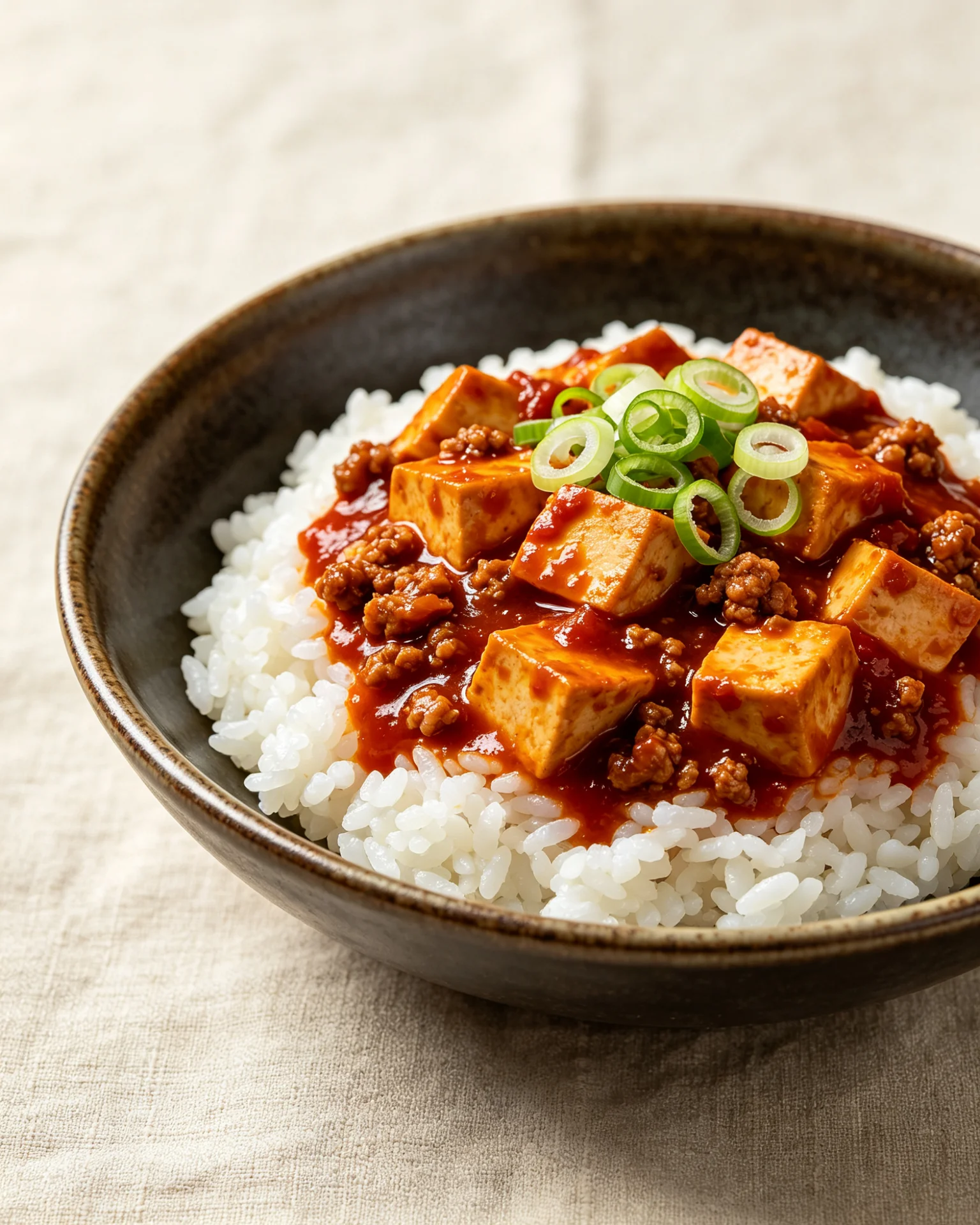
Mapo Tofu Recipe (麻婆豆腐)
Jump to Section
The first time I made mapo tofu at home, the sauce broke. The oil separated from the stock and floated on top of the dish in visible orange pools. The tofu was correct, the doubanjiang was correct, the Sichuan peppercorn was correct. But instead of the glossy, unified, brick-red sauce that coats every cube in a proper mapo tofu, I had oily broth with tofu sitting in it. I could not figure out what had gone wrong.
The problem was that I had added the cornstarch slurry all at once, too late, at too high a temperature. Mapo tofu sauce is an oil-water emulsion, the chilli oil and rendered meat fat on one side, the chicken stock and tofu water on the other. These two phases naturally want to separate. Cornstarch gelatinises at 62-70°C and the gelatinised starch acts as the emulsifier that holds the oil and water together. One large addition at the wrong temperature breaks the emulsion rather than building it. Three smaller additions at 30-second intervals, added while the sauce is at a controlled simmer, build the emulsion progressively and produce the glossy, stable coating that mapo tofu should have.
What is mapo tofu and where does the name come from?
Mapo tofu (麻婆豆腐, má pó dòu fu) is named after a real person. In the Qing dynasty, a woman in Chengdu known as Chen Mapo ran a small restaurant near the north gate of the city. Pó means old woman or grandmother. Má means pockmarked, she reportedly had a pockmarked face, and the name stuck to the dish she was famous for. The dish has been documented from approximately the 1860s.
The má in the name also refers to the numbing sensation from Sichuan peppercorn, the same character, different meaning in context. So the dish’s name contains two things simultaneously: the woman who created it and the defining sensory experience of eating it. That is an unusual piece of culinary etymology.
The dish is silken tofu in a spiced doubanjiang-based sauce with ground pork or beef, fermented black beans, and Sichuan peppercorn. It is one of the defining dishes of Sichuan cuisine and one of the most widely adapted Chinese dishes in the world, the Japanese version, Korean version, and various Western adaptations all share the same name and basic structure while producing noticeably different results.
Why does mapo tofu use silken tofu and not firm?
This is the most debated ingredient question in mapo tofu and the answer involves the sauce mechanism.
Silken tofu contains approximately 90% water by weight. Firm tofu contains approximately 80%, extra-firm approximately 70%. During cooking in the hot sauce, the water in silken tofu releases gradually into the surrounding liquid. This released water is what the cornstarch emulsifies with the chilli oil to produce the glossy, thick coating that defines properly made mapo tofu.
Without sufficient water from the tofu, the cornstarch has insufficient liquid to emulsify properly. The sauce stays thin or the oil separates. Firm tofu releases less water, which produces a structurally different sauce, thinner, less glossy, with the oil more likely to separate. This is why restaurants and traditional recipes specify soft or silken tofu.
The counterargument, that silken tofu crumbles, is valid but solved by the brine soak, which is covered in the next section. The textural contrast between the barely-holding-together silken cubes and the crispy fried meat is part of what makes the dish what it is. Firm tofu cubes that hold their shape produce a different eating experience.
Red House Spice correctly notes that traditional mapo tofu uses regular soft tofu rather than silken, the pressed block variety, not the container-set variety. The key requirement in both cases is softness and high water content. Medium-soft tofu from the block works well. Ultra-soft silken from the container also works but requires more careful handling.
Why do you brine the tofu before cooking?
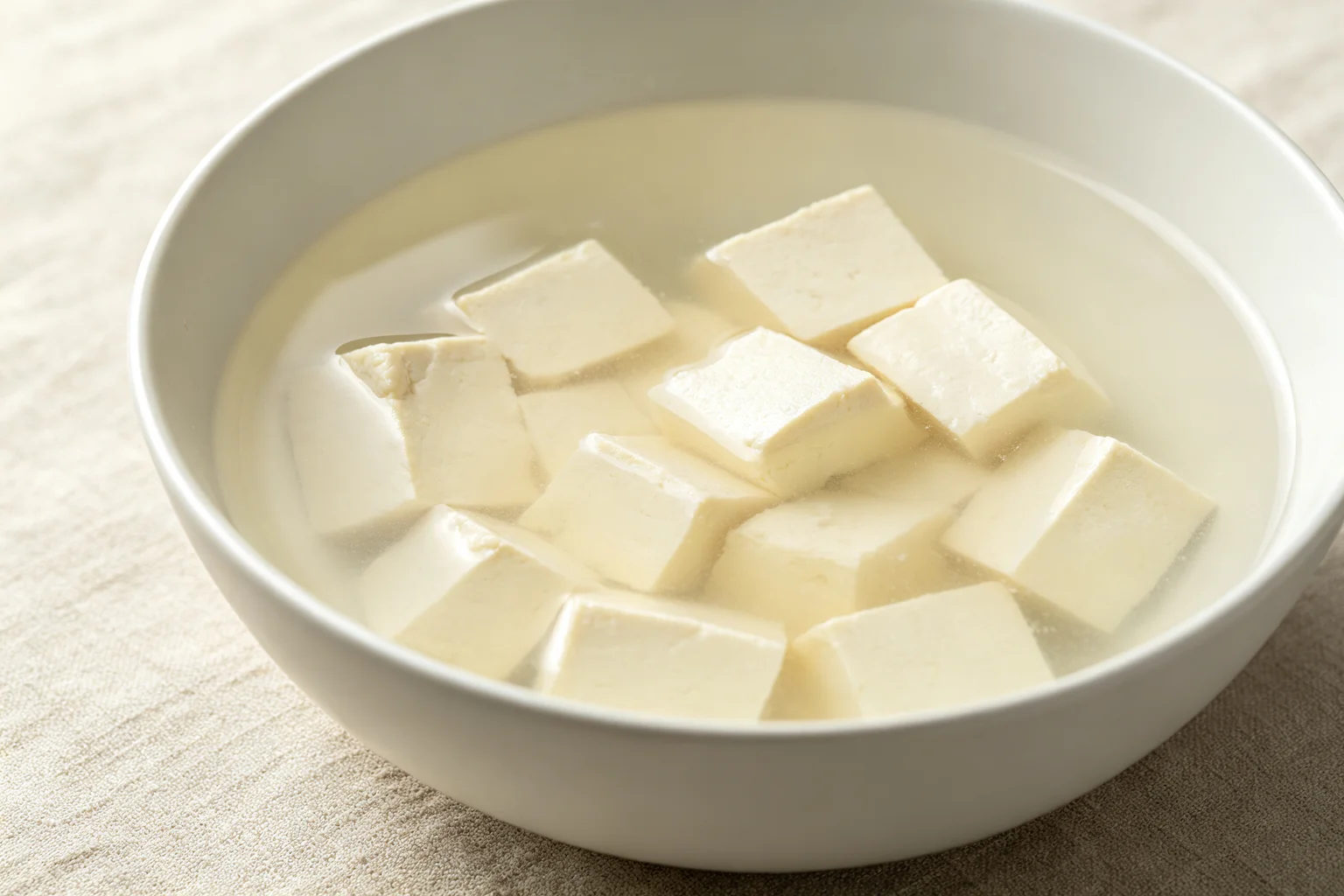
Silken tofu has no structural skin. The proteins are uniformly distributed through the block with no firmer outer layer. The first contact between a silken cube and a wok utensil, lifting it, moving it, produces crumbling without some form of pre-treatment.
Brine soaking provides that treatment. Place the tofu cubes in a bowl and pour over hot water, approximately 80°C, not boiling, lightly salted. Leave for 5-8 minutes.
The hot water causes the surface proteins of each cube to denature slightly and form a thin, firmer membrane around the exterior. This membrane gives the cube just enough structural integrity to survive being transferred to the wok, gently moved through the sauce, and served without crumbling into pieces. The salt draws a small amount of surface moisture from the tofu through osmosis, concentrating the outer protein layer further and adding a base level of seasoning to every cube.
Without the brine soak, silken tofu moves into the wok in fragments. With it, the cubes hold their shape through the cooking process and arrive at the table visually intact, soft and barely holding together when touched, but intact.
Why does the doubanjiang oil need to turn red?
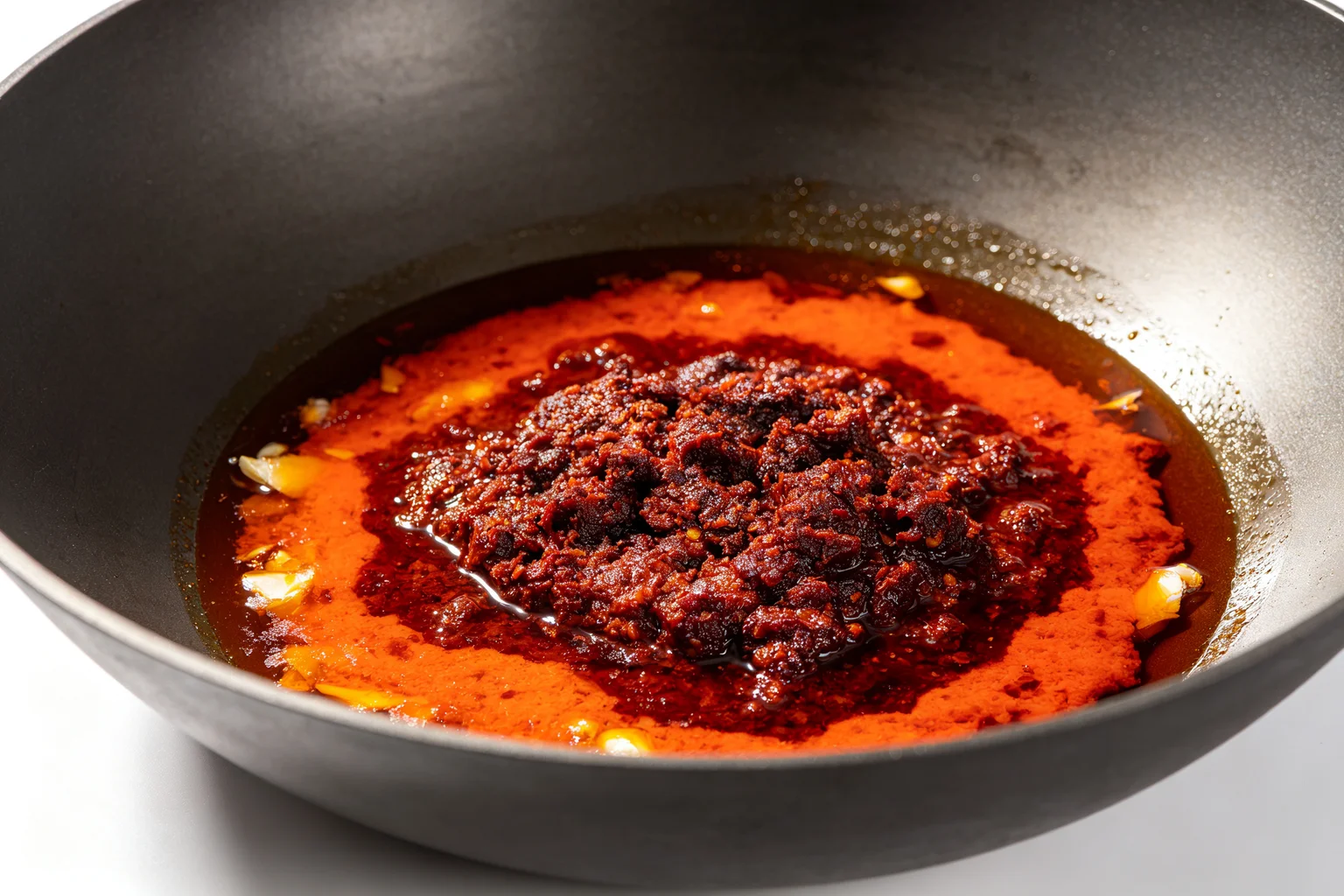
The red colour in doubanjiang comes from capsanthin and capsorubin, carotenoid pigment compounds that are fat-soluble, not water-soluble. They cannot dissolve in the stock or in the tofu water. They dissolve only in fat.
When doubanjiang is fried in oil at approximately 140-160°C, these carotenoids dissolve from the paste into the surrounding oil. The oil changes colour visibly, from its original neutral or pale yellow to a vivid, translucent red-orange. This colour change is not just visual confirmation that something has happened. It is confirmation that the fat-soluble flavour and colour compounds have fully transferred from the paste into the fat that will coat every ingredient in the dish.
The same transfer happens with the volatile aromatic compounds in the chilli, they dissolve into the fat and become distributed through the entire sauce when that fat is later emulsified.
Oil that has not turned red means the temperature was insufficient or the frying time was too short. The flavour compounds are still largely trapped inside the paste. The dish will taste of paste rather than of integrated spice throughout.
Fry the doubanjiang for 2-3 full minutes at medium heat, stirring constantly. The paste should darken from bright red to a deeper, more concentrated colour. The oil around it should be vivid red-orange. That is the correct state.
What does douchi do that doubanjiang does not?
Douchi (豆豉, fermented black beans) and doubanjiang are both fermented bean products but they provide different things to the sauce.
Doubanjiang, fermented broad bean and chilli paste, provides heat, the fat-soluble colour compounds that turn the oil red, and the primary fermented umami base. It is the structural flavour ingredient.
Douchi provides a second, different layer of umami. Fermented black beans go through a secondary fermentation process that produces compounds not present in doubanjiang, a deeper, slightly funky, more complex umami character with a mild sweetness from the secondary microbial activity. This is the same type of umami layering that makes a great broth better than a good broth: two different umami compounds producing an effect greater than either alone.
Douchi contains almost no heat, its contribution is entirely umami depth. In a dish that already has significant heat from the doubanjiang and dried chilli, the douchi amplifies the savouriness without pushing the spice level higher. You can taste its absence, mapo tofu without douchi is slightly thinner in flavour, which is why it is worth finding at an Asian grocery store even though many Western recipes omit it.
How does the cornstarch emulsify the sauce and why three additions?
Covered in the opening, but the detail matters for the technique.
Cornstarch gelatinises at 62-70°C. Below this temperature it does not activate. Above approximately 90°C added all at once, it can clump before distributing evenly or the emulsion can break before it forms. The correct temperature range is a controlled simmer, the surface should be bubbling gently but not vigorously.
Each addition of cornstarch slurry (approximately 1 tablespoon cornstarch mixed with 2 tablespoons cold water) gelatinises into the sauce and begins stabilising the oil-water interface. The first addition starts the emulsion. The second strengthens it. The third completes it and produces the glossy, spoon-coating consistency.
One large addition attempts to complete this process in a single step, which requires precise temperature control to avoid lumping or breaking. Three smaller additions are more forgiving, each one builds on the previous and the process can be corrected between additions if the sauce looks wrong.
Between additions, watch the sauce surface. If oil is still pooling visibly, add the next portion sooner. If the sauce is already glossy and thick, the third addition may not be needed.
Why does the Sichuan peppercorn go on at the very end off heat?
Hydroxy-alpha-sanshool, the numbing compound in Sichuan peppercorn, is a volatile molecule. It evaporates readily at temperatures above 80°C. Added during the cooking process, most of the sanshool is gone before the dish reaches the table. The numbing effect is present but muted.
Added off heat over the finished dish immediately before serving, the volatile compounds remain concentrated in the peppercorn powder and hit the palate directly on the first bite. The numbing effect is maximal.
This is the same principle covered in the Sichuan chicken recipe on this site, toasted peppercorn ground while warm and added off heat produces dramatically more numbing than pre-ground peppercorn added during cooking. For mapo tofu specifically, the contrast between the heat of the doubanjiang sauce and the numbing arrival of the peppercorn is the defining sensation of eating the dish correctly. Do not add it earlier.
Toast whole Sichuan peppercorns in a dry pan for 2-3 minutes until fragrant. Grind while still warm. Add directly over the finished dish off heat. Use within 2 minutes of grinding for maximum effect.
Ingredients
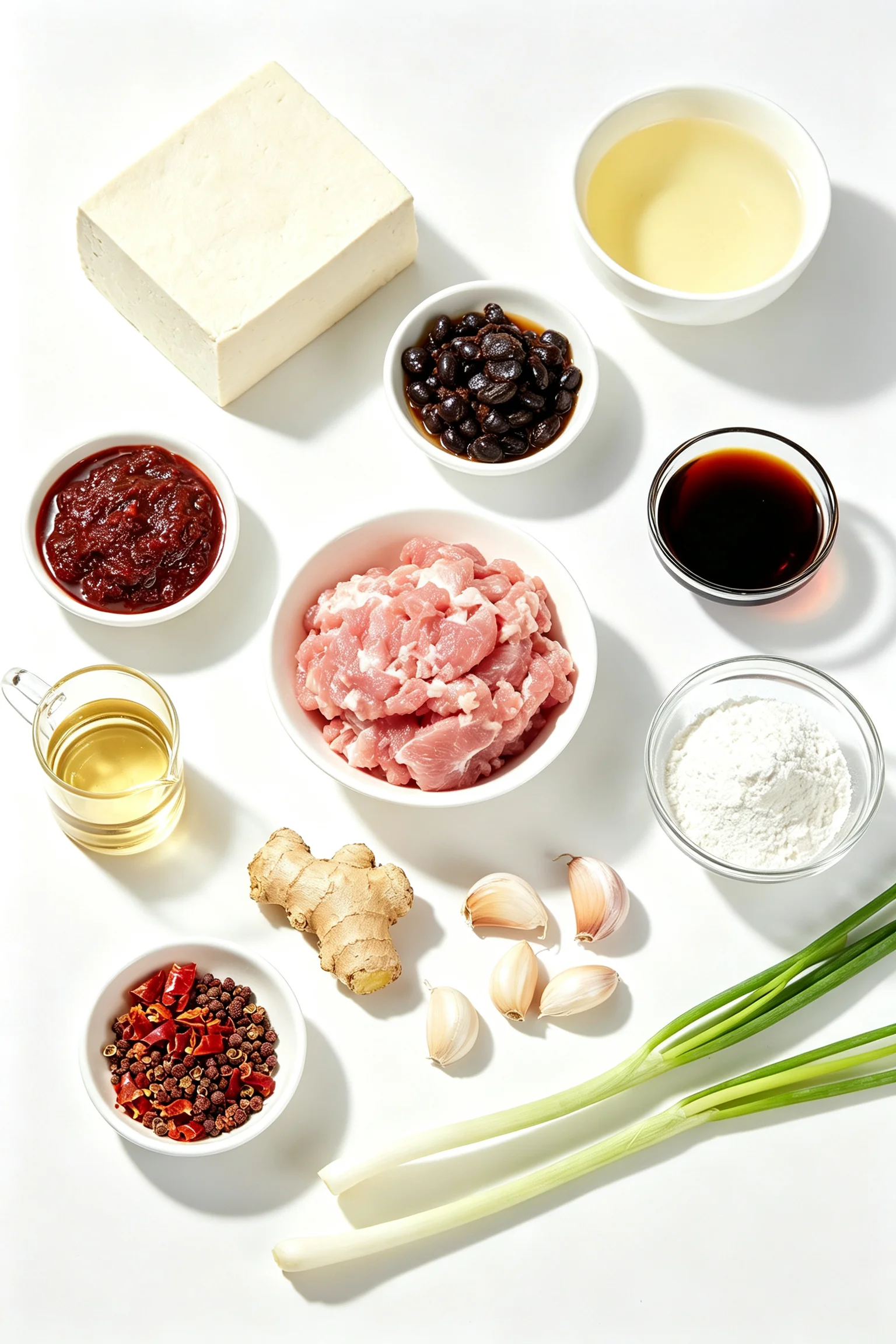
Serves 4
Tofu and brine:
- 400g (14oz) soft or silken tofu, cut into 2cm cubes
- Hot water for brining (approximately 80°C)
- 1 tsp salt for the brine
Meat:
- 200g (7oz) ground pork or beef (80/20 lean to fat)
Sauce base:
- 3 tbsp neutral oil
- 3 tbsp Pixian doubanjiang, finely chopped
- 1 tbsp douchi (fermented black beans), roughly chopped
- 4 garlic cloves, finely minced
- 2cm fresh ginger, finely minced
- 2 tsp dried chilli flakes (adjust to heat preference)
Broth and seasoning:
- 300ml (1¼ cups) chicken stock
- 1 tbsp light soy sauce
- 1 tsp dark soy sauce
- 1 tsp sugar
Cornstarch slurry (three additions):
- 3 tbsp cornstarch
- 6 tbsp cold water
- Mix together and divide into three equal portions
Finishing:
- 1½ tsp Sichuan peppercorns, toasted and ground (added off heat)
- 1 tsp sesame oil (added off heat)
- 3 spring onions, thinly sliced (whites into the sauce, greens to finish)
Instructions
Brine the tofu first. Everything else moves fast once the oil is hot.
Step 1: Brine the tofu
Place the tofu cubes in a wide bowl. Pour over hot water at approximately 80°C, hot from the kettle but not boiling.
Step 2: Toast and grind the Sichuan peppercorn
In a dry pan over medium heat, toast the Sichuan peppercorns for 2-3 minutes until fragrant and citrusy-smelling. Remove from heat.
Step 3: Fry the meat
Heat a wok over high heat. Add 1 tablespoon of oil.
Step 4: Fry the doubanjiang to red oil
Reduce heat to medium. Add the remaining 2 tablespoons of oil.
Step 5: Add stock and tofu
Pour in the chicken stock. Add the soy sauces and sugar.
Step 6: Three-addition cornstarch emulsification
With the sauce at a gentle simmer (not boiling), add the first third of the cornstarch slurry. Stir gently and watch the sauce thicken and begin to gloss over.
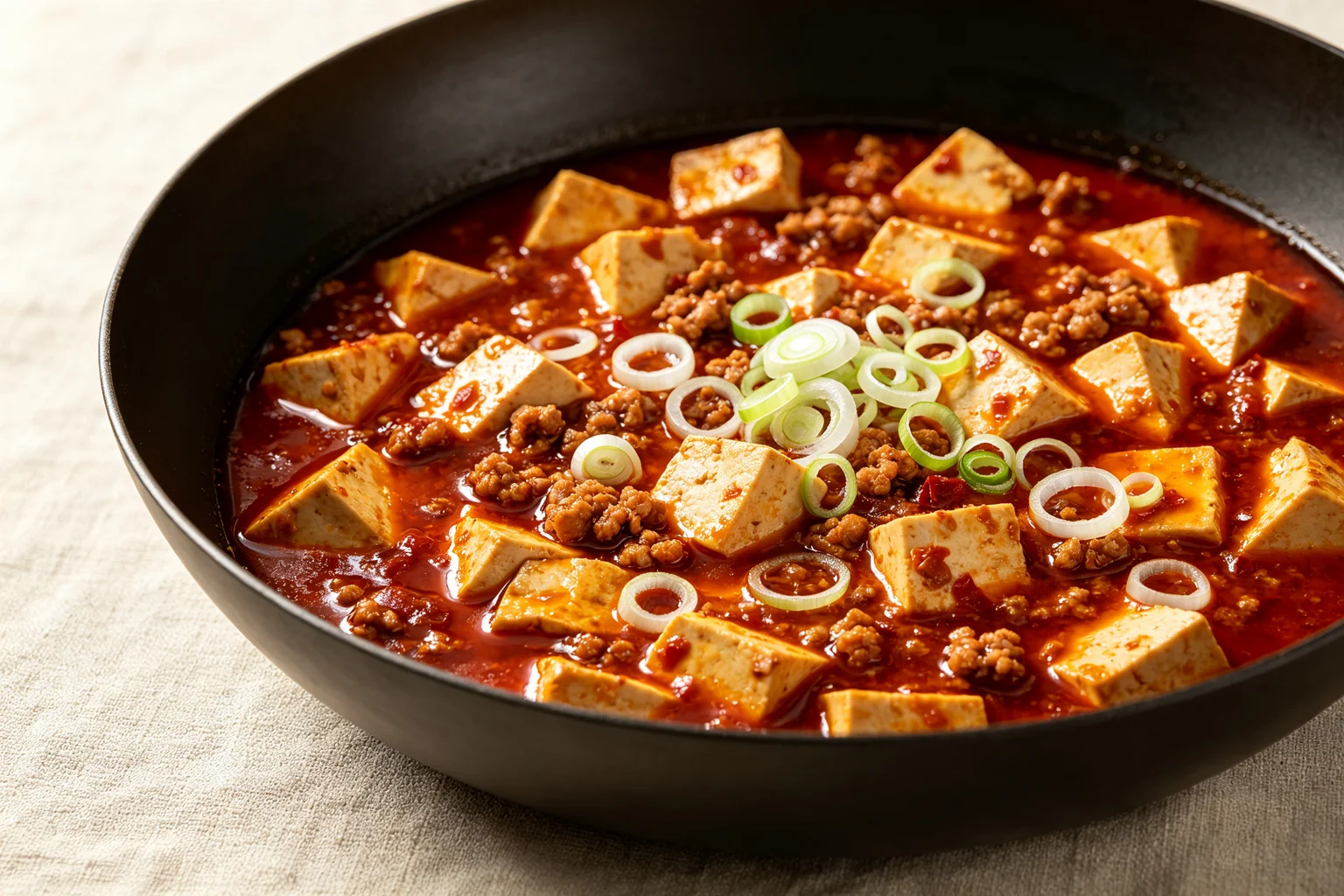
The finished sauce should be a thick, glossy, unified red emulsion with no visible oil pooling on the surface.
Step 7: Finish off heat
Remove from heat. Add the sesame oil.
How do you store and reheat mapo tofu?
Keeps in the refrigerator for 2 days. The emulsification will have partially broken overnight, the oil may have separated slightly and the sauce will be thicker and more concentrated from the tofu continuing to release water.
To reheat: add a small splash of chicken stock or water to the portion in a small pan. Heat gently over medium-low heat, stirring carefully to avoid breaking the tofu. The sauce will re-emulsify as it warms. Do not boil, vigorous heat breaks the emulsion again.
Add a small pinch of freshly ground Sichuan peppercorn off heat when serving leftovers, the volatile sanshool from the original dish will have largely evaporated overnight.
Love Chinese food?
Check out my complete guide to Chinese home cooking, pantry essentials, and techniques.
FAQ
Why did my mapo tofu sauce separate into oil and watery broth? The cornstarch emulsification broke. Three causes. First, the slurry was added all at once at too high a temperature, add in three smaller portions at a controlled simmer. Second, the sauce was boiled vigorously after the cornstarch was added, once the emulsion forms, reduce to the lowest heat that maintains it. Third, insufficient cornstarch, each tablespoon of cornstarch emulsifies a limited amount of oil and liquid. If the sauce has more oil than the cornstarch can stabilise, it breaks.
Can I make mapo tofu vegetarian? Yes. Replace the ground meat with finely diced shiitake mushrooms, dried and rehydrated, they provide similar textural contrast and significant umami from their glutamate content. Replace the chicken stock with kombu dashi or mushroom stock. The douchi can stay, it is fermented black beans with no animal products. The doubanjiang is also plant-based. The core flavour structure remains intact without meat.
What is the difference between Pixian doubanjiang and regular doubanjiang? Pixian doubanjiang (郫县豆瓣酱) is aged for 3-5 years rather than the standard 6-12 months. The extended fermentation produces significantly more complex umami compounds and a deeper, more rounded heat profile. In mapo tofu, Pixian doubanjiang integrates into the sauce differently from younger doubanjiang, the flavour is less sharp and more present throughout the dish. Both work. Pixian is worth seeking at an Asian grocery store for a noticeably different result.
Why is my tofu breaking apart during cooking? The brine soak was skipped or insufficient. Without the brine soak, silken tofu has no surface structure and crumbles on contact with any utensil. Brine in hot salted water for the full 5-8 minutes. Handle only with a wide slotted spoon. When moving the tofu in the sauce, fold rather than stir, push the sauce over the tofu rather than moving the tofu through the sauce.
You might also like: Check out our complete Chinese cooking guide for more essential ingredients and techniques.
Mapo Tofu Recipe (麻婆豆腐)
PT15M
PT20M
PT35M
Nutrition Facts
Ingredients
- 400g (14oz) soft or silken tofu, cut into 2cm cubes
- Hot water for brining (approximately 80°C)
- 1 tsp salt for the brine
- 200g (7oz) ground pork or beef (80/20 lean to fat)
- 3 tbsp neutral oil
- 3 tbsp Pixian doubanjiang, finely chopped
- 1 tbsp douchi (fermented black beans), roughly chopped
- 4 garlic cloves, finely minced
- 2cm fresh ginger, finely minced
- 2 tsp dried chilli flakes (adjust to heat preference)
- 300ml (1¼ cups) chicken stock
- 1 tbsp light soy sauce
- 1 tsp dark soy sauce
- 1 tsp sugar
- 3 tbsp cornstarch
- 6 tbsp cold water
- Mix together and divide into three equal portions
- 1½ tsp Sichuan peppercorns, toasted and ground (added off heat)
- 1 tsp sesame oil (added off heat)
- 3 spring onions, thinly sliced (whites into the sauce, greens to finish)
Instructions
- *Brine the tofu first. Everything else moves fast once the oil is hot.*
- Place the tofu cubes in a wide bowl. Pour over hot water at approximately 80°C, hot from the kettle but not boiling. Add 1 teaspoon of salt. Leave for 5-8 minutes. Drain carefully using a slotted spoon. The cubes should feel slightly firmer on the outside. Handle gently from this point.
- In a dry pan over medium heat, toast the Sichuan peppercorns for 2-3 minutes until fragrant and citrusy-smelling. Remove from heat. Grind while still warm. Set aside, do not add to the dish until the very end.
- Heat a wok over high heat. Add 1 tablespoon of oil. Add the ground pork or beef and fry over high heat, breaking up with a spatula, until crispy and browned, 3-4 minutes. The meat should have some crispy, slightly charred pieces. Remove to a plate. Do not discard the meat fat in the wok.
- Reduce heat to medium. Add the remaining 2 tablespoons of oil. Add the finely chopped doubanjiang. Fry for 2-3 minutes, stirring constantly, until the oil around the paste turns vivid red-orange. This is the confirmation that the fat-soluble flavour compounds have transferred into the oil. Add the chopped douchi, garlic, ginger, and chilli flakes. Stir 30-45 seconds until fragrant. Add the spring onion whites.
- Pour in the chicken stock. Add the soy sauces and sugar. Bring to a gentle simmer. Return the cooked meat to the wok. Gently lower the brined tofu cubes into the simmering sauce using a slotted spoon. Do not stir vigorously, fold the tofu through the sauce carefully. Simmer 3-4 minutes.
- With the sauce at a gentle simmer (not boiling), add the first third of the cornstarch slurry. Stir gently and watch the sauce thicken and begin to gloss over. After 30 seconds, add the second third. Stir. After another 30 seconds, assess the sauce, if it is glossy and coats a spoon thickly, the third addition may not be needed. If it still looks thin or oily, add the final third. The finished sauce should be a thick, glossy, unified red emulsion with no visible oil pooling on the surface.
- Remove from heat. Add the sesame oil. Sprinkle the freshly ground Sichuan peppercorn generously over the surface. Do not stir it in, it will distribute as the dish is served. Add the spring onion greens. Serve immediately over steamed rice. ## How do you store and reheat mapo tofu? Keeps in the refrigerator for 2 days. The emulsification will have partially broken overnight, the oil may have separated slightly and the sauce will be thicker and more concentrated from the tofu continuing to release water. To reheat: add a small splash of chicken stock or water to the portion in a small pan. Heat gently over medium-low heat, stirring carefully to avoid breaking the tofu. The sauce will re-emulsify as it warms. Do not boil, vigorous heat breaks the emulsion again. Add a small pinch of freshly ground Sichuan peppercorn off heat when serving leftovers, the volatile sanshool from the original dish will have largely evaporated overnight.
Did you make this recipe?
Tag @asianfoodsdaily on Instagram or leave a comment below!
Testing Notes
Tested in Asha's kitchen. Last reviewed June 9, 2025.
Ingredient Substitutions
Substitution notes coming soon.
About Asha
Half Asian, half African cook raised between two food-obsessed cultures. I've spent 10 years learning Asian cooking traditions through family, friends, and thousands of hours at the stove — testing every dish until it works in a standard home kitchen.
Read my full storyRelated Recipes
More delicious dishes you might enjoy


Loading comments...