Chongqing Chicken Wings (La Zi Ji / 辣子鸡
Jump to Section
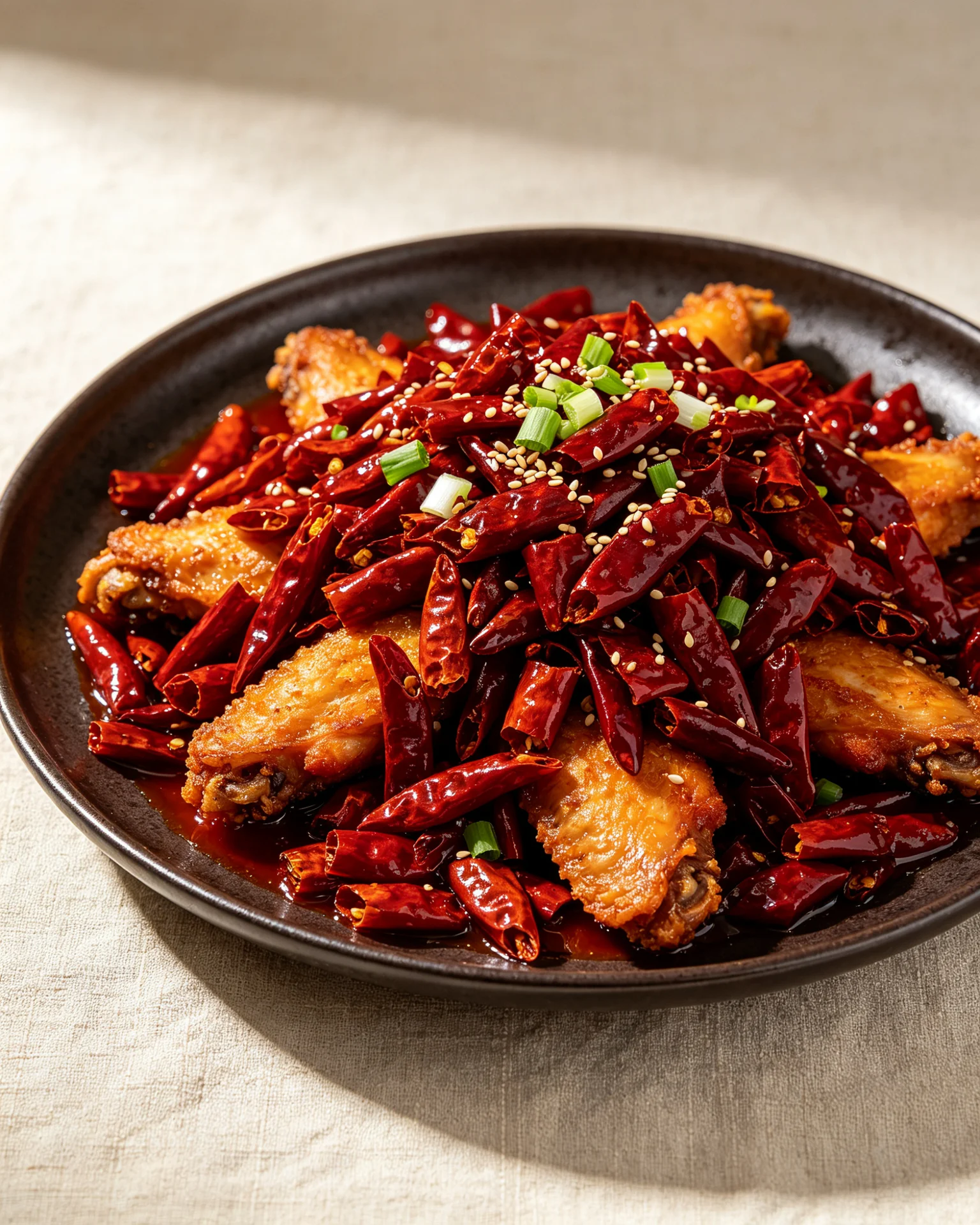
You lower a batch of wings into hot oil, they come out blistered gold and crackling. You toss them in a dry spice mix of toasted Sichuan peppercorns and cumin. Then you bury the whole thing under a mountain of dried red chillies, not because you’re going to eat all of them, but because that is how it is done. That is la zi ji (辣子鸡), and it might be the most dramatic thing you will make on a Tuesday night.
The mountain of chillies is not decorative. Capsaicin, the compound responsible for chilli heat, is fat-soluble. When whole dried chillies are added to hot oil at low heat, the capsaicin and aromatic compounds dissolve from the chilli flesh into the surrounding oil. The oil becomes infused with chilli flavour. When the fried chicken is tossed in this infused oil, every surface of every wing gets coated with the dissolved capsaicin and chilli aromatics. The chilli itself stays mostly intact, its seeds still contain concentrated heat. But the chicken has absorbed the flavour through the oil. That is why la zi ji is described as flavourful rather than overwhelmingly hot at the chicken level. The chillies are the flavour mechanism, not the garnish.
What is la zi ji and where does it come from?
La zi ji (辣子鸡) means spicy seed chicken, là is spicy, zi refers to the dried chilli seeds, jī is chicken. The dish originated in the Geleshan area of Chongqing around 1986, where a restaurant began cooking local free-range chicken with a large quantity of dried chillies and Sichuan peppercorns. The format spread rapidly, first through Chongqing, then through China, then internationally as Sichuan cuisine became one of the most recognised Chinese food exports of the early 21st century.
Sichuan cooking is built around mala (麻辣), má for the numbing buzz of Sichuan peppercorns, là for the direct heat of dried chillies. Together they do not just make food spicy. The peppercorns take the sharp edge off the heat and replace it with something closer to an electric tingle, a physical sensation from hydroxy-alpha-sanshool activating specific tactile receptors on the tongue and lips. The heat arrives first, then the numbing follows, then the heat seems less intense because the numbing has raised the sensation threshold. It is a different eating experience from any other chilli preparation.
The traditional format uses a whole chopped chicken, bone-in, small pieces. This recipe uses chicken wings, which produce a better result at home for reasons covered below.
Why chicken wings and not chopped chicken pieces?
Chicken wings have a higher skin-to-meat ratio than any other chicken cut. This matters specifically for the la zi ji cooking method.
Chicken skin contains significant collagen, the same structural protein that produces gelatin in bone broth and aspic, covered in the xiaolongbao recipe on this site. During frying at 160-200°C, the collagen in the skin denatures and converts to gelatin, then the gelatin heats further and its water content evaporates. The remaining structure, dehydrated protein and rendered fat, contracts and crisps into a thin, shatteringly crispy layer that approaches chicharron in texture.
Wing sections have enough skin surface relative to the meat below that a significant proportion of each piece undergoes this transformation. The result is a self-basted, crackly-skinned piece with the rendered fat keeping the exterior from burning while the interior stays juicy.
Boneless skinless chicken is the worst choice for this dish, without skin there is no collagen, without collagen there is no crackly crust, and the lean meat dries out during the second fry. Bone-in thighs or drumsticks work if wings are unavailable. The skin is non-negotiable.
What does baking soda do in the marinade?
The Maillard reaction, the browning that produces the golden colour and complex flavour on the wing surface, is pH-dependent. It proceeds faster and at lower temperatures at higher pH.
Raw chicken surface has a pH of approximately 6-6.5 (slightly acidic). Adding a small amount of baking soda (sodium bicarbonate) to the marinade raises the surface pH to approximately 7-8. At this higher pH, the amino acids and reducing sugars that participate in the Maillard reaction become more reactive, browning occurs faster and at lower oil temperature than with untreated chicken.
In practice: baking soda-treated wings develop deep golden colour at 160-170°C without the risk of the cornstarch coating burning before the interior cooks through. The colour develops more evenly across the surface. A quarter teaspoon is sufficient, more than this produces a slightly metallic, soapy off-flavour.
The secondary effect: the alkaline environment partially breaks down the surface myofibrillar proteins, producing a slightly more tender exterior texture. This is the same alkaline chemistry as lye water in ramen noodles and siu mai wrappers, applied at much lower concentration for a subtler effect.
Why double-fry instead of single fry?
A chicken wing has two competing requirements: the interior must reach 70°C to cook through, and the exterior starch coating must dehydrate completely to achieve maximum crispiness. These two requirements conflict at a single temperature.
At temperatures low enough to cook the interior without burning the exterior (160-170°C), the starch coating cooks but retains moisture driven out from the interior as the chicken heats. The interior steam continuously re-moistens the exterior crust from within. The wing comes out cooked but not maximally crispy.
At temperatures high enough to rapidly dehydrate the exterior (190-200°C), the exterior crisps fast but the intense heat can produce an overcooked, slightly dry interior before the crust has had time to develop fully.
The double-fry separates the two outcomes:
First fry at 160-170°C for 7-8 minutes: cooks the wing through to 70°C internal temperature and drives off most of the interior moisture. The coating firms but does not fully crisp.
Rest for 2-3 minutes on a wire rack: the surface moisture that was driven to the exterior during the first fry redistributes slightly. The exterior becomes drier than it was immediately out of the oil.
Second fry at 190-200°C for 60-90 seconds: the high heat contacts a now-drier exterior coating. Without interior moisture competing, the exterior dehydrates rapidly into a shatteringly crispy crust. The interior is already cooked, this fry is purely about the crust.
The result is a wing that is fully cooked, maximally crispy, and not dry inside. A single fry at either temperature produces a compromise that achieves neither outcome fully.
Why must the chillies be bloomed at low heat?
The aromatic compounds in dried chillies, capsaicin, carotenoid pigments, volatile terpenoids, are sensitive to oxidation at high temperatures.
At oil temperatures above approximately 180°C, these compounds oxidise rapidly on contact with the hot oil. The oxidation produces quinones and other breakdown products with a bitter, harsh, acrid character. This is the flavour of burnt chilli, a sharp bitterness that is different from chilli heat and cannot be corrected by adding more of anything.
At 120-140°C, the same compounds dissolve steadily from the chilli into the oil through diffusion, without reaching the temperature required for rapid oxidation. The compounds remain intact and the oil becomes fragrant, deeply flavoured, and noticeably red-orange rather than brown.
The visual indicator is the chilli colour. Properly bloomed chillies darken from bright red to a deep brick red and become slightly glossy, some dehydration and gentle surface Maillard reaction, correct. Blackened chillies mean the temperature was too high and the aromatic compounds have oxidised, the oil will taste bitter regardless of what else is done.
Keep the heat at medium-low once the chillies go in. If the chillies darken too fast, remove the wok from heat for 30 seconds and return.
Why do you not eat most of the chillies?
Covered in the opening but worth mapping fully because the eating format confuses first-time la zi ji eaters.
The dried chillies in this dish perform two functions: they deliver flavour compounds into the cooking oil (covered above), and they provide the dramatic visual presentation that signals the dish’s Sichuan identity. In Chongqing restaurants, the chillies cover the chicken so completely that diners must physically search through the pile to find the pieces, this is where the Sichuan joke about la zi ji being “recreational sport as much as a meal” comes from.
The chillies are not removed before serving. They stay on the plate and provide ambient chilli fragrance as you eat. Most diners eat around them, occasionally picking up a piece with a chopstick if they want additional direct heat from the seeds.
Eating a whole chilli provides a significant heat hit from the seeds, which still contain concentrated capsaicin that has not migrated into the oil. If you eat through the chillies deliberately, the dish becomes substantially hotter than if you pick through them for the chicken. This is by design, the format allows each person to calibrate their own heat level by how many chillies they eat alongside the chicken.
Which dried chillies to use?
Two chilli varieties define authentic la zi ji and understanding their different functions helps calibrate the dish correctly.
Erjingtiao (二荆条): Long, thin, relatively mild Sichuan chillies with exceptional fragrance. Low heat, high aromatic output. These provide most of the chilli fragrance in the oil. The majority of the chillies in the dish should be erjingtiao.
Facing heaven chillies (朝天椒, facing-upward chillies): Shorter, rounder, significantly hotter. Less aromatic than erjingtiao. Used in smaller proportion for heat amplification.
A 3:1 ratio of erjingtiao to facing heaven chillies produces fragrant oil with manageable heat. A 1:1 ratio produces significant heat. All facing heaven chillies produces very hot oil with less aromatic complexity.
Do not use Thai bird chillies, too small, too hot, wrong aromatic profile for this dish. California dried chillies are a readily available Western substitute for erjingtiao, mild, fragrant, similar aromatic character. Kashmiri chillies also work.
Available at Chinese grocery stores or online at The Mala Market, which stocks specifically sourced Sichuan varieties.
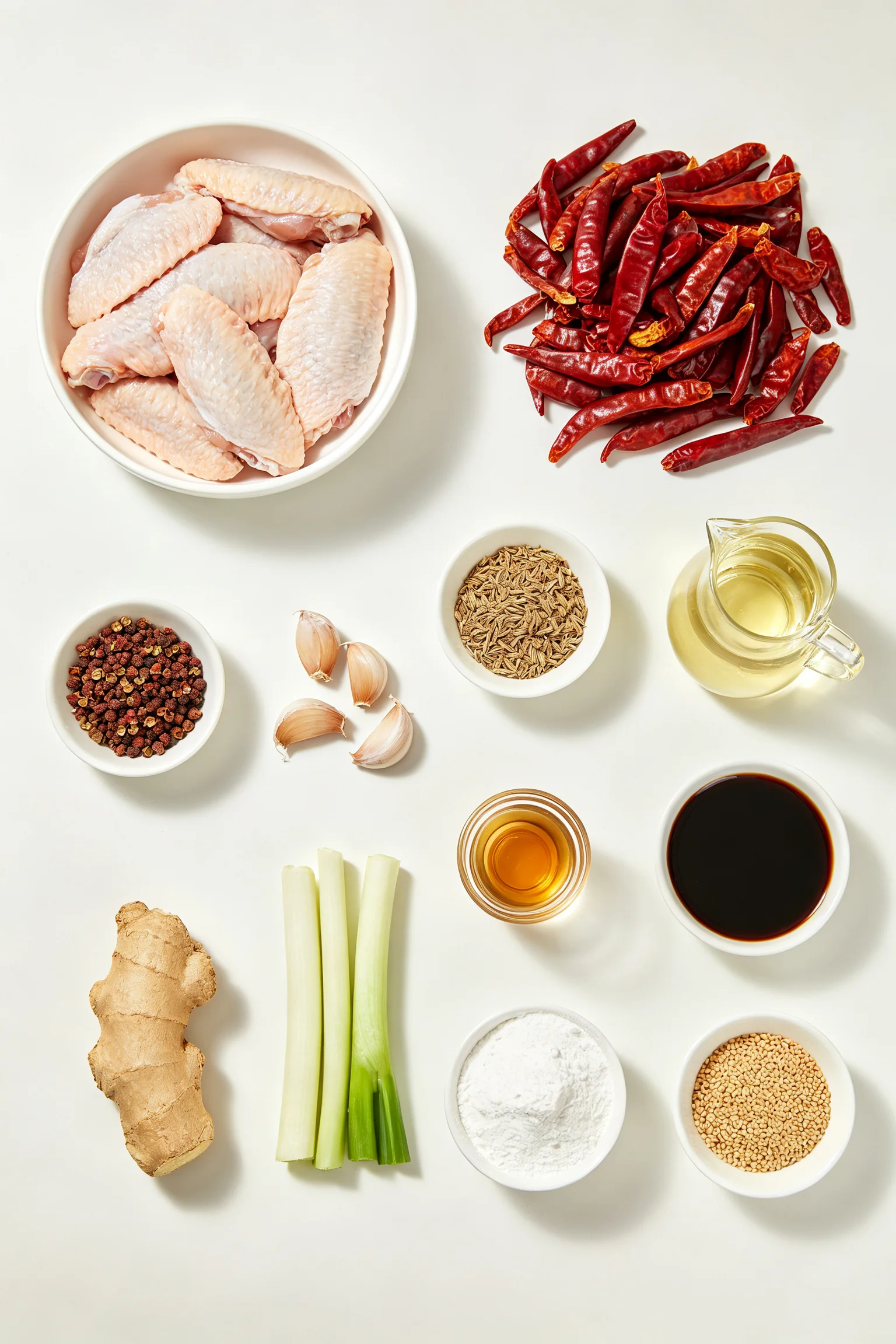
Ingredients
Serves 2-3
Wings and marinade:
- 1kg (2.2lb) chicken wings, split into flats and drumettes
- 2 tbsp Shaoxing wine
- 1 tbsp light soy sauce
- 1 tsp salt
- ¼ tsp baking soda
- 3 tbsp cornstarch
- Neutral oil for deep frying (enough for 6-8cm depth)
Chilli and spice layer:
- 80g (approximately 3 cups loosely packed) dried red chillies, mix of erjingtiao and facing heaven, stems removed, halved or left whole
- 2 tbsp Sichuan peppercorns, toasted and roughly crushed
- 1 tsp cumin seeds, toasted
- 4 cloves garlic, thinly sliced
- 3cm fresh ginger, thinly sliced
- 3 spring onions, cut into 3cm sections (whites separated from greens)
- 2 tbsp neutral oil
- 1 tsp sugar
- ½ tsp dark soy sauce
Finishing:
- 1 tsp sesame oil (added off heat)
- 1 tbsp toasted sesame seeds
- Spring onion greens, thinly sliced
Instructions
The wings can marinate for 30 minutes or overnight. Overnight produces noticeably more flavour.
Step 1: Marinate the wings
Combine wings with Shaoxing wine, soy sauce, salt, and baking soda in a large bowl. Mix thoroughly so every wing is coated.
Step 2: Toast and prep the spices
In a dry wok or pan over medium heat, toast the Sichuan peppercorns for 2 minutes until fragrant and beginning to pop. Remove.
If using whole dried chillies, snip off the stems. Leave whole or halve lengthwise and shake out some seeds for less heat. The more seeds removed, the less intense the heat from the chillies themselves.
Step 3: First fry
Heat oil to 160-170°C in a wok or deep heavy pot. Test with a small piece of cornstarch-coated wing, it should sizzle immediately and float.
Fry the wings in two batches, do not crowd. First batch: 7-8 minutes until golden and cooked through. Remove to a wire rack. Allow oil to return to temperature before the second batch. Second batch: same.
Step 4: Rest
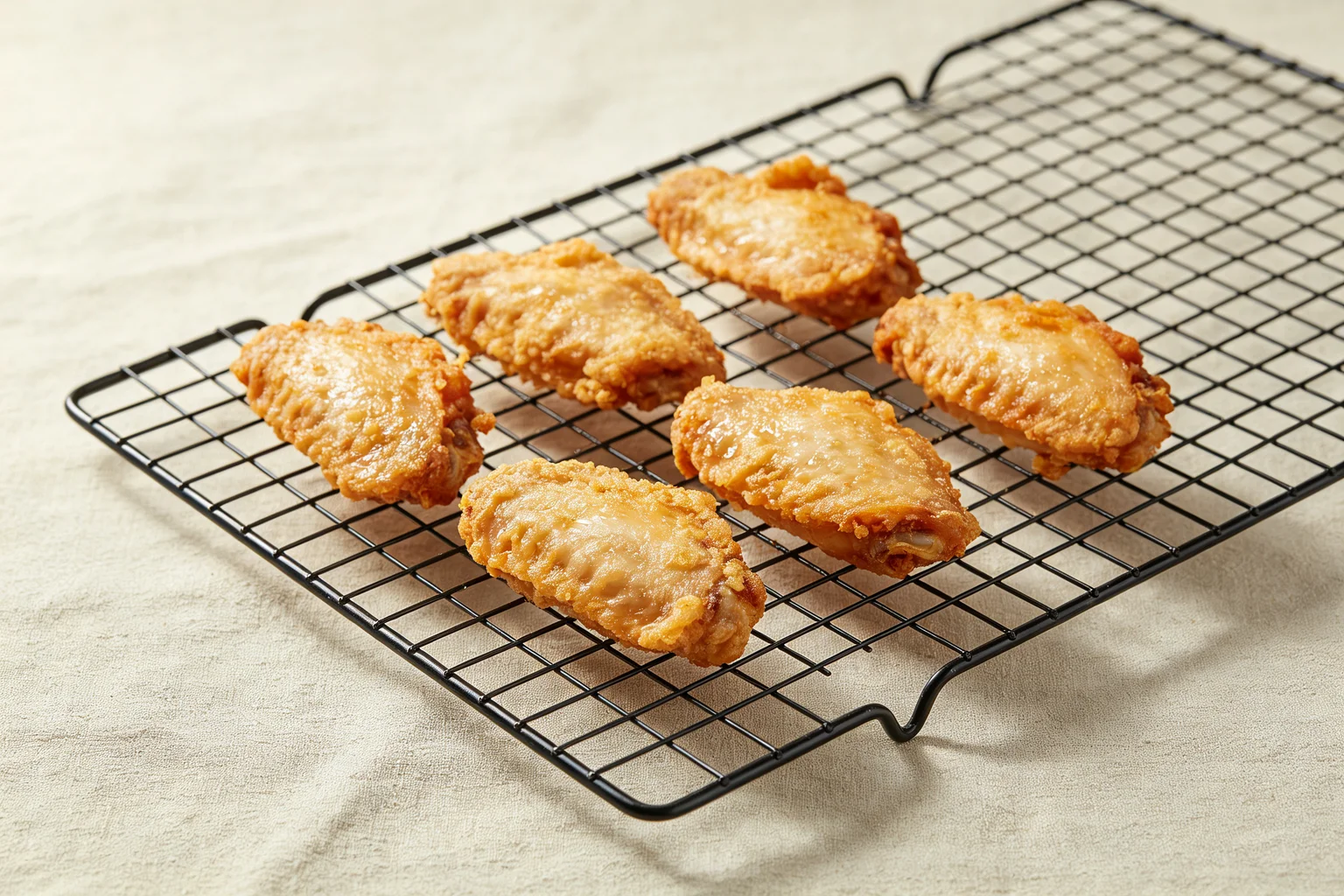
Leave all wings on the wire rack for 3 minutes. The surface moisture redistributes during this rest and the exterior becomes drier for the second fry.
Step 5: Second fry
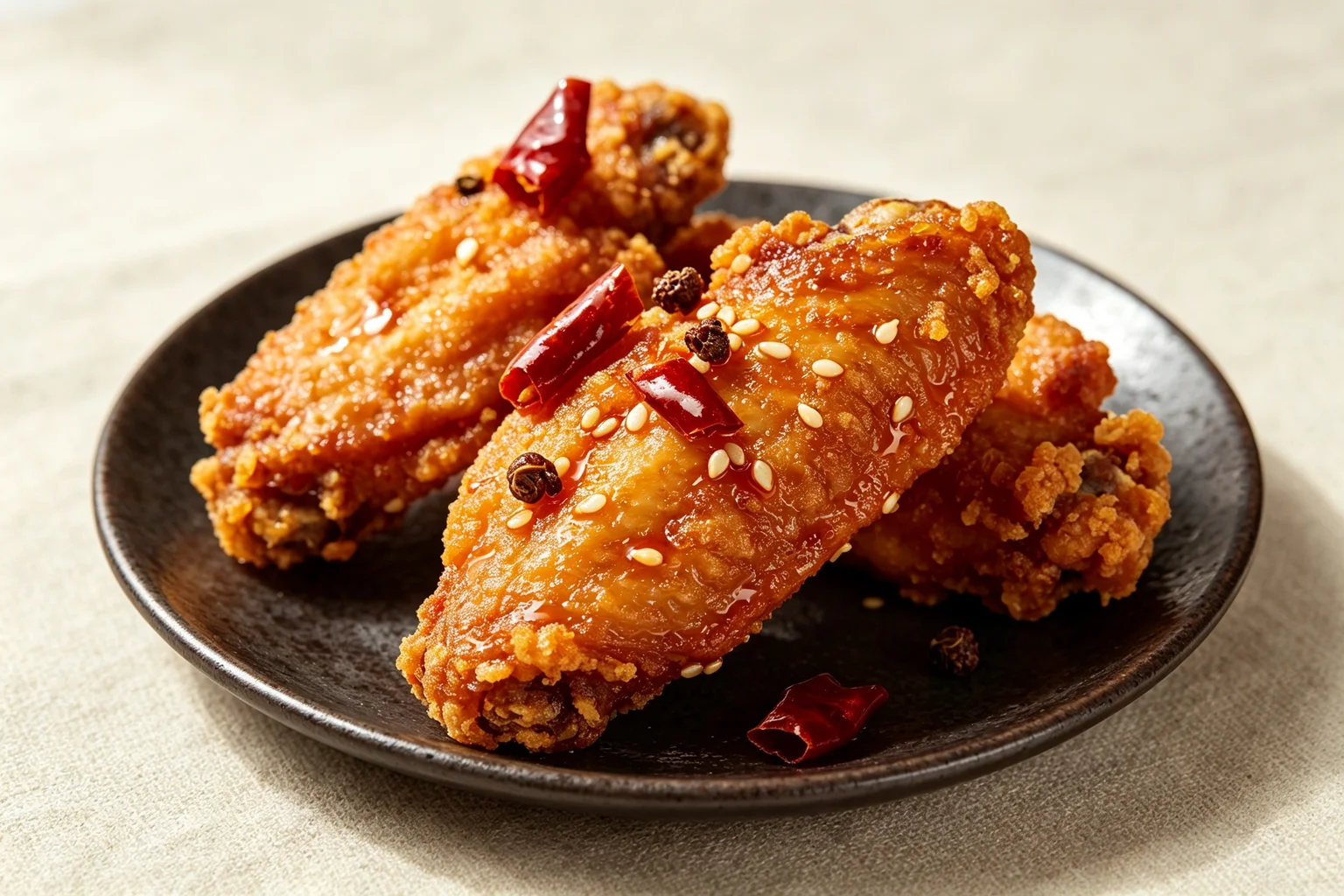
Increase oil temperature to 190-200°C. Return all wings to the oil.
Step 6: Bloom the chillies
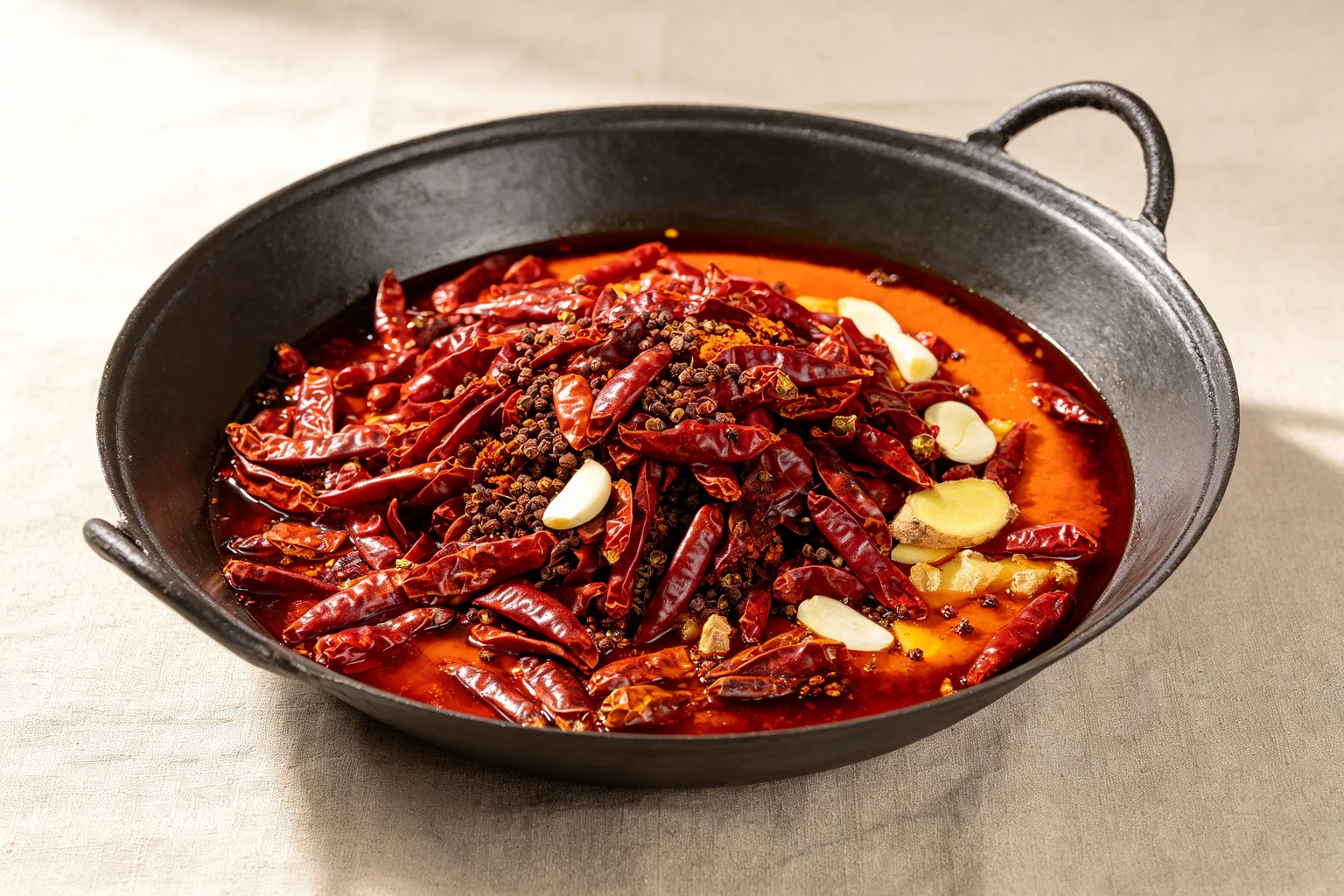
Discard most of the frying oil, leaving approximately 3 tablespoons in the wok. Reduce heat to medium-low.
Add the crushed Sichuan peppercorns, garlic, ginger, and spring onion whites. Stir 1 minute at medium-low heat until fragrant.
Step 7: Toss and finish
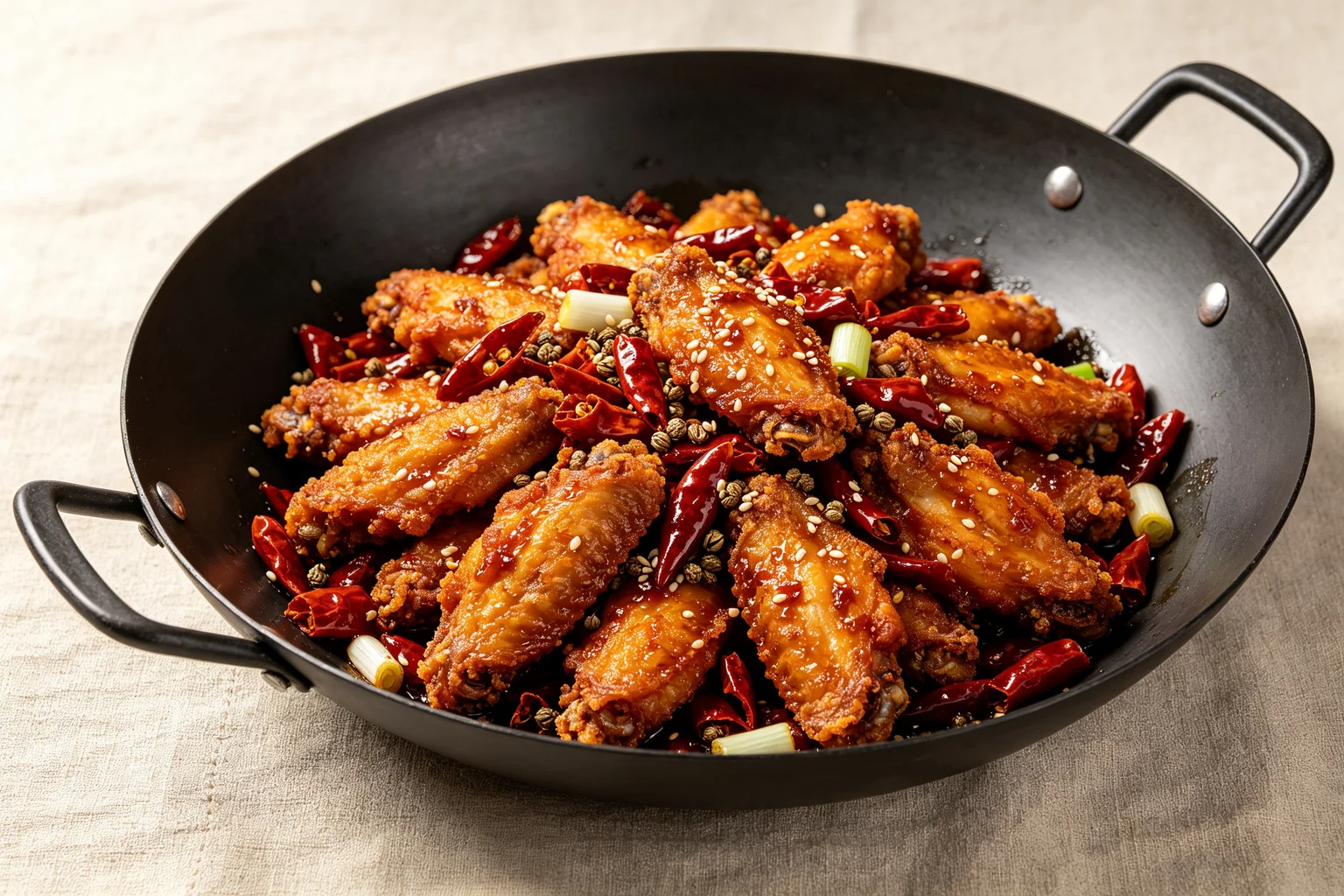
Add the fried wings to the wok. Add toasted cumin, sugar, and dark soy sauce.
Remove from heat. Add sesame oil. Toss once more.
Step 8: Serve buried in chillies
Transfer to a serving plate. Pile the chillies on top and around the wings until the chicken is mostly hidden.
How do you reheat Chongqing chicken wings?
The double-fry crust is at its best within 20 minutes of the second fry. After that the crust softens as the interior moisture migrates back to the surface.
To reheat: air fryer at 200°C for 4-5 minutes restores most of the crispness without drying the interior. Oven at 220°C on a wire rack for 8 minutes also works. Do not microwave, the crust becomes leathery and the chillies lose their fragrance.
The chillies can be re-used in a second batch of la zi ji, store them separately from the wings in an airtight container and add fresh chillies to supplement.
Love Chinese food?
Check out my complete guide to Chinese home cooking, pantry essentials, and techniques.
FAQ
Why is my la zi ji bitter? The chillies burned during blooming. At high heat, the capsaicin and aromatic carotenoid compounds in the chilli oxidise rapidly into bitter quinone compounds. Keep the heat at medium-low once the chillies go into the oil. The chillies should darken to deep brick red, not black. If they black in under a minute, the oil was too hot. Discard and start the blooming step again with fresh oil and chillies.
How do I make this less spicy without losing the flavour? Two adjustments. First, use only erjingtiao or mild California dried chillies, no facing heaven chillies. The fragrance remains but the heat drops significantly. Second, shake the seeds out of every chilli before adding, most of the direct chilli heat comes from the seeds. The chilli flesh and oil contribute flavour; the seeds contribute heat. You can remove nearly all seeds and still have a deeply flavoured dish.
Can I make this without a deep fryer? Yes. A wok or deep heavy-based pan with 6-8cm of neutral oil works identically to a dedicated fryer. A thermometer is essential, the temperature distinction between the first fry (160-170°C) and second fry (190-200°C) matters and is difficult to judge by eye alone. The chopstick test works as a rough guide: gentle bubbling from a dry chopstick tip = approximately 160°C; immediate vigorous bubbling = approximately 190°C.
Do you eat the Sichuan peppercorns in the finished dish? You can eat the crushed peppercorn pieces if you enjoy the textural crunch and concentrated numbing hit. Many people pick around them. Roughly crushing rather than grinding to powder gives you the choice, the larger pieces are visible and easily avoided, while the smaller fragments distribute through the dish and coat every wing with numbing oil. The whole peppercorns used for blooming should be avoided, they are very intense when bitten
Chongqing Chicken Wings (La Zi Ji / 辣子鸡
fried chicken wings, Chinese chicken wings,, spicy chicken wings
PT40M (includes 30 min marination)
PT20M
PT1H
Nutrition Facts
Ingredients
- 2½ lbs (1.1 kg) chicken wing mid-joints, flats and drumettes separated
- 1½ tsp kosher salt
- 1 tsp white pepper
- 1 tbsp Shaoxing rice wine (or dry sherry)
- 1 egg white
- 3 tbsp cornstarch
- Neutral oil for frying (vegetable or peanut)
- 2 tbsp whole Sichuan peppercorns, toasted and ground
- 1½ tbsp cumin seeds, toasted and ground
- 1 tsp cayenne pepper
- 1½ tsp sugar
- 1 tsp kosher salt
- ½ tsp garlic powder
- 2½ cups whole dried Facing Heaven chiles (or arbol)
- 1 tbsp neutral oil
- 4 garlic cloves, thinly sliced
- 1-inch piece ginger, julienned
- 2 scallions, thinly sliced (green parts only)
- 1 tbsp toasted sesame seeds
- Lime wedges for serving
Instructions
- *The wings can marinate for 30 minutes or overnight. Overnight produces noticeably more flavour.*
- Combine wings with Shaoxing wine, soy sauce, salt, and baking soda in a large bowl. Mix thoroughly so every wing is coated. Leave 30 minutes at room temperature or overnight in the refrigerator. Before frying, add the cornstarch and toss until every wing is evenly coated. No wet patches, any uncoated area will not crisp properly.
- In a dry wok or pan over medium heat, toast the Sichuan peppercorns for 2 minutes until fragrant and beginning to pop. Remove. Roughly crush in a mortar, not to powder, just broken open. Toast the cumin seeds for 1 minute. Set aside separately. If using whole dried chillies, snip off the stems. Leave whole or halve lengthwise and shake out some seeds for less heat. The more seeds removed, the less intense the heat from the chillies themselves.
- Heat oil to 160-170°C in a wok or deep heavy pot. Test with a small piece of cornstarch-coated wing, it should sizzle immediately and float. Fry the wings in two batches, do not crowd. First batch: 7-8 minutes until golden and cooked through. Remove to a wire rack. Allow oil to return to temperature before the second batch. Second batch: same.
- Leave all wings on the wire rack for 3 minutes. The surface moisture redistributes during this rest and the exterior becomes drier for the second fry.
- Increase oil temperature to 190-200°C. Return all wings to the oil. Fry 60-90 seconds until the exterior is deeply golden and shatteringly crispy. Remove immediately to the wire rack. Do not fry longer, the second fry is purely for the crust, not for cooking.
- Discard most of the frying oil, leaving approximately 3 tablespoons in the wok. Reduce heat to medium-low. Add the dried chillies. Stir constantly for 2-3 minutes until they darken to a deep brick red and the kitchen smells intensely of chilli. The oil should be visibly red. Do not let them blacken. Add the crushed Sichuan peppercorns, garlic, ginger, and spring onion whites. Stir 1 minute at medium-low heat until fragrant.
- Add the fried wings to the wok. Add toasted cumin, sugar, and dark soy sauce. Turn heat to high. Toss vigorously for 30-45 seconds until every wing is coated in the chilli oil and spices. Remove from heat. Add sesame oil. Toss once more.
- Transfer to a serving plate. Pile the chillies on top and around the wings until the chicken is mostly hidden. This is not optional, the drama of finding the chicken in the chillies is part of the eating experience. Scatter sesame seeds and fresh spring onion greens. Serve immediately. ## How do you reheat Chongqing chicken wings? The double-fry crust is at its best within 20 minutes of the second fry. After that the crust softens as the interior moisture migrates back to the surface. To reheat: air fryer at 200°C for 4-5 minutes restores most of the crispness without drying the interior. Oven at 220°C on a wire rack for 8 minutes also works. Do not microwave, the crust becomes leathery and the chillies lose their fragrance. The chillies can be re-used in a second batch of la zi ji, store them separately from the wings in an airtight container and add fresh chillies to supplement.
Did you make this recipe?
Tag @asianfoodsdaily on Instagram or leave a comment below!
Testing Notes
Tested in Asha's kitchen. Last reviewed June 26, 2025.
Ingredient Substitutions
Substitution notes coming soon.
About Asha
Half Asian, half African cook raised between two food-obsessed cultures. I've spent 10 years learning Asian cooking traditions through family, friends, and thousands of hours at the stove — testing every dish until it works in a standard home kitchen.
Read my full storyRelated Recipes
More delicious dishes you might enjoy


Loading comments...