Xiaolongbao Recipe (小笼包 / Soup Dumplings)
Jump to Section
The first batch I made tore during steaming. Not spectacularly, just small punctures at the thinnest parts of the wrapper, enough for the soup to escape before the dumpling reached the spoon. The filling was fine. The aspic was correct. The problem was that I had not rested the dough long enough. Freshly kneaded dough is under mechanical tension, the gluten network is stressed and elastic. When you roll it thin, the elastic gluten resists and the thinnest sections tear rather than hold. After 45 minutes of resting, the same dough rolled to tissue-thin without a single tear. The gluten had relaxed into a lower-energy state and the dough was plastic rather than elastic.
That is the most important insight in this recipe. The aspic trick is the most surprising, but the dough resting is what actually determines whether your wrappers hold or not. Both are covered below with the mechanism behind each.
What is xiaolongbao and where does it come from?
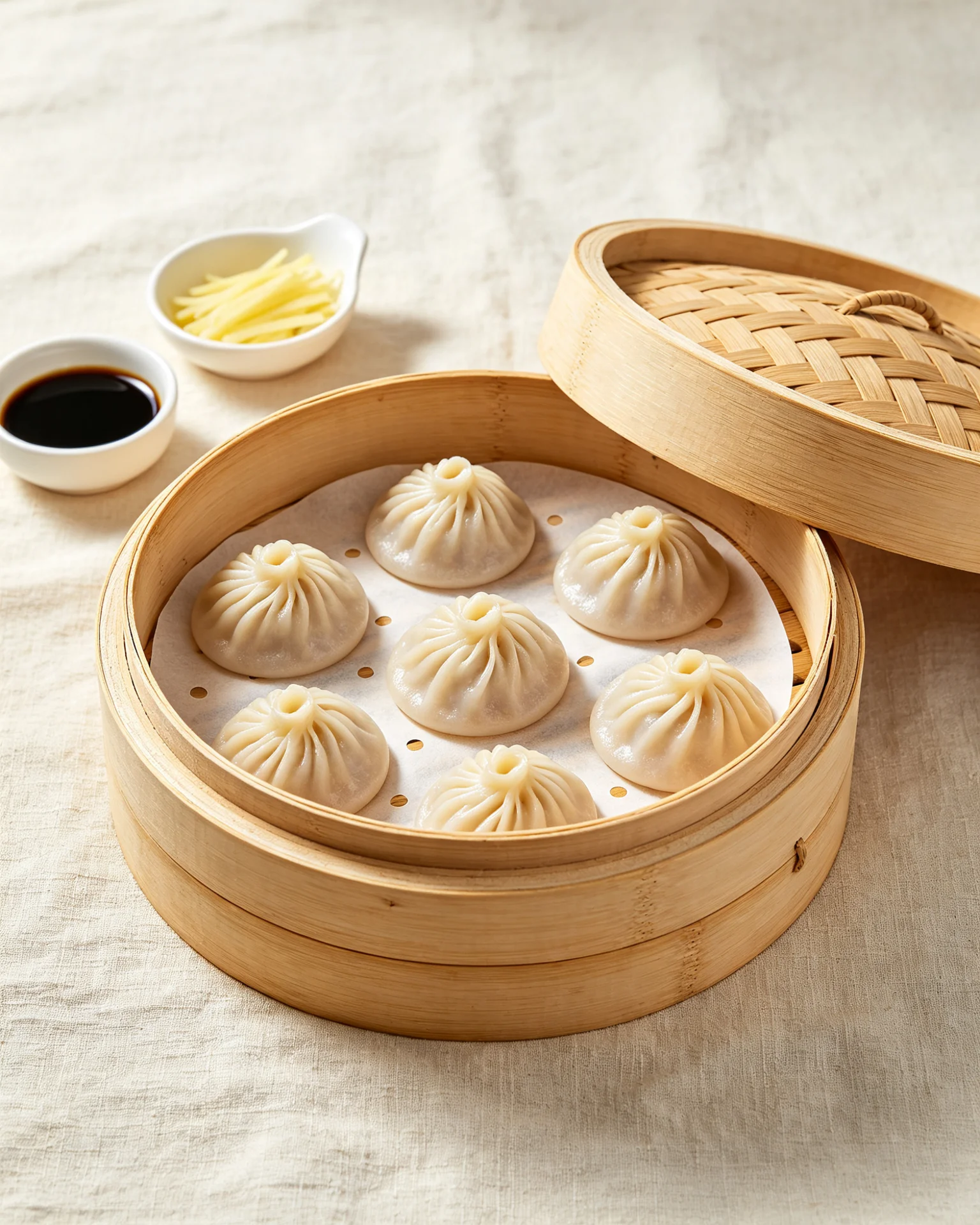
Xiaolongbao (小笼包, xiǎolóngbāo) means small-basket bun, xiǎo is small, lóng is the type of bamboo steaming basket, bāo is a filled bun or dumpling. The name refers to the bamboo steamer it is cooked and served in, not to the dumpling itself.
The dish is documented from Nanxiang, a town now absorbed into the Shanghai municipality, in the late Qing dynasty. The original xiaolongbao was a filled bun, larger, thicker-skinned, closer to a baozi than the delicate dumplings known today. The evolution toward thinner skins and the specific soup-inside format happened over several generations of refinement.
Din Tai Fung, the Taiwanese restaurant chain founded in Taipei in 1958 and expanded globally, is largely responsible for the international standard most people associate with xiaolongbao: the 18-pleat format, the specific filling-to-soup ratio, the delicate wrapper. Din Tai Fung’s kitchen reportedly operates a quality control standard that counts the pleats on every dumpling, 18 is the target. The standard produced by home cooks is usually 12-16. The soup still appears at 8.
How does the soup get inside?
The soup starts as a solid. This is the aspic trick and it is the most counterintuitive thing about xiaolongbao.
Collagen is the structural protein of animal connective tissue, skin, tendons, and the tissue surrounding bones. When you simmer pork skin or pork bones in water above approximately 70°C, a specific thing happens to the collagen: the hydrogen bonds holding its triple-helix structure together break, and the three protein chains unwind into separate gelatin chains floating in the liquid.
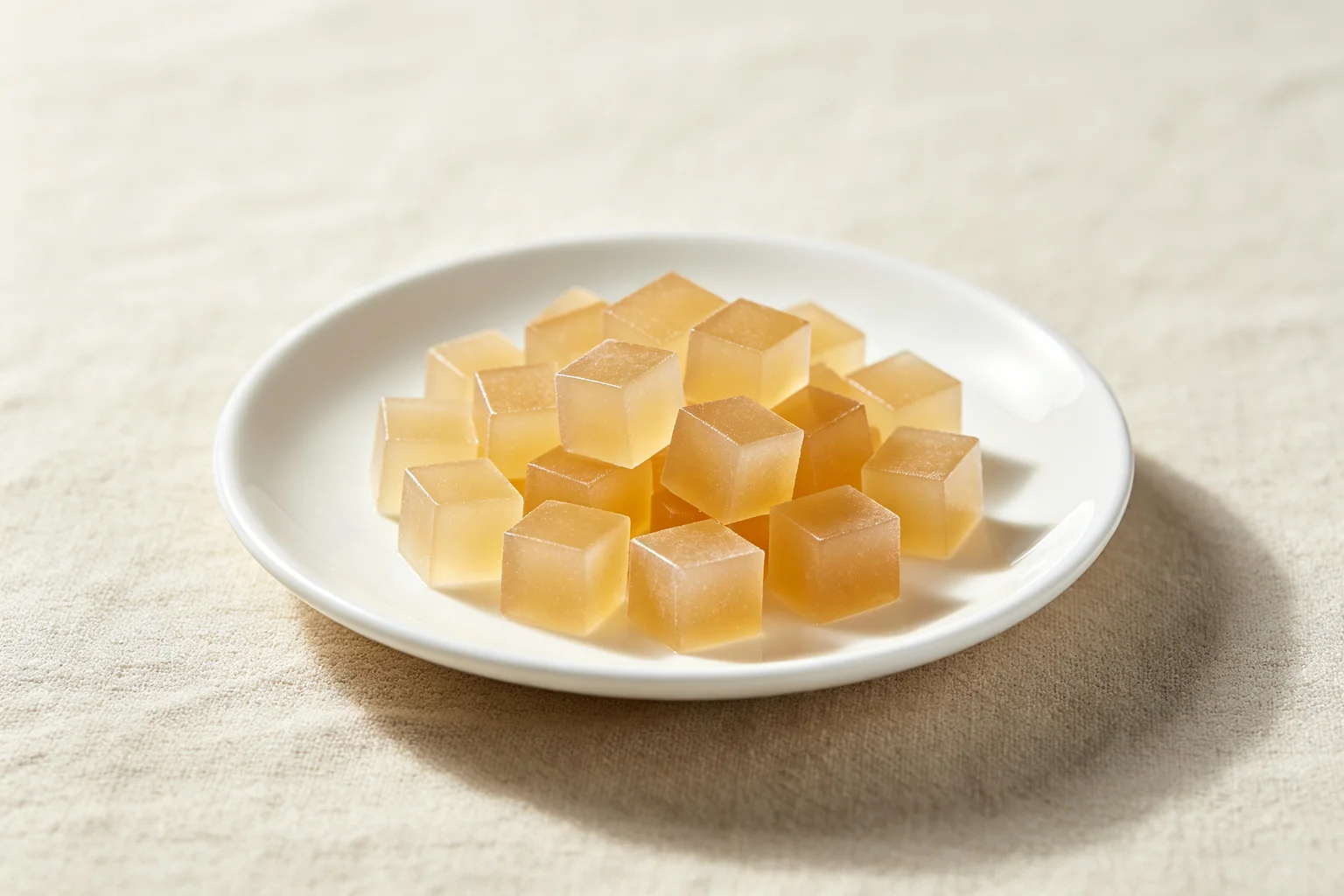
When this gelatin-rich liquid cools below approximately 25-30°C, the gelatin chains partially re-associate through weak hydrogen bonds, forming a three-dimensional network that traps the water. The liquid sets into a solid gel, the aspic. It is firm enough to cut into cubes and mix into the pork filling.
During steaming at 100°C, the steam heat re-exceeds the gel’s melting point (approximately 35-40°C). The gel network dissolves back into liquid. The soup appears inside the sealed dumpling without anyone having poured liquid into it.
This is a reversible physical phase transition, the same gelatin chains form and dissolve gel networks repeatedly as the temperature changes. It is the same collagen extraction mechanism covered in the Cantonese congee recipe on this site, where the knuckle bones produce gelatin that sets the broth to a jelly in the refrigerator.
Powdered gelatin is the practical shortcut: it is already denatured collagen in powder form, ready to form the same gel network when dissolved in hot liquid and cooled. It produces identical results to the traditional pork skin method in a fraction of the time.
Why does the dough need to rest?
Wheat flour contains two proteins, glutenin and gliadin, that form the gluten network when hydrated and mechanically worked during kneading. Kneading aligns these proteins and creates cross-links between them, building an elastic network under mechanical tension.
In this tensioned state, freshly kneaded dough is highly elastic. When you roll it, the gluten resists deformation and the thin sections spring back toward their original shape. If you force it thinner than the tension can hold, it tears.
Resting the dough covered at room temperature for 30-60 minutes allows the gluten network to undergo stress relaxation, the protein chains find lower-energy configurations and the cross-links between them reorganise into a more stable arrangement. The dough shifts from elastic (resists deformation) to more plastic (accepts deformation).
Rested dough rolled thin holds its shape. Unrested dough rolled thin either springs back or tears. This is why the resting step is not optional and why adding more resting time, up to 60 minutes, consistently improves the wrapper quality. The dough will look unchanged after resting, but the behaviour when rolled is completely different.
Why do you roll the edges thinner than the centre?
This is the step most recipes describe without explaining.
During pleating, each fold of the wrapper edge creates a stack of 2-3 layers at the fold point. The standard 18 pleats involve 18 individual folds around the circumference. Each fold adds 2-3 layers, the pleated top of the dumpling therefore has 36-54 compacted layers of wrapper.
If the wrapper is rolled to a uniform thickness, approximately 1-1.5mm, which is already thin, the pleated top would be 36-54mm thick. That is a dense, doughy knot completely at odds with the delicate sealed top of properly made xiaolongbao.
Rolling the edges progressively thinner, approximately 0.5-0.8mm at the perimeter, while keeping the centre slightly thicker (approximately 1.5-2mm, enough to hold the filling weight during assembly) compensates for this pleat multiplication. The pleated top ends up approximately 9-15mm of compacted thin wrapper, still thicker than the body but not unpleasantly doughy.
The rolling technique: place the dough round on the board, position the rolling pin at the edge, and roll toward the centre without quite reaching it. Rotate the round slightly and repeat. The centre stays thicker from not being directly rolled; the edges get thinner from repeated passes of the pin.
Why must the dumplings not touch each other in the steamer?
Steam moisture is the reason.
During steaming, water vapour condenses on the cooler surfaces of the dumplings, particularly in the first 2-3 minutes before they heat through. This condensed moisture hydrates the outer surface of the wrapper. Hydrated gluten is significantly more adhesive than dry gluten, this is the same phenomenon that makes wet dough stick to work surfaces.
If two dumplings are touching when this hydration occurs, their wrapper surfaces fuse together. The fusion point becomes a merged layer of gluten protein as the heat drives the proteins to intermingle. By the time the dumplings are cooked, the fused area is structurally as strong as the surrounding wrapper.
Attempting to separate two fused dumplings tears one or both, creating a puncture through which all the soup escapes. The dumpling that reaches the spoon is empty.
The minimum 2cm spacing between dumplings prevents any contact during the slight expansion of the filling as it heats. Line the steamer with parchment or cabbage leaves to prevent sticking at the base, the base contact is a different failure mode from the side fusion problem, but both result in torn wrappers.
How do you eat xiaolongbao without burning your mouth?
The soup inside a properly steamed xiaolongbao reaches approximately 90-95°C by the end of the 8-10 minute steaming time. The thin wrapper is a poor thermal conductor, heat does not transfer efficiently from the interior soup to the exterior air. A xiaolongbao left for 2-3 minutes after steaming drops to only approximately 75-80°C, still well above the pain threshold for direct mouth contact (approximately 60-65°C for most people).
Biting directly into the dumpling punctures the wrapper and releases near-boiling soup onto the mucous membranes of the palate in a sudden flood. This is how xiaolongbao acquired its reputation for burning first-time eaters.
The correct technique is specific:
Place the dumpling on a large spoon. Nibble a small hole in the side of the wrapper, not the bottom, which would let the soup spill onto the spoon. Allow the steam to escape from the hole for 10-20 seconds. Then sip the soup through the hole carefully. The soup cools to approximately 60-65°C within 30-45 seconds of the hole being opened, warm but not scalding.
Some people add a few drops of the black vinegar-ginger dipping sauce to the soup on the spoon before sipping. Both approaches are correct. The key is the 10-20 second wait after opening the hole.
Then eat the remaining dumpling in one bite.
What is the dipping sauce and why ginger with black vinegar?
Chinese black vinegar (Chinkiang vinegar, 镇江香醋) has a complex, slightly smoky character significantly different from rice vinegar, it is aged from glutinous rice and wheat bran and contains a range of organic acids and aromatic compounds beyond simple acetic acid.
The julienned fresh ginger is not just flavour. Raw ginger contains gingerols and shogaols, volatile aromatic compounds with warming character and anti-nausea properties. The traditional pairing with xiaolongbao is partly practical: the rich pork fat in the filling can be heavy when eaten in quantity, and ginger historically was paired with rich meats to aid digestion.
The black vinegar’s acidity performs the same function it does in every other dish on this site where acid balances fat, it cuts through the richness of the pork filling and prevents the soup from tasting one-dimensionally rich after several dumplings. The ginger adds fragrance and warmth.
Do not substitute white rice vinegar, the complexity of Chinkiang is the point.
Ingredients
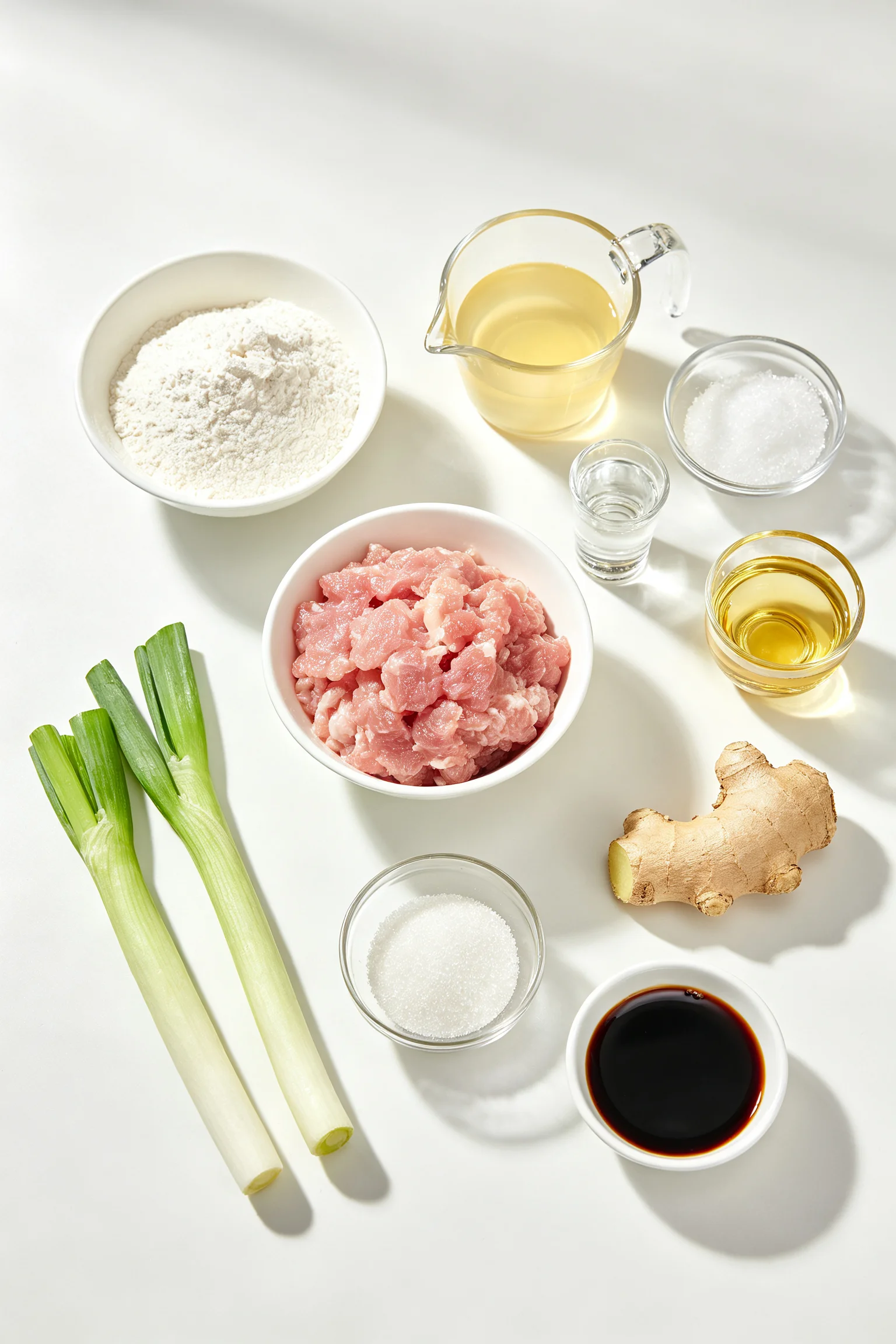
Makes 24 xiaolongbao
Aspic (make at least 3 hours ahead, overnight is better):
- 500ml (2 cups) good chicken or pork stock
- 2 tsp powdered gelatin (or 1 leaf gelatin per 100ml stock)
- 1 tsp soy sauce
- ½ tsp salt
Or traditional method: simmer 300g pork skin in 600ml water for 2 hours, strain, season, refrigerate overnight until set.
Dough:
- 200g (1½ cups) plain flour (all-purpose)
- 100ml (7 tbsp) boiling water
- Pinch of salt
Filling:
- 250g (9oz) ground pork (80/20 lean to fat)
- 150g aspic, diced small (approximately 5mm cubes)
- 2 tbsp light soy sauce
- 1 tbsp Shaoxing wine
- 1 tbsp sesame oil
- 1 tsp sugar
- ½ tsp white pepper
- 2cm fresh ginger, finely grated
- 2 spring onions, white parts only, finely minced
Dipping sauce:
- 3 tbsp Chinkiang black vinegar
- 2cm fresh ginger, finely julienned
Instructions
Make the aspic first, it needs at least 3 hours to set. Make the dough while the aspic sets.
Step 1: Make the aspic
Bloom the gelatin: sprinkle powdered gelatin over 3 tablespoons of cold stock. Leave 5 minutes until it absorbs the liquid and swells.
Heat the remaining stock until just simmering. Remove from heat. Add the bloomed gelatin and stir until completely dissolved. Add soy sauce and salt. Taste, the aspic should be well-seasoned, slightly saltier than you want the finished soup, because the flavour will be diluted inside the dumpling.
Pour into a flat container (a small baking dish works well). Refrigerate until firmly set, at least 3 hours. The set aspic should hold a clean cut and not be sticky on the surface. Once set, dice into 5mm cubes. Keep refrigerated until needed.
Step 2: Make the dough
Pour boiling water over the flour and salt in a bowl. Stir with chopsticks or a fork until the water is absorbed and shaggy dough forms.
Step 3: Make the filling
Combine ground pork with soy sauce, Shaoxing wine, sesame oil, sugar, white pepper, grated ginger, and spring onions. Mix vigorously in one direction for 3-4 minutes until the filling is slightly sticky and cohesive, this is the myosin development covered in the siu mai recipe on this site.
Add the diced aspic cubes to the seasoned pork. Fold gently, do not stir aggressively, which breaks up the cubes and melts them into the pork. The aspic pieces should remain visible and distinct. Keep the filling refrigerated until ready to assemble.
Step 4: Roll the wrappers
Divide the rested dough into 24 equal pieces (approximately 12-13g each). Keep unused pieces covered.
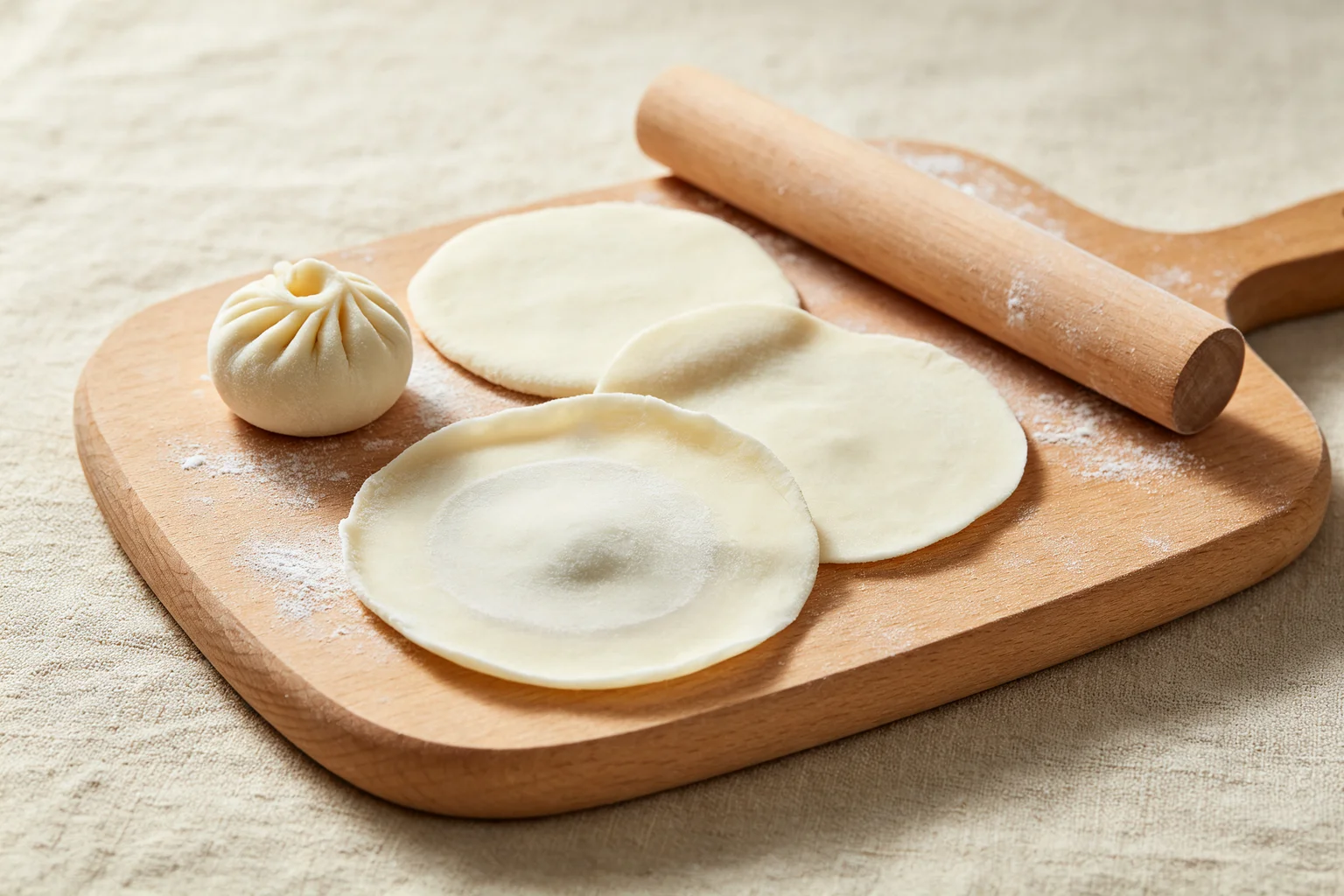
Roll each piece into a ball, then flatten slightly. Using a small rolling pin, roll from the edge toward the centre without quite reaching the centre. Rotate slightly and repeat. Work around the perimeter, rolling the edges progressively thinner than the centre. The final wrapper should be approximately 8-9cm in diameter, thin and translucent at the edges, slightly thicker at the centre.
Work quickly, wrappers dry out fast. Cover finished wrappers with a slightly damp cloth while you continue rolling.
Step 5: Fill and pleat
Working with one wrapper at a time, place approximately 1 tablespoon of cold filling in the centre, including several pieces of aspic. The filling should be cold, warm filling begins melting the aspic and makes the dumpling harder to seal.
Hold the filled wrapper in your non-dominant hand. Using the thumb and index finger of your dominant hand, create small pleats around the edge of the wrapper, working in one direction. Each pleat tucks the edge of the wrapper over itself and pinches. Aim for 12-18 pleats. Gather the pleats at the top and twist to seal. The top should be completely closed with no gaps.
Place the sealed dumpling on a parchment-lined surface. Keep finished dumplings covered with a damp cloth to prevent drying.
Step 6: Steam
Line bamboo steamer baskets with parchment paper cut to fit, with small holes poked through. Or line with blanched cabbage leaves.
Bring water in the steamer base to a full rolling boil. Place the steamer over the boiling water, cover, and steam for 8-10 minutes. Do not lift the lid during steaming.
Serve in the steamer basket. Provide the black vinegar-ginger dipping sauce alongside.
Step 7: Eat correctly
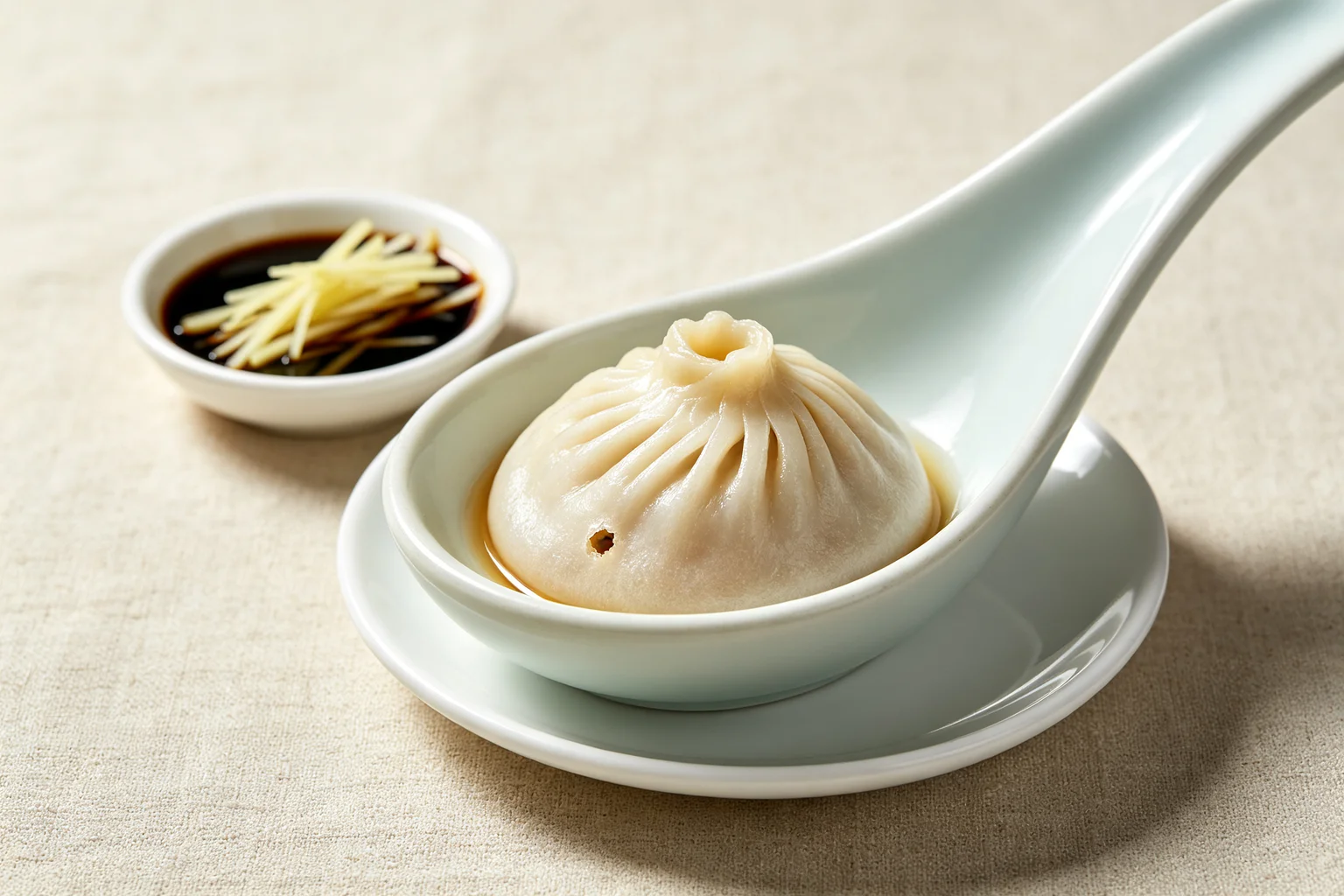
Place each dumpling on a large spoon. Nibble a small hole in the side.
How do you store and freeze xiaolongbao?
Freeze before steaming, not after. Cooked xiaolongbao do not reheat well, the wrapper toughens and the soup leaks. Uncooked xiaolongbao freeze extremely well.
To freeze: place assembled uncooked xiaolongbao on a parchment-lined tray with pieces not touching. Freeze until solid, approximately 2 hours. Transfer to a freezer bag. They keep for up to 3 months.
To cook from frozen: place directly in the lined steamer without thawing. Steam for 12-13 minutes rather than 8-10. The extra time allows the frozen filling to cook through and the aspic to melt completely. Check that the soup has liquefied inside before serving, press gently on the top of one dumpling; you should feel liquid movement inside.
FAQ
Why is there no soup inside my xiaolongbao? Three causes. First, the aspic was not cold enough when assembled, warm aspic melts before the wrapper is sealed and the soup escapes during assembly. Keep the filling refrigerated and work quickly. Second, the seal at the top was not tight, a gap in the pleating allows the soup to escape during steaming. Pinch the top firmly and twist. Third, the dumplings touched each other in the steamer and fused, tearing when separated, maintain 2cm minimum spacing.
Can I use store-bought dumpling wrappers? Yes, with modifications. Store-bought round dumpling or gyoza wrappers are thicker than traditional xiaolongbao wrappers. Roll each one slightly thinner with a rolling pin before using, paying particular attention to the edges. The thicker starting point means fewer pleats are possible, aim for 8-12 rather than 18. The soup will still appear inside. The wrapper texture is noticeably less delicate than hand-rolled but the dish still tastes correct.
How do I know if the dough has rested long enough? Tear off a small piece of dough and roll it as thin as possible. If it springs back immediately and tears, the gluten is still under tension, rest for another 15 minutes and test again. If it rolls thin and holds its shape without significant spring-back, the gluten has relaxed and the dough is ready. In practice, 45 minutes at room temperature is almost always sufficient. In a cold kitchen, the relaxation is slower, extend to 60 minutes.
What is the difference between xiaolongbao and tangbao? Tangbao (汤包, soup bun) is the giant soup dumpling eaten with a straw, the oversized version made famous by certain Shanghai and Wuxi restaurants. A tangbao can be the size of a small bowl. The same aspic technique is used but the filling-to-soup ratio is different, and the format is designed for a straw rather than chopsticks and a spoon. Xiaolongbao is the small, 18-pleat standard; tangbao is the theatrical large version. Both use the same collagen gelatin mechanism. Neither should be confused with xiao long bao in Taiwan, where the same name refers to what mainland Chinese call xiaolongbao, the terminology is consistent; only the scale differs between xiaolongbao and tangbao.
You might also like: Check out our complete Chinese cooking guide for more essential ingredients and techniques.
Xiaolongbao Recipe (小笼包 / Soup Dumplings)
PT3H (includes aspic setting time)
PT10M
PT3H10M
Nutrition Facts
Ingredients
- 500ml (2 cups) good chicken or pork stock
- 2 tsp powdered gelatin (or 1 leaf gelatin per 100ml stock)
- 1 tsp soy sauce
- ½ tsp salt
- 200g (1½ cups) plain flour (all-purpose)
- 100ml (7 tbsp) boiling water
- Pinch of salt
- 250g (9oz) ground pork (80/20 lean to fat)
- 150g aspic, diced small (approximately 5mm cubes)
- 2 tbsp light soy sauce
- 1 tbsp Shaoxing wine
- 1 tbsp sesame oil
- 1 tsp sugar
- ½ tsp white pepper
- 2cm fresh ginger, finely grated
- 2 spring onions, white parts only, finely minced
- 3 tbsp Chinkiang black vinegar
- 2cm fresh ginger, finely julienned
Instructions
- *Make the aspic first, it needs at least 3 hours to set. Make the dough while the aspic sets.*
- Bloom the gelatin: sprinkle powdered gelatin over 3 tablespoons of cold stock. Leave 5 minutes until it absorbs the liquid and swells. Heat the remaining stock until just simmering. Remove from heat. Add the bloomed gelatin and stir until completely dissolved. Add soy sauce and salt. Taste, the aspic should be well-seasoned, slightly saltier than you want the finished soup, because the flavour will be diluted inside the dumpling. Pour into a flat container (a small baking dish works well). Refrigerate until firmly set, at least 3 hours. The set aspic should hold a clean cut and not be sticky on the surface. Once set, dice into 5mm cubes. Keep refrigerated until needed.
- Pour boiling water over the flour and salt in a bowl. Stir with chopsticks or a fork until the water is absorbed and shaggy dough forms. When cool enough to handle, knead by hand for 8-10 minutes until the dough is smooth and elastic, it will feel slightly firm. Form into a ball, cover tightly with plastic wrap or a damp cloth, and rest at room temperature for at least 45 minutes. Do not skip or shorten this step.
- Combine ground pork with soy sauce, Shaoxing wine, sesame oil, sugar, white pepper, grated ginger, and spring onions. Mix vigorously in one direction for 3-4 minutes until the filling is slightly sticky and cohesive, this is the myosin development covered in the siu mai recipe on this site. Add the diced aspic cubes to the seasoned pork. Fold gently, do not stir aggressively, which breaks up the cubes and melts them into the pork. The aspic pieces should remain visible and distinct. Keep the filling refrigerated until ready to assemble.
- Divide the rested dough into 24 equal pieces (approximately 12-13g each). Keep unused pieces covered. Roll each piece into a ball, then flatten slightly. Using a small rolling pin, roll from the edge toward the centre without quite reaching the centre. Rotate slightly and repeat. Work around the perimeter, rolling the edges progressively thinner than the centre. The final wrapper should be approximately 8-9cm in diameter, thin and translucent at the edges, slightly thicker at the centre. Work quickly, wrappers dry out fast. Cover finished wrappers with a slightly damp cloth while you continue rolling.
- Working with one wrapper at a time, place approximately 1 tablespoon of cold filling in the centre, including several pieces of aspic. The filling should be cold, warm filling begins melting the aspic and makes the dumpling harder to seal. Hold the filled wrapper in your non-dominant hand. Using the thumb and index finger of your dominant hand, create small pleats around the edge of the wrapper, working in one direction. Each pleat tucks the edge of the wrapper over itself and pinches. Aim for 12-18 pleats. Gather the pleats at the top and twist to seal. The top should be completely closed with no gaps. Place the sealed dumpling on a parchment-lined surface. Keep finished dumplings covered with a damp cloth to prevent drying.
- Line bamboo steamer baskets with parchment paper cut to fit, with small holes poked through. Or line with blanched cabbage leaves. Place the dumplings in the steamer with at least 2cm between each one, they must not touch. Bring water in the steamer base to a full rolling boil. Place the steamer over the boiling water, cover, and steam for 8-10 minutes. Do not lift the lid during steaming. Serve in the steamer basket. Provide the black vinegar-ginger dipping sauce alongside.
- Place each dumpling on a large spoon. Nibble a small hole in the side. Wait 10-20 seconds for the steam to escape. Sip the soup through the hole. Then eat the remaining dumpling. Do not rush the waiting step. ## How do you store and freeze xiaolongbao? Freeze before steaming, not after. Cooked xiaolongbao do not reheat well, the wrapper toughens and the soup leaks. Uncooked xiaolongbao freeze extremely well. To freeze: place assembled uncooked xiaolongbao on a parchment-lined tray with pieces not touching. Freeze until solid, approximately 2 hours. Transfer to a freezer bag. They keep for up to 3 months. To cook from frozen: place directly in the lined steamer without thawing. Steam for 12-13 minutes rather than 8-10. The extra time allows the frozen filling to cook through and the aspic to melt completely. Check that the soup has liquefied inside before serving, press gently on the top of one dumpling; you should feel liquid movement inside.
Did you make this recipe?
Tag @asianfoodsdaily on Instagram or leave a comment below!
Testing Notes
Tested in Asha's kitchen. Last reviewed August 6, 2025.
Ingredient Substitutions
Substitution notes coming soon.
About Asha
Half Asian, half African cook raised between two food-obsessed cultures. I've spent 10 years learning Asian cooking traditions through family, friends, and thousands of hours at the stove — testing every dish until it works in a standard home kitchen.
Read my full storyTechnique & Pantry Guides
Related Recipes
More delicious dishes you might enjoy


Loading comments...