Sri Lankan Pol Sambol (Coconut Sambol) Recipe
Jump to Section
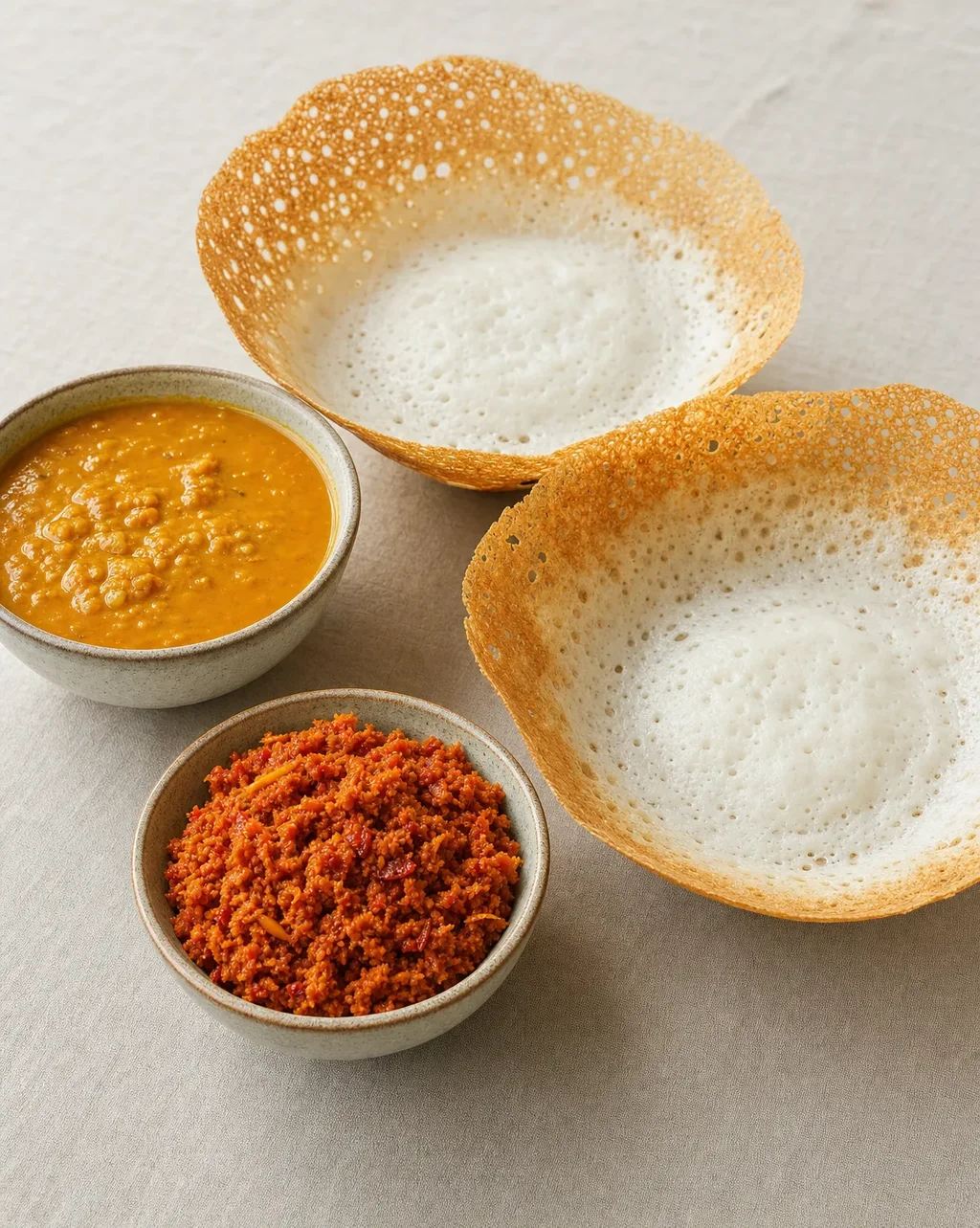
Pol sambol is the condiment that makes a Sri Lankan meal feel complete. It sits alongside the rice and curries at lunch, next to the hoppers at breakfast, and on the table at dinner with roti. No cooking required. No heat, no waiting. Just fresh coconut, chilli, red onion, lime, and the technique that most recipes either get wrong or skip entirely.
What is pol sambol?
Pol sambol is a fresh Sri Lankan coconut relish made from hand-scraped coconut mixed with dried red chilli, red onion, lime juice, and salt. Pol means coconut in Sinhala. Sambol is a category of Sri Lankan condiment — fresh, uncooked, served at room temperature alongside the main meal.
It appears at almost every Sri Lankan meal in some form. With parippu and rice it is the acid and heat that cuts through the richness of the lentils. With hoppers at breakfast it is the coconut base that makes the whole plate feel grounded. It is not a garnish or an optional extra. It is part of the meal’s flavour structure.
The traditional version includes maldive fish — dried, cured tuna — pounded into the sambol for an umami depth that most non-Sri Lankan recipes omit or mark as optional. This recipe gives you both versions: with maldive fish for the authentic result, and without for a fully vegan version that still works.
Why hand-mix, not blend?
Every competitor recipe offers a blender or food processor as an alternative. This is the one place where that swap genuinely damages the dish — not just changes it.
Pol sambol is built on scraped fresh coconut, and fresh coconut has a specific texture: slightly coarse strands with individual fibres intact. That texture does two things. It gives the sambol body — something to grip the chilli and lime rather than collapsing into a paste. And it creates contrast against the softness of the rice or the crunch of a hopper edge.
A blender turns scraped coconut into a fine, wet paste in seconds. The sambol loses its body, the lime juice pools at the bottom, and the whole thing looks and eats like a coconut chutney — which is a different dish.
Hand-mixing preserves the coconut texture because you are folding, not shearing. The shallots and chilli get rubbed into the coconut fibres rather than pulverised with them. The result holds its shape on the plate and has a texture you can actually feel when you eat it.
If you do not have the time or inclination to hand-mix, use a mortar and pestle to pound the chilli, onion, and salt to a coarse paste first, then fold the paste into the coconut by hand. You get the flavour integration without losing the coconut texture.
Does pol sambol need maldive fish?
Maldive fish is in traditional pol sambol. It is not optional in the sense that its presence changes the dish in a specific way — it adds a layer of savoury depth underneath the coconut and chilli that you can taste even when you do not know it is there. Sri Lankan cooks who grew up eating pol sambol made with maldive fish will tell you something is missing from the version without it.
That said, pol sambol without maldive fish is still pol sambol. Vegan Sri Lankan households make it without maldive fish daily. The dish works — it is brighter, cleaner, and more purely coconut-forward. It is a different version rather than a lesser one.
If you can find maldive fish — sold in Sri Lankan and some South Asian grocery stores as hard, dark, irregular pieces — pound 1–2 teaspoons of it to a rough powder in a mortar before adding it. It should be broken down enough to distribute through the sambol but not so fine that it disappears. Small flecks are the right texture.
Ingredients
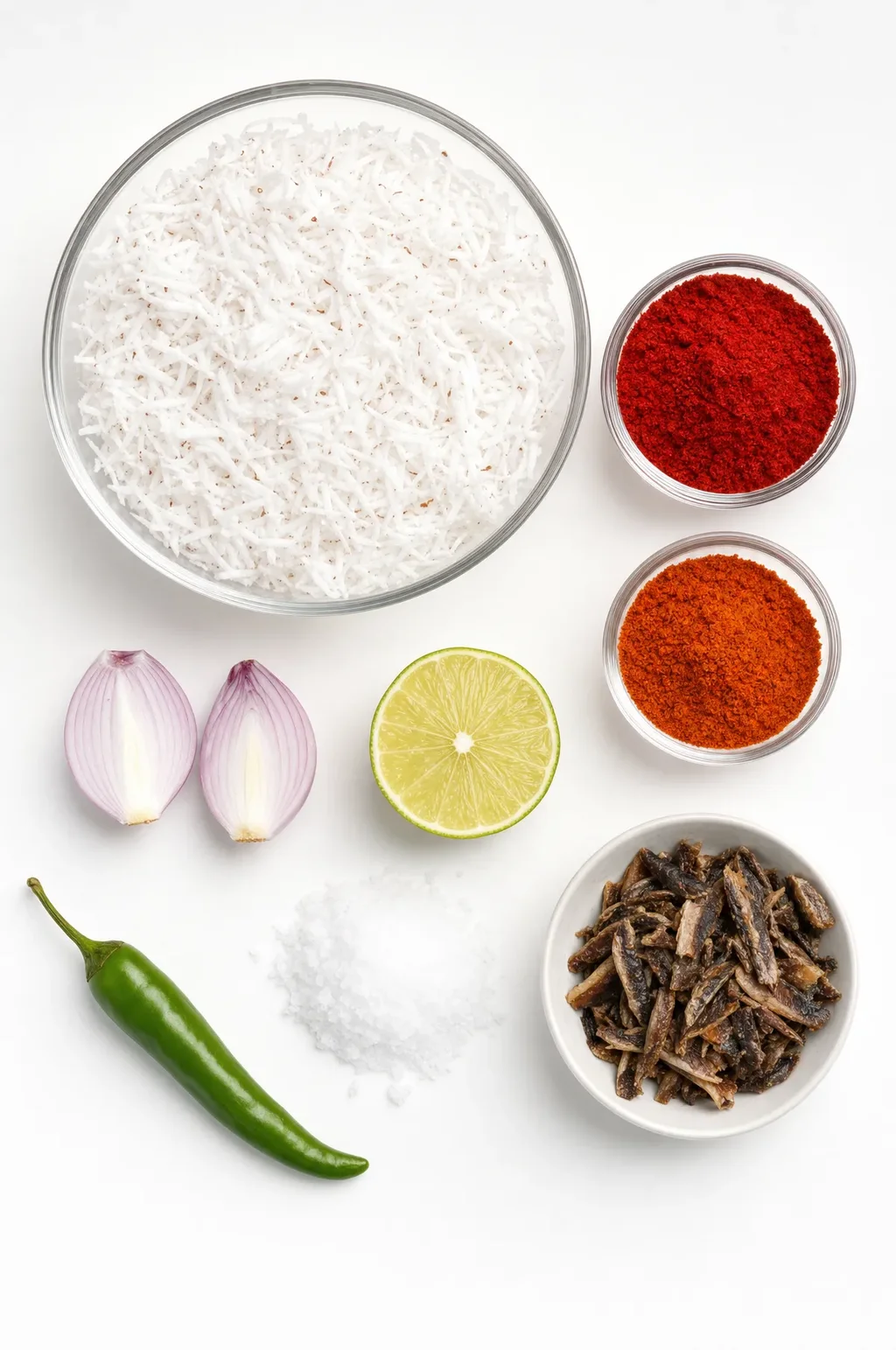
Serves 4 as a condiment
- 200g (2 cups) freshly scraped coconut — from approximately 1 medium coconut
- 2 shallots (or ½ small red onion), very finely sliced
- 1–2 tsp Kashmiri chilli powder or mild red chilli powder — for colour
- ½–1 tsp hot chilli powder or cayenne — for heat, adjust to taste
- 1 tsp maldive fish, pounded to a rough powder — optional, omit for vegan
- 1½ tbsp fresh lime juice (about 1 lime)
- ½ tsp salt, or to taste
- 1 green chilli, finely sliced — optional, for extra heat
How to open and scrape a fresh coconut
Pierce two of the three eyes at the top of the coconut with a skewer or screwdriver. Drain the coconut water out — keep it to drink or use in cooking. Place the drained coconut on a folded tea towel on a hard floor or sturdy surface. Strike it firmly around its equator with the back of a heavy chef’s knife or a hammer, rotating it after each strike. After 4–5 strikes it will crack cleanly along the equator into two halves.
Prise the white flesh away from the shell with a sturdy knife or a butter knife — work around the edge and the flesh releases in sections. Use the fine side of a box grater or a coconut scraper to grate the flesh into long, fine strands. You need the fine grater, not the coarse one. Coarse-grated coconut produces a chunkier, wetter sambol.
One medium coconut yields approximately 200–250g of scraped flesh, which is the right amount for 4 people as a condiment.
Instructions
Step 1: Prepare the coconut
Scrape the fresh coconut as above and set aside in a bowl. The coconut should be at room temperature — cold coconut from the refrigerator is stiff and does not absorb the chilli and lime evenly.
Step 2: Pound the aromatics
If using a mortar and pestle: add the sliced shallots, chilli powders, maldive fish (if using), and salt. Pound to a coarse paste — 2–3 minutes.
If mixing by hand: slice the shallots as finely as possible and place them in the bowl with the coconut. Add the chilli powders, maldive fish, and salt directly.
Step 3: Combine
Add the pounded paste (or the direct aromatics) to the scraped coconut. Use your fingers to mix and rub everything together — press the chilli and onion into the coconut fibres rather than stirring.
Step 4: Add lime and taste
Add the lime juice. Mix again.
Step 5: Rest briefly
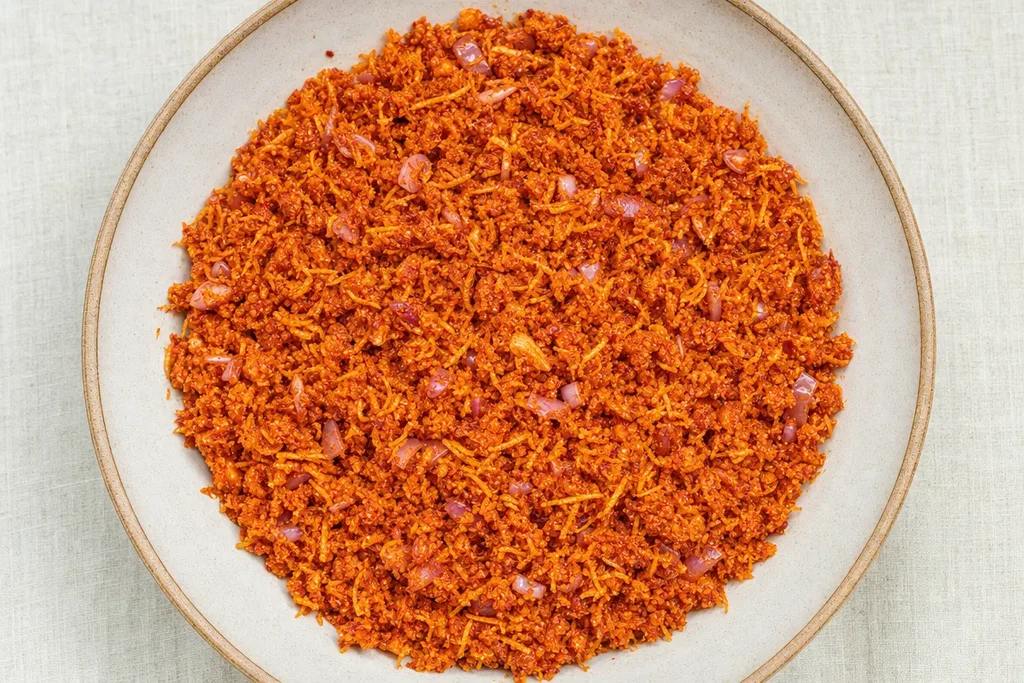
Leave the sambol to sit for 5 minutes before serving. The lime juice softens the shallot slightly and the flavours settle.
Serve at room temperature alongside rice and curry, hoppers, string hoppers, roti, or kiribath.
What to serve pol sambol with
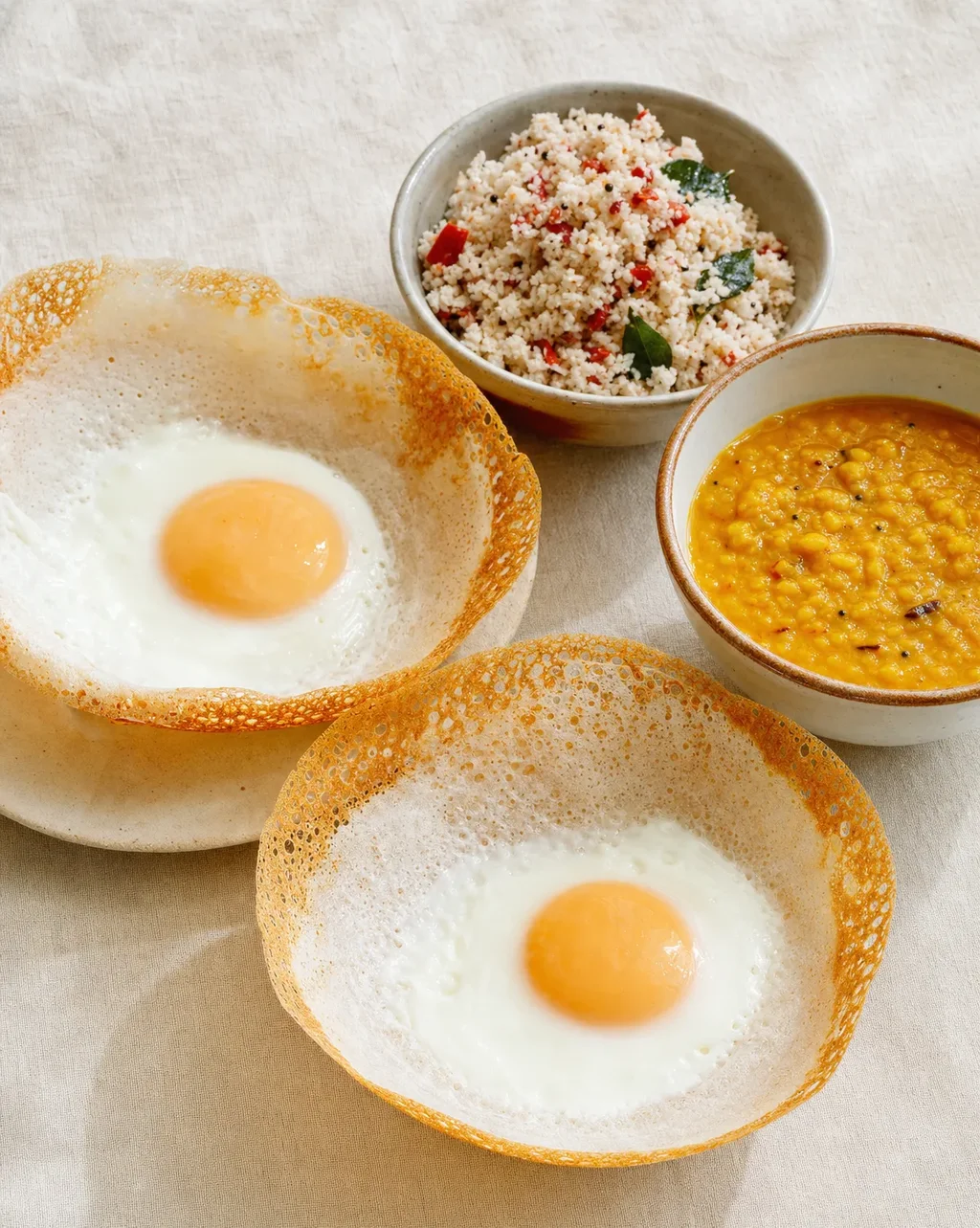
Pol sambol belongs at both ends of the Sri Lankan meal day. At breakfast, it sits next to hoppers or string hoppers with a curry for dipping — the coconut and chilli against the fermented rice batter is one of the defining flavour combinations in Sri Lankan cooking. At lunch, it cuts through the richness of a rice and curry spread the same way a pickle or relish does in other cuisines. Alongside parippu, it is the two-dish combination that every Sri Lankan home cook makes first.
It also works in ways the cuisine page does not mention: on hot buttered toast, alongside scrambled eggs, spooned over congee, or eaten straight from the bowl with a spoon. Once you have a bowl of it in the refrigerator, you will find uses for it.
Storage
Pol sambol is best eaten the day it is made. The coconut continues to absorb the lime juice and chilli over time and the texture softens noticeably after 24 hours. It keeps in the refrigerator for 2 days in a sealed container. The colour deepens and the flavour intensifies — some people prefer it on day two, though the texture is softer.
Do not freeze pol sambol. The coconut texture does not survive freezing and thawing.
Substitutions
Frozen grated coconut: Thaw completely at room temperature, then squeeze out excess moisture in a clean cloth before using. Frozen coconut is wetter than fresh — skipping the squeeze produces a watery sambol that does not hold together. The flavour is slightly less sweet than fresh but the texture is close.
No maldive fish: Leave it out. The sambol is complete without it — brighter and more coconut-forward rather than deficient.
No Kashmiri chilli powder: Use paprika for the colour and a small amount of cayenne for the heat. Kashmiri chilli is low heat and high colour — paprika replicates the colour well, though the flavour is slightly different.
Lemon instead of lime: It works. The flavour is less aromatic than lime but the acid function is the same. Use slightly less — lemon juice is sharper than lime juice at the same volume.
Love Sri Lankan food?
Check out my complete guide to Sri Lankan home cooking, pantry essentials, and techniques.
FAQ
What is the difference between pol sambol and lunu miris? Both are Sri Lankan sambols built on red chilli and red onion, but they are different dishes. Pol sambol contains fresh scraped coconut as its main ingredient — the coconut is the body of the dish. Lunu miris has no coconut at all; it is a paste of red onion, dried red chilli, and Maldive fish pounded together. Lunu miris is drier, more intensely spiced, and darker in flavour. Pol sambol is fresher, sweeter from the coconut, and more textured.
Can I use desiccated coconut for pol sambol? Desiccated coconut produces a noticeably inferior result. It is dried and sweetened, which changes the flavour, and its fine, dry texture turns to a sandy paste when mixed with lime juice rather than holding the fibrous body of fresh-scraped coconut. If fresh and frozen coconut are both unavailable, rehydrate desiccated coconut in a small amount of cold water, drain, and squeeze dry before using. The result is workable but not the same dish.
How spicy is pol sambol? Traditional Sri Lankan pol sambol is genuinely hot. The heat is adjustable — reduce or omit the hot chilli powder while keeping the Kashmiri chilli powder for colour, and the sambol is mild but still flavourful. The coconut fat in the dish tempers the heat slightly compared to a chilli paste, so the same quantity of chilli in pol sambol burns less than it would in a sauce.
Is pol sambol vegan? Pol sambol without maldive fish is fully vegan and is eaten that way in Sri Lankan vegan and vegetarian households regularly. The maldive fish is traditional but not structural — the dish works without it.
Sri Lankan Pol Sambol (Coconut Sambol) Recipe
Sri Lankan, Coconut, Sambol
PT10M
PT0M
PT10M
Ingredients
- 200g (2 cups) freshly scraped coconut — from approximately 1 medium coconut
- 2 shallots (or ½ small red onion), very finely sliced
- 1–2 tsp Kashmiri chilli powder or mild red chilli powder — for colour
- ½–1 tsp hot chilli powder or cayenne — for heat, adjust to taste
- 1 tsp maldive fish, pounded to a rough powder — optional, omit for vegan
- 1½ tbsp fresh lime juice (about 1 lime)
- ½ tsp salt, or to taste
- 1 green chilli, finely sliced — optional, for extra heat
Instructions
- Scrape the fresh coconut as above and set aside in a bowl. The coconut should be at room temperature — cold coconut from the refrigerator is stiff and does not absorb the chilli and lime evenly.
- If using a mortar and pestle: add the sliced shallots, chilli powders, maldive fish (if using), and salt. Pound to a coarse paste — 2–3 minutes. The shallots should be broken down but not completely smooth. Small pieces are correct. A uniform paste is too far. If mixing by hand: slice the shallots as finely as possible and place them in the bowl with the coconut. Add the chilli powders, maldive fish, and salt directly.
- Add the pounded paste (or the direct aromatics) to the scraped coconut. Use your fingers to mix and rub everything together — press the chilli and onion into the coconut fibres rather than stirring. Mix for 2–3 minutes until the coconut is evenly red-orange from the chilli powder and you can smell the onion throughout.
- Add the lime juice. Mix again. Taste for salt, heat, and acid — the sambol should be spicy, slightly sour from the lime, and coconut-sweet underneath. Adjust with more lime, salt, or chilli powder. Add the sliced green chilli if you want extra heat and texture.
- Leave the sambol to sit for 5 minutes before serving. The lime juice softens the shallot slightly and the flavours settle. Do not leave it longer than 30 minutes — the coconut starts to absorb too much moisture and the texture softens. Serve at room temperature alongside rice and curry, hoppers, string hoppers, roti, or kiribath. ## What to serve pol sambol with Pol sambol belongs at both ends of the Sri Lankan meal day. At breakfast, it sits next to hoppers or string hoppers with a curry for dipping — the coconut and chilli against the fermented rice batter is one of the defining flavour combinations in Sri Lankan cooking. At lunch, it cuts through the richness of a rice and curry spread the same way a pickle or relish does in other cuisines. Alongside parippu, it is the two-dish combination that every Sri Lankan home cook makes first. It also works in ways the cuisine page does not mention: on hot buttered toast, alongside scrambled eggs, spooned over congee, or eaten straight from the bowl with a spoon. Once you have a bowl of it in the refrigerator, you will find uses for it.
Did you make this recipe?
Tag @asianfoodsdaily on Instagram or leave a comment below!
Testing Notes
Tested in Asha's kitchen. Last reviewed June 4, 2026.
Ingredient Substitutions
Substitution notes coming soon.
About Asha
Half Asian, half African cook raised between two food-obsessed cultures. I've spent 10 years learning Asian cooking traditions through family, friends, and thousands of hours at the stove — testing every dish until it works in a standard home kitchen.
Read my full storyRelated Recipes
More delicious dishes you might enjoy


Loading comments...