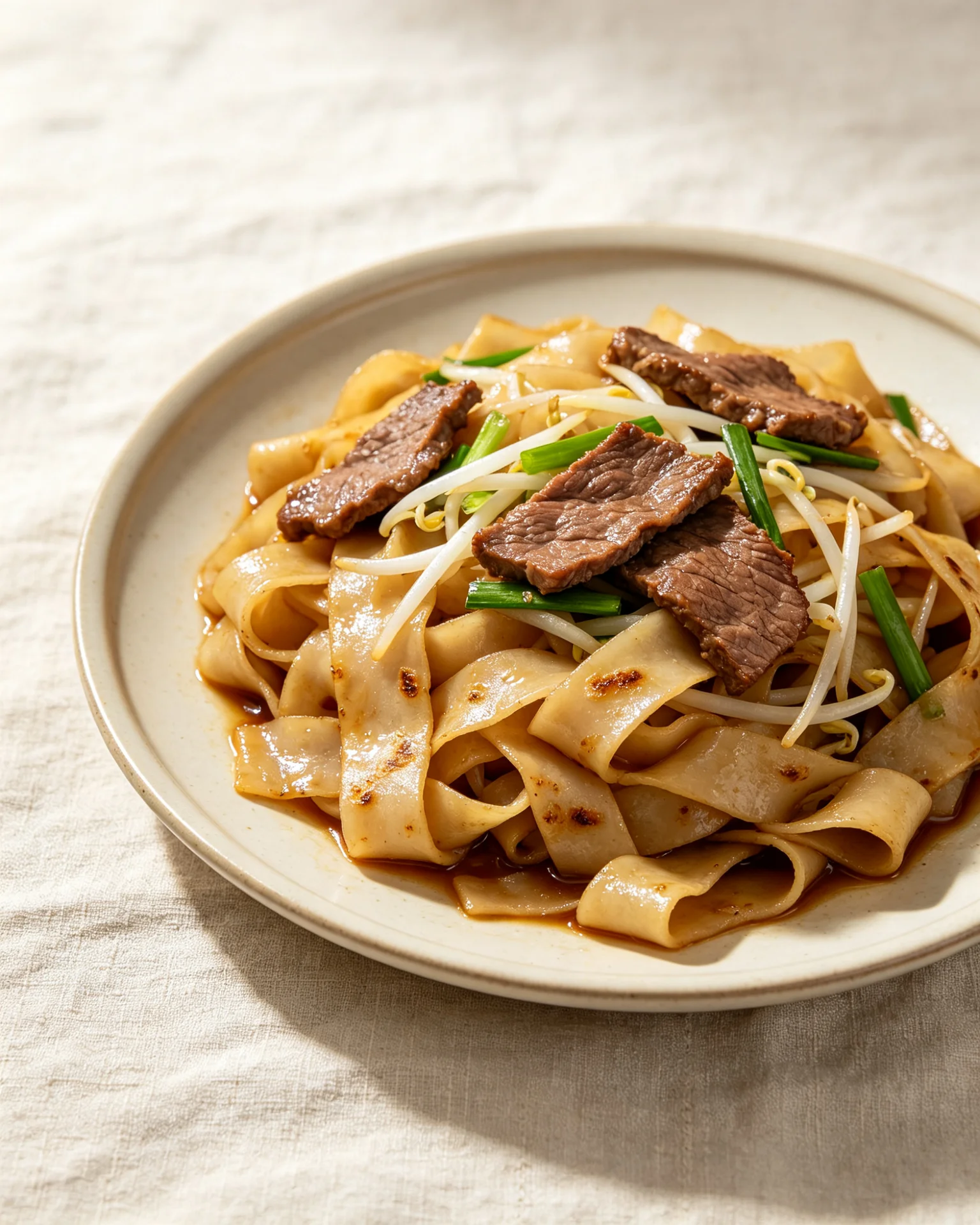
Beef Chow Fun Recipe (干炒牛河)
Jump to Section
The first time I made beef chow fun at home I put everything in the wok at once, beef, noodles, and sauce together. The wok temperature dropped immediately from the combined moisture of the beef and noodles. Everything steamed rather than seared. The noodles were soft and pale, the beef was grey, and nothing had any char on it. It tasted correct but flat, like the components had been warmed together rather than cooked.
The problem is thermal mass. A home burner produces 5-8kW of heat. The beef releases moisture as it cooks. The noodles release moisture as they heat. Combined, their steam drops the wok surface temperature from the 200°C+ needed for searing and charring to approximately 100°C, the temperature of steam. At 100°C you get cooked food. You do not get wok hei. You do not get the slight char on the noodle surface that makes this dish. The solution is to cook each component separately at maximum temperature, then combine at the end. The sequence is the technique.
What is beef chow fun?
Beef chow fun (干炒牛河, gān chǎo niú hé in Mandarin, gon chao ngau ho in Cantonese) means dry stir-fried beef ho fun, gon = dry, chao = stir-fry, ngau = beef, ho = the wide rice noodles. It is a Cantonese dish, firmly rooted in southern Chinese cooking rather than Western Chinese takeout, and one of the signature dishes of the cha chaan teng (茶餐廳), the Hong Kong-style casual diners that define working-class Hong Kong food culture.
The dry in the name distinguishes it from wet beef hor fun, the broth-based version with a thick cornstarch-thickened sauce that pools in the bowl. Dry chow fun has no pool of sauce. The seasoning coats the noodles and beef. The noodles have visible char marks. The dish arrives looking relatively unadorned.
It is considered one of the tests of a wok cook’s skill in Cantonese cooking, the wok must be hot enough to char the noodles without burning them, the beef must be tender despite high heat, and the whole dish must be assembled in under three minutes of actual cooking time. The preparation, however, takes longer than that.
Why does the beef need baking soda?
Baking soda (sodium bicarbonate) in the beef marinade is the velvet technique, the same process used in Chinese stir-fry across many dishes on this site, covered in most detail in the hibachi chicken recipe.
Beef muscle contains myofibrillar proteins, primarily actin and myosin, held in their folded three-dimensional structures by hydrogen bonds and electrostatic interactions at neutral pH (approximately 6.5-7 for fresh beef).
When baking soda raises the surface pH to approximately 8-9, some of these bonds are disrupted. The proteins partially unfold, not fully denatured, but with more exposure of water-binding sites along the protein chains. These partially unfolded proteins form additional hydrogen bonds with surrounding water molecules, holding more moisture within the meat structure.
When the velveted beef hits the wok at 200°C+, the muscle proteins contract and expel moisture. The baking soda-treated proteins, holding more moisture at the start, retain more moisture after the same contraction. The beef stays juicy rather than drying out at high heat.
The quantity matters: a quarter to half teaspoon per 300g of beef. This is the same alkaline protein chemistry as kansui in ramen noodles and lye water in siu mai wrappers, covered in the siu mai recipe on this site, applied at much lower concentration for a subtle texture effect rather than a structural one. More than half a teaspoon produces a soapy, slightly metallic flavour and over-softens the protein to a mushy texture.
Why cut the beef against the grain?
Beef muscle consists of parallel bundles of muscle fibres, the long protein filaments that contracted during the animal’s movement. These fibre bundles run in the same direction through any piece of meat and are visible as parallel lines or striations on the cut surface.
Cutting along the grain, parallel to the fibre direction, produces slices containing long continuous fibre segments. Each bite must sever these fibres along their full length, which requires more chewing force. The texture is stringy.
Cutting against the grain, perpendicular to the fibre direction, produces slices containing very short fibre segments. The full depth of the slice may only span 2-3 fibre diameters. These short segments offer minimal chewing resistance regardless of the cut’s natural toughness.
For beef chow fun, cut the flank steak into slices 2-3mm thick, strictly across the grain. Flank steak has a very visible grain, the parallel striations are easy to identify before cutting. Orient the knife at 90 degrees to these lines. The difference between along-grain and against-grain slices of flank steak is dramatic, the against-grain version is noticeably more tender even raw.
Why do you cook the noodles dry before adding sauce?
Fresh ho fun noodles contain gelatinised rice starch and approximately 65-70% moisture by weight. When they contact a very hot dry wok surface at 200°C+, the rice starch on the exterior undergoes rapid thermal reactions. At these temperatures, with minimal moisture to moderate the heat, Maillard-adjacent char reactions occur between the starch components and produce slightly bitter, smoky aromatic compounds on the noodle surface.
This is the slight char on the exterior of the noodles that gives dry-style beef chow fun its characteristic flavour. It is what distinguishes the dish from soft steamed or sauce-cooked noodles.
If sauce or liquid is added to the wok before this char forms, the liquid immediately begins evaporating and the temperature at the noodle surface drops below the char threshold. The noodles heat through and absorb the sauce but the char reactions cannot proceed. The noodles taste correct but lack the smoky char character.
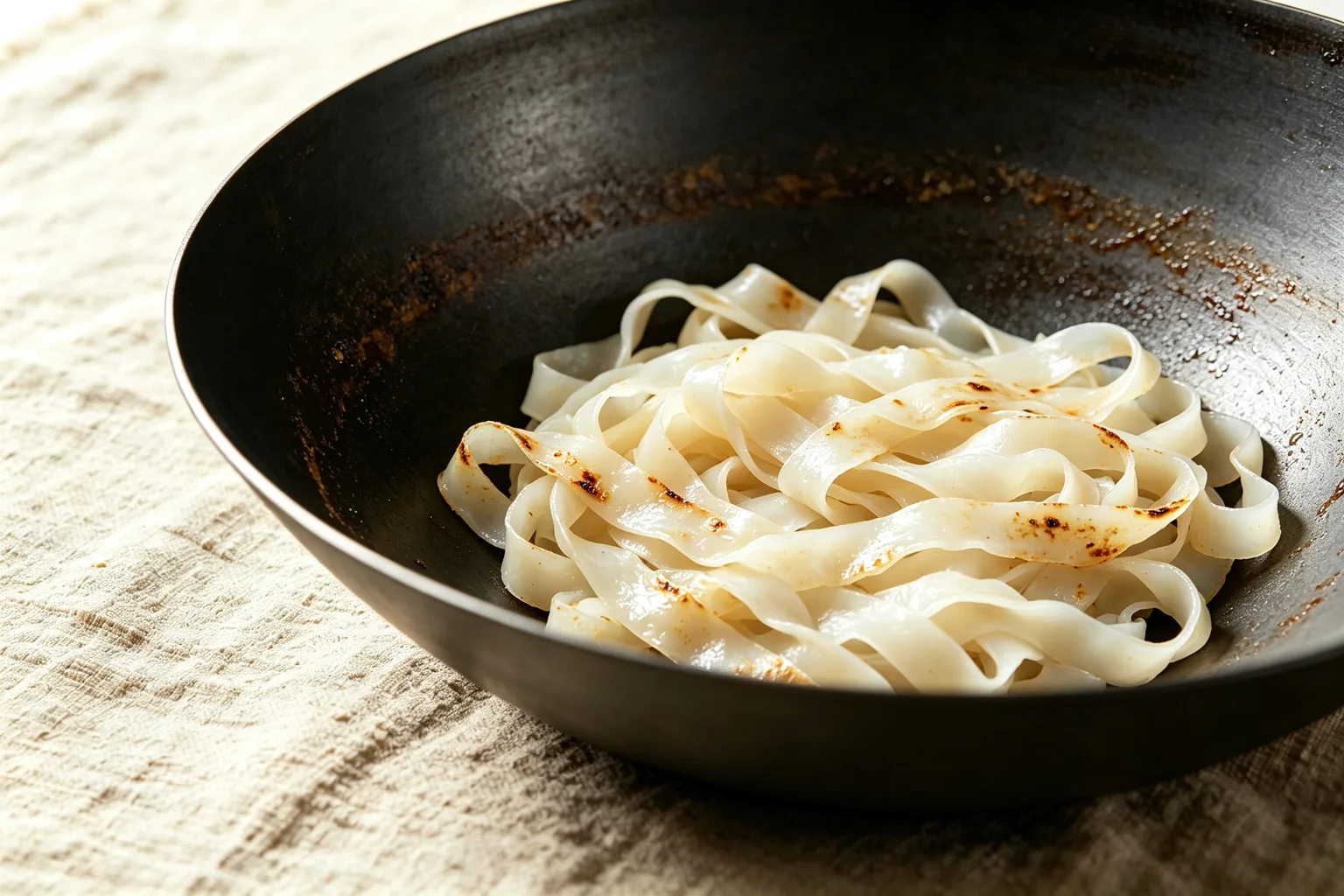
The correct sequence: noodles go into the hot dry wok, left undisturbed for 30-45 seconds until the contact surface begins to char slightly. Then begin tossing. Then add sauce. This order is not optional, the char must form before the liquid arrives.
Leave the noodles undisturbed for the first 30-45 seconds. Do not immediately start stirring. The charring only happens at the contact surface between the noodle and the hot wok, movement breaks this contact before the char can develop.
Why cook the beef and noodles separately?
This is the sequence issue from the opening paragraph explained fully.
A home wok burner produces 5-8kW. A restaurant wok burner produces 50-100kW. At restaurant heat, adding cold ingredients drops the temperature momentarily but the burner recovers it in seconds. At home heat, the recovery is much slower.
Fresh ho fun noodles at room temperature contain approximately 65-70% moisture. Velveted beef also releases moisture during cooking. When both go into the wok simultaneously, their combined moisture creates steam at the wok surface. Steam is 100°C. At 100°C the Maillard reaction cannot proceed. The char on the noodles cannot form. The beef cannot sear.
By cooking the beef first and removing it, the beef sears at maximum wok temperature. By cooking the noodles second in the same clean hot wok, the noodles char at maximum wok temperature. When they are combined at the end, the combination step is brief, a few seconds of tossing with sauce, and the temperature drop does not matter because the char and sear have already happened.
This is also why each component should be cooked in small quantities. The beef should go in as a single layer, not stacked or crowded. The noodles for two servings should be the maximum per batch. Adding more increases collective moisture and accelerates the temperature drop.
How do you approximate wok hei at home?
Wok hei (鑊氣, literally breath of the wok) is the smoky, slightly charred, complex flavour produced by cooking over extreme heat in a seasoned wok. At restaurant intensity it requires burners producing 50-100kW. At home it is an approximation. A good approximation, but an approximation.
The variables that matter most:
Pan choice: Carbon steel or cast iron wok. Not non-stick, non-stick coatings degrade above approximately 260°C and the maximum safe temperature is the temperature at which wok hei begins to be achievable. A well-seasoned carbon steel wok holds heat better than cast iron and develops its own non-stick seasoning over time.
Preheat time: 5 full minutes over the highest burner setting before anything goes in. The wok should be smoking when a small drop of water flicked in vaporises instantly. This is the correct starting temperature. Most home cooks underheat the wok.
Batch size: Maximum two servings per cook. See above, more ingredients means more moisture, faster temperature drop, less char.
Movement: Keep the wok moving during stir-frying, not to cook faster, but to expose different noodle surfaces to the hot wok floor. The char comes from the contact surface. Moving the noodles rotates which surface contacts the wok.
Liquid timing: Add sauce and liquid at the very last moment, after all char and sear has developed. Cold liquid immediately drops the wok temperature.
Following all these produces beef chow fun that is noticeably better than the version that ignores them, not identical to restaurant wok hei, but in the same direction.
Why do ho fun noodles break and how do you prevent it?
Fresh ho fun is made by spreading rice flour batter on a flat surface and steaming it into sheets, then cutting into wide strips. The noodle’s structure is a gelatinised starch gel, held together by starch interactions rather than the gluten network of wheat noodles.
Starch gels are temperature-sensitive. When cold from the refrigerator, the rice starch undergoes retrogradation, the same starch re-crystallisation process covered in the tteokbokki recipe on this site, and the noodle becomes firmer and more brittle. Cold ho fun applied to a hot wok with a wide spatula blade snaps rather than flexes. The rigid starch gel cracks under mechanical pressure.
Room-temperature ho fun has re-softened to near its gelatinised state. The noodle bends without breaking. The same spatula pressure that snaps cold noodles simply folds warm ones.
Leave fresh ho fun at room temperature for 30-45 minutes before cooking. Separate the noodle sheets gently by hand before they go into the wok, pull the layers apart rather than cutting. During stir-frying, use chopsticks or the tip of a spatula rather than the full blade pressing down on the noodles.
If the noodles are still sticking together after reaching room temperature, microwave for 20-30 seconds and separate immediately while warm.
Ingredients
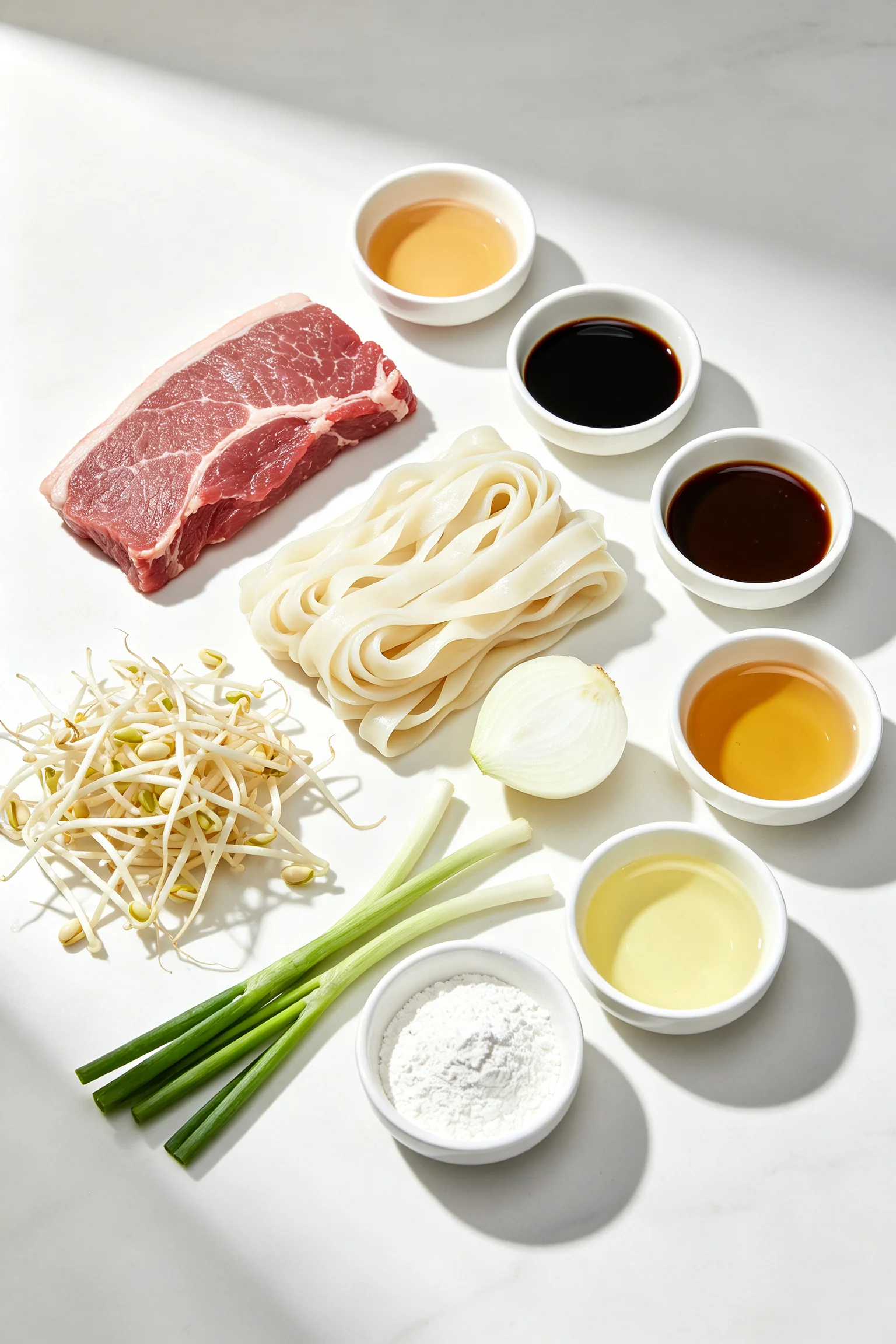
Serves 2
Beef and velvet marinade:
- 300g (10.5oz) flank steak, cut against the grain into 2-3mm thick slices
- 1 tbsp light soy sauce
- 1 tbsp Shaoxing wine
- 1 tsp cornstarch
- ¼ tsp baking soda
- ¼ tsp white pepper
- 1 tsp sesame oil
- 1 tsp neutral oil
Noodles and aromatics:
- 400g (14oz) fresh ho fun (wide rice noodles), at room temperature, separated
- 1 medium onion, thinly sliced
- 3 spring onions, cut into 5cm sections (whites and greens separated)
- 2 cups (100g) bean sprouts
- 3 tbsp neutral oil for cooking
Sauce (mix together in a bowl):
- 2 tbsp light soy sauce
- 1 tbsp dark soy sauce
- 1 tbsp oyster sauce
- ½ tsp sugar
- ½ tsp white pepper
- 1 tsp sesame oil
Instructions
Marinate the beef first. Everything else moves fast once the wok is hot.
Step 1: Velvet the beef
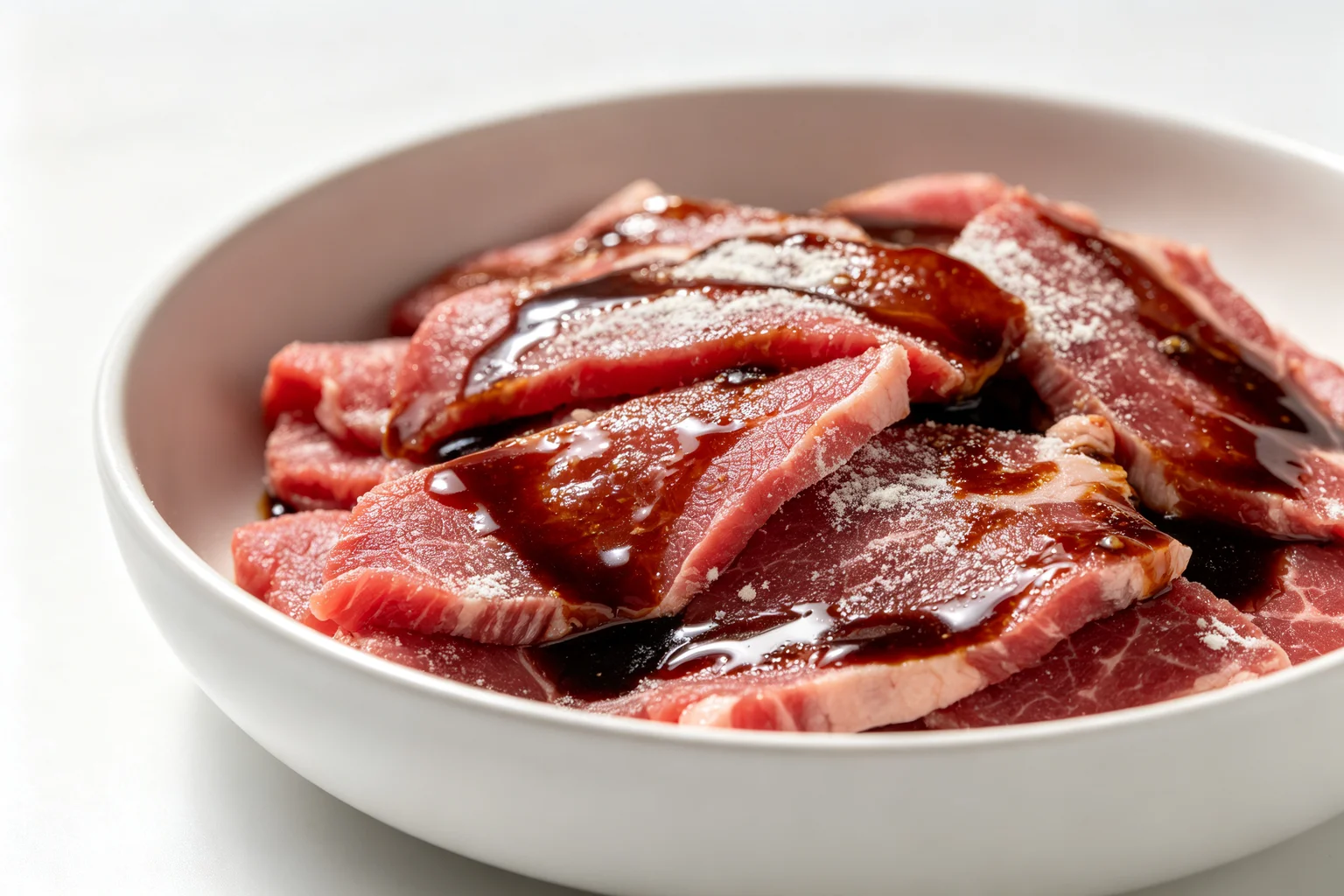
Combine the sliced beef with all marinade ingredients. Mix thoroughly and massage the marinade into the beef.
Step 2: Prepare everything
Bring the ho fun to room temperature. Separate the sheets gently by hand into individual noodle strips.
Step 3: Preheat the wok
Heat the wok over the highest burner setting for 5 full minutes until smoking. Add 1 tablespoon of oil.
Step 4: Sear the beef
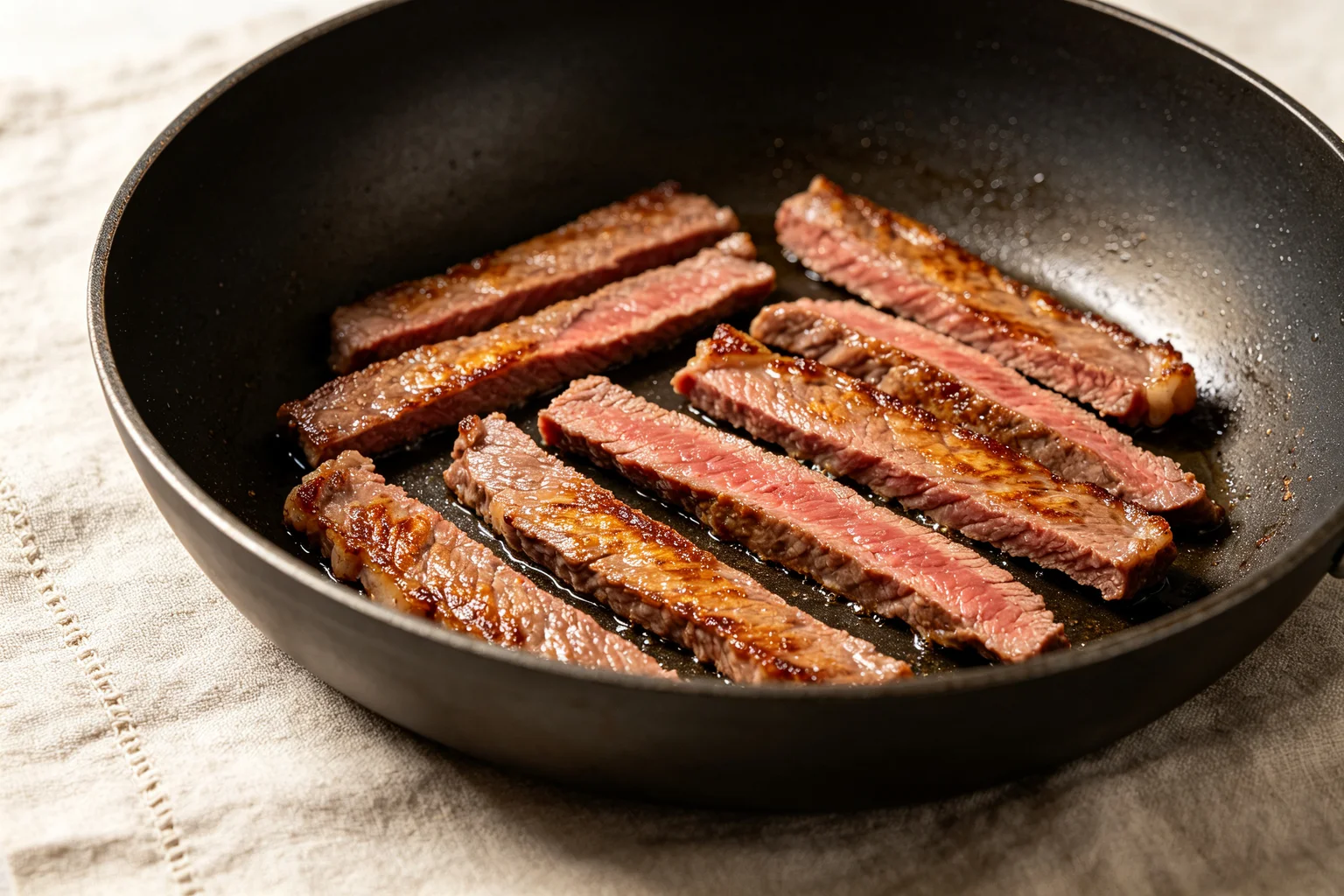
Add the marinated beef in a single layer. Do not stir for 30 seconds, allow the contact surface to sear.
Step 5: Char the noodles
Wipe out the wok if needed. Return to maximum heat.
Step 6: Add aromatics and sauce
Add the sliced onion and spring onion whites. Toss with the noodles for 30 seconds.
Pour the sauce around the perimeter of the wok, not directly on the noodles. The sauce hits the hot wok surface and begins to caramelise before reaching the noodles, the same perimeter technique covered in the hibachi chicken recipe on this site. Toss vigorously until every noodle strand is coated and the sauce is absorbed.
Step 7: Return the beef and finish
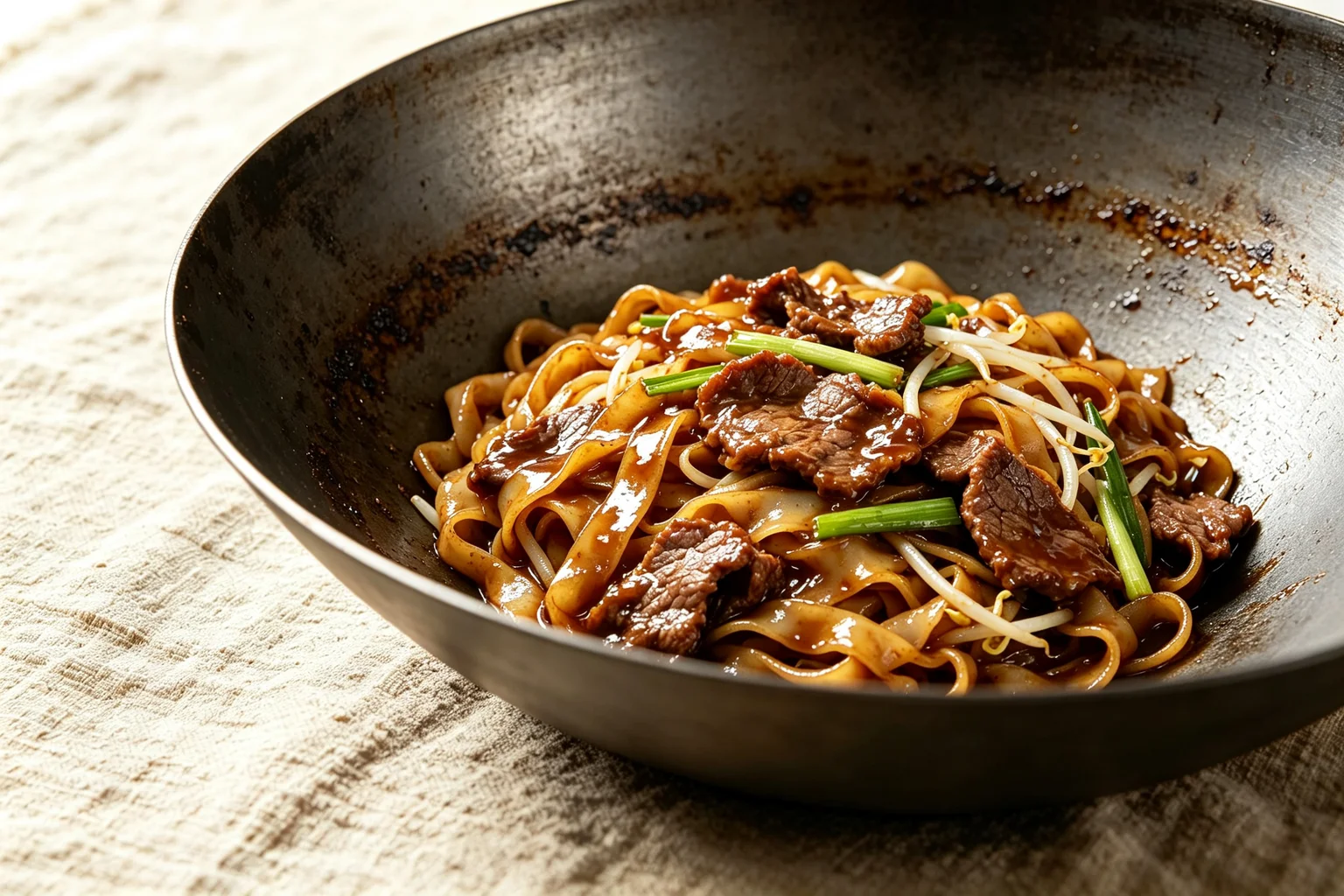
Return the seared beef to the wok. Toss 30 seconds until heated through and combined.
Plate immediately. Beef chow fun waits for no one, it softens and loses its char texture within minutes.
Love Chinese food?
Check out my complete guide to Chinese home cooking, pantry essentials, and techniques.
FAQ
Why are my noodles sticky and clumped? The ho fun was cold from the refrigerator and not separated before cooking. Cold noodles stick to each other and break rather than separate in the wok. Bring to room temperature for 30-45 minutes and separate the sheets gently by hand before cooking. If they are still stuck, microwave 20-30 seconds and separate immediately while warm.
Can I use dried rice noodles instead of fresh ho fun? Yes, with adjustment. Soak dried wide rice noodles in room-temperature water for 30-40 minutes until pliable but still slightly firm at the core, the same partial hydration technique used in the pad thai recipe on this site. Do not boil. Boiling fully gelatinises the starch and leaves no absorption capacity for the sauce in the wok. The result is acceptable but the texture of fresh ho fun is noticeably superior, fresh noodles are worth seeking at any Chinese grocery store.
How do I know if I have cut the beef against the grain correctly? Look at the cut surface of the beef slice after cutting. If you can see long parallel fibres running the full length of the slice, you cut along the grain. If the fibres appear as small dots or very short segments across the width of the slice, you cut against the grain. For flank steak the grain is very visible and runs lengthwise along the muscle. Cut perpendicular to these lines.
Can I make beef chow fun without a wok? A large, heavy cast iron flat pan preheated for 5 minutes on the highest burner setting works reasonably well. The flat surface means the noodles char at multiple contact points simultaneously rather than just at the base curve of a wok, in some ways producing more even charring than an inadequately heated wok. The technique is identical: preheat until smoking, cook in small batches, add sauce last. A non-stick pan should not be used, the temperatures required exceed the safe operating range of non-stick coatings.
You might also like: Check out our complete Chinese cooking guide for more essential ingredients and techniques.
Beef Chow Fun Recipe (干炒牛河)
beef chow fun, ho fun, 干炒牛河
PT40M (includes 30 min beef marination)
PT15M
PT55M
Nutrition Facts
Ingredients
- 300g (10.5oz) flank steak, cut against the grain into 2-3mm thick slices
- 1 tbsp light soy sauce
- 1 tbsp Shaoxing wine
- 1 tsp cornstarch
- ¼ tsp baking soda
- ¼ tsp white pepper
- 1 tsp sesame oil
- 1 tsp neutral oil
- 400g (14oz) fresh ho fun (wide rice noodles), at room temperature, separated
- 1 medium onion, thinly sliced
- 3 spring onions, cut into 5cm sections (whites and greens separated)
- 2 cups (100g) bean sprouts
- 3 tbsp neutral oil for cooking
- 2 tbsp light soy sauce
- 1 tbsp dark soy sauce
- 1 tbsp oyster sauce
- ½ tsp sugar
- ½ tsp white pepper
- 1 tsp sesame oil
Instructions
- *Marinate the beef first. Everything else moves fast once the wok is hot.*
- Combine the sliced beef with all marinade ingredients. Mix thoroughly and massage the marinade into the beef. Leave at room temperature for 30 minutes, or refrigerate for up to 4 hours.
- Bring the ho fun to room temperature. Separate the sheets gently by hand into individual noodle strips. Mix the sauce in a small bowl. Have everything within arm's reach of the wok before the burner goes on.
- Heat the wok over the highest burner setting for 5 full minutes until smoking. Add 1 tablespoon of oil. Swirl to coat.
- Add the marinated beef in a single layer. Do not stir for 30 seconds, allow the contact surface to sear. Then stir-fry vigorously for 1-2 minutes until the beef is approximately 80% cooked through. Remove to a plate immediately. The beef will finish cooking when returned later.
- Wipe out the wok if needed. Return to maximum heat. Add 1 tablespoon of oil. Add the separated ho fun in a single layer. Leave completely undisturbed for 30-45 seconds, do not stir. The contact side should begin to show light char marks. Then begin tossing gently with chopsticks or a spatula tip.
- Add the sliced onion and spring onion whites. Toss with the noodles for 30 seconds. Add the bean sprouts. Toss 20 seconds, they should wilt slightly but retain crunch. Pour the sauce around the perimeter of the wok, not directly on the noodles. The sauce hits the hot wok surface and begins to caramelise before reaching the noodles, the same perimeter technique covered in the hibachi chicken recipe on this site. Toss vigorously until every noodle strand is coated and the sauce is absorbed.
- Return the seared beef to the wok. Toss 30 seconds until heated through and combined. Add the spring onion greens. Toss once more. Plate immediately. Beef chow fun waits for no one, it softens and loses its char texture within minutes.
Did you make this recipe?
Tag @asianfoodsdaily on Instagram or leave a comment below!
Testing Notes
Tested in Asha's kitchen. Last reviewed April 25, 2025.
Ingredient Substitutions
Substitution notes coming soon.
About Asha
Half Asian, half African cook raised between two food-obsessed cultures. I've spent 10 years learning Asian cooking traditions through family, friends, and thousands of hours at the stove — testing every dish until it works in a standard home kitchen.
Read my full storyRelated Recipes
More delicious dishes you might enjoy



Loading comments...