Burmese Food & Myanmar Cuisine Guide
Burmese food is the most misrepresented cuisine in Southeast Asia. The standard description “like Thai food but milder” is repeated so often that it has become the accepted shorthand, despite being almost completely wrong. Burmese food is not mild. It is not a variation of Thai food. It has its own cooking techniques, its own fermented ingredient vocabulary, and a salad tradition so particular to Myanmar that nothing like it exists anywhere else in the region. This guide explains the cuisine from the inside: the technique that defines every Burmese curry, the fermented ingredients that build its base flavour, and the dishes a home cook should understand before cooking their first Burmese meal.
What is Burmese food?
Burmese food is the cuisine of Myanmar, built around a daily meal format of steamed white rice surrounded by a curry, a clear soup, a selection of cooked or raw vegetables, and ngapi fermented fish or shrimp paste used both as a cooking ingredient and as a table condiment. The meal is served all at once. There are no courses. Everything arrives at the same time and is eaten in whatever order the diner chooses.
The cuisine sits at a cultural crossroads Indian influence from the west, Chinese influence from the north and east, Southeast Asian influence from the south and has absorbed elements from all three without becoming any of them. The spicing comes from Indian cooking, particularly turmeric, cumin, and coriander. The noodle culture comes from Chinese cooking. The fresh herb and fish sauce tradition comes from Southeast Asia. But the technique that defines Burmese curry the see-byan method belongs to Myanmar alone.
The see-byan method: the technique that defines Burmese cooking
To understand Burmese food, you need to understand one technique. Everything else follows from it.
A Burmese curry is not built on coconut milk. It is not built on a paste of fresh aromatics blended with lemongrass and galangal. It is built on a slow cooked base of sliced onion, garlic, ginger, and tomato fried in a generous amount of oil until the tomato has completely broken down and the oil begins to separate and float to the surface of the pan. Then meat or fish is added. Then enough water to cover. Then the whole thing simmers, uncovered, until the water evaporates completely and the oil separates and rises again — this time carrying the fully cooked flavour of every aromatic in the base.
That separated oil at the top of a finished Burmese curry is the signal that the dish is done. It is not a sign that something went wrong or that the dish is greasy. It is called si oil and its presence means the raw, pungent compounds in the onion, garlic, and ginger have fully cooked and transformed into something mellow, deep, and complex. The oil is then either left on top when serving or stirred back through, depending on the cook’s preference.
This method is called see-byan: to return the oil. The name describes the technique exactly. You add oil, add aromatics, add water, cook until the water leaves and the oil returns. A Burmese cook judges a curry by whether the oil has returned properly. A curry where the oil has not separated is undercooked. The aromatics are still raw, the garlic still sharp, the flavour still unintegrated.
The practical difference between see-byan and other curry methods is stark. Thai curry finished with coconut milk is creamy, aromatic, and bright. Indian curry with tomato and yoghurt is tangy and textured. Burmese curry finished through see-byan is dry, intensely savoury, slightly oily in the best possible way, with a depth that comes from the long, slow cooking of aromatics in fat rather than from coconut milk or cream. It is closer in character to a braise than a sauce.
The thoke tradition: Burmese salads
The second defining category of Burmese cooking is the thoke the salad. Burmese salads are unlike anything else in Southeast Asian cooking. They are not dressed with vinaigrette. They are not simple side dishes. They are complete flavour statements built on a combination of fresh or blanched ingredients, fish sauce, lime juice, peanut oil, toasted chickpea flour, dried shrimp, and crunchy toppings including fried garlic, roasted peanuts, and sesame seeds.
The toasted chickpea flour is the key ingredient that most non-Burmese recipes omit. Besan chickpea flour is dry-roasted in a pan until golden and nutty, then stirred through the salad dressing. It absorbs moisture, thickens the dressing slightly, and adds a nuttiness that binds everything together. A Burmese salad without toasted chickpea flour tastes like all the individual components. With it, the components become a dish.
The most famous thoke is lahpet thoke tea leaf salad. Fermented tea leaves, mixed at the table with fried garlic chips, roasted peanuts, sesame seeds, dried shrimp, sliced tomato, and shredded cabbage. The fermented tea leaves are pungent, slightly bitter, and deeply savoury from their long fermentation. The crunchy toppings add texture. The whole thing is bracingly alive — nothing like a salad in any other tradition.
There is no equivalent dish anywhere in the world. Myanmar is the only cuisine that ferments tea leaves and uses them as a food ingredient rather than a drink. Lahpet thoke is the most obvious example of Burmese culinary exceptionalism — a dish that could only have come from this particular culture, in this particular geography, with this particular relationship to the tea plant.
Other thokes include: tomato thoke (fresh tomatoes, fish sauce, lime, garlic oil, dried shrimp, toasted chickpea flour), ginger thoke (pickled young ginger with sesame and fried beans), and pennywort thoke (gotu kola leaves with coconut and lime). Each follows the same structural logic: a central fresh ingredient, a fish-sauce-and-lime dressing, toasted chickpea flour, and crunchy toppings.
Ngapi: the flavour base of Burmese cooking
Every cuisine has a base fermented ingredient that defines its savoury depth. Korean cooking has doenjang and ganjang. Japanese cooking has miso and soy. Sri Lankan cooking has maldive fish. Burmese cooking has ngapi.
Ngapi is fermented fish or shrimp paste dark, intensely pungent, and extremely powerful in small quantities. It is made by salting fish or shrimp and allowing them to ferment for weeks or months until they break down into a thick, sticky paste. The smell is strong enough that ngapi is always sold in sealed containers and always stored away from other foods.
In cooking, ngapi functions as an umami foundation. Added to curries in small quantities a teaspoon, sometimes less it provides the savoury bottom note that onion, garlic, and turmeric alone cannot produce. In the thoke salads it appears as dried shrimp a milder, less pungent form of the same fermented fish flavour.
At the table, ngapi is served as ngapi yay a dipping sauce made from ngapi, lime juice, chilli, garlic, and tomato, served alongside a plate of fresh and blanched vegetables. Every Burmese meal includes some version of this condiment. The plate of vegetables often including long beans, morning glory, drumstick leaves, and cabbage is dipped into the sauce and eaten alongside the curry and rice.
For cooks outside Myanmar who cannot access ngapi, shrimp paste (belacan) is the closest substitute. Miso provides a fermented depth but lacks the fish character. For fully vegan cooking, white miso dissolved with a small amount of nori provides a partial approximation, though the result is noticeably different.
The key dishes every Burmese cook should know
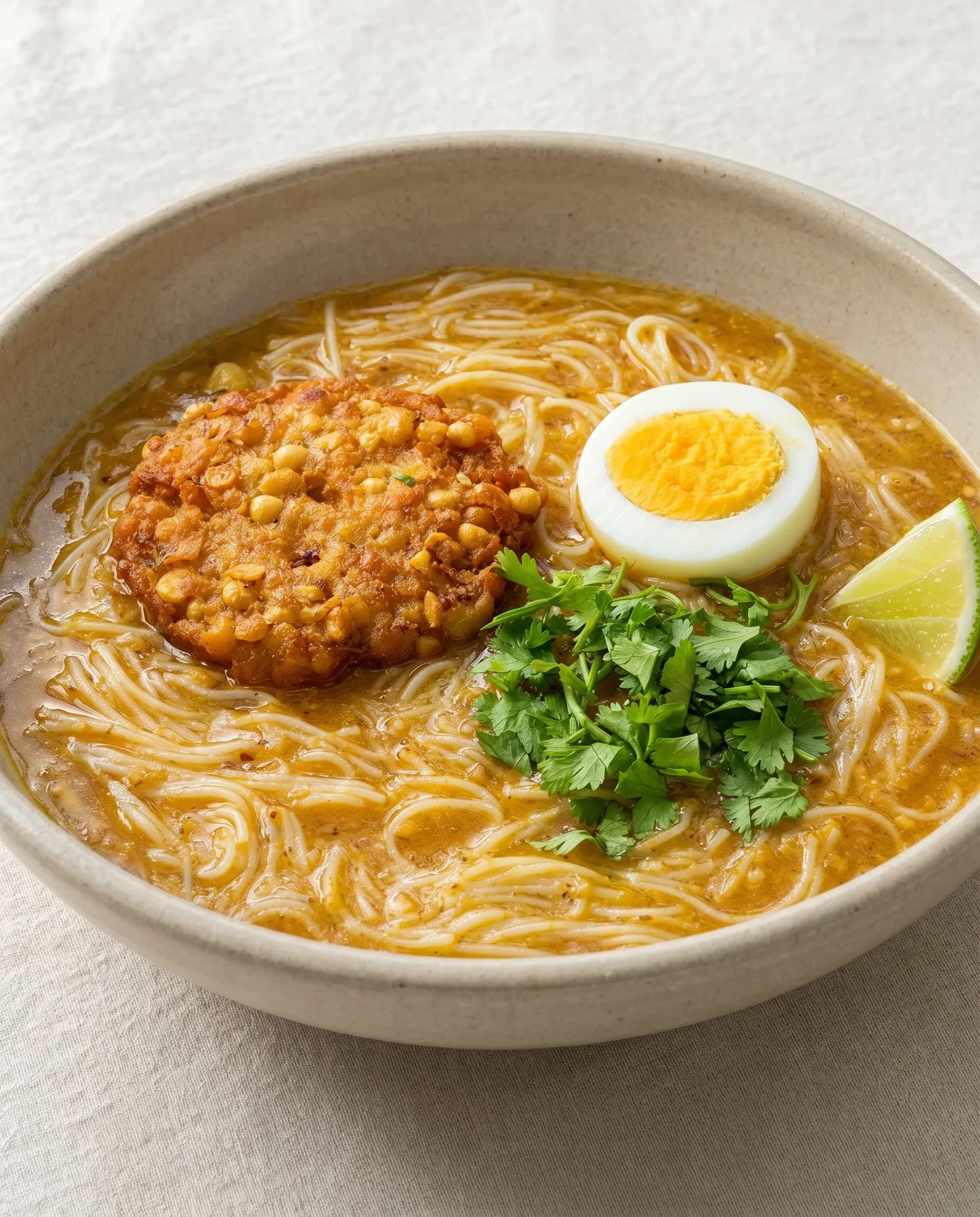
Mohinga. The national dish. A fish-based rice noodle soup made from catfish or any firm white fish, simmered with lemongrass, ginger, banana stem, fish sauce, and ngapi, then thickened with toasted chickpea flour and rice flour. Served with rice noodles, a crispy fritter on top, a boiled egg, fresh coriander, and a squeeze of lime. Mohinga is a breakfast dish in Myanmar sold by vendors with mobile carts from early morning, eaten quickly before work. It has a broth that is simultaneously light and deeply complex, with the banana stem adding a fibrous texture that absorbs the broth beautifully.
Burmese chicken curry (see-byan). The foundational see-byan curry, made with chicken thighs, onion, garlic, ginger, tomato, turmeric, and fish sauce. Cooked using the oil-separation method until the oil returns to the surface and the chicken is completely tender. Served over rice with a clear soup, pickled vegetables, and a raw salad. This is the dish that teaches the see-byan technique. Once you can make it correctly oil separated, aromatics fully cooked, chicken falling from the bone every other Burmese curry becomes a variation.
Lahpet thoke. Tea leaf salad. Fermented tea leaves, fried garlic chips, roasted peanuts, sesame seeds, dried shrimp, sliced tomato, shredded cabbage. Mixed at the table. Served as a starter or a palate-resetter between heavier dishes. The most singular dish in the Burmese repertoire there is genuinely nothing like it outside Myanmar.
Tomato thoke. Burmese tomato salad. Ripe tomatoes, fish sauce, lime juice, toasted chickpea flour, peanut oil, dried shrimp, fried shallots. The easiest entry point into Burmese cooking. No specialist equipment, accessible ingredients, and it teaches the flavour logic that runs through every thoke.
Ohn no khao swe. Coconut chicken noodle soup the exception to the no-coconut-milk rule in Burmese cooking. Egg noodles in a rich coconut and chicken curry broth, served with a range of crunchy toppings including fried noodles, crispy onion, lime, and chilli flakes. Often compared to Thai khao soi, which it resembles structurally, though the flavour profile deeper, less sweet, more savory from the fish sauce base is distinctly Burmese.
Shan noodles. The signature noodle dish of the Shan State, in the mountainous east of Myanmar. Thin rice noodles in a clear, lightly spiced broth with marinated chicken or pork, served with sesame oil, toasted garlic, and pickled vegetables on the side. Lighter and cleaner than most Burmese noodle dishes a reflection of Shan cuisine’s proximity to Yunnan Chinese cooking.
Regional differences in Burmese food
Myanmar is an ethnically diverse country with over 130 officially recognised ethnic groups, and the cuisine varies significantly by region.
Yangon and the Irrawaddy Delta. The culinary melting pot of Myanmar. Yangon’s food culture is shaped by the city’s history as a colonial port — Indian, Chinese, and Burmese traditions exist side by side in the tea shops, street stalls, and curry houses. The city is where you find the widest range of Burmese dishes, from mohinga in the morning to lahpet thoke in the evening.
Mandalay and the central dry zone. Mandalay cooking is known for its heartiness — more meat, stronger flavours, and dishes like Mandalay mee shay (rice noodles with a rich meat sauce and toasted chickpea flour). The dry zone’s climate produces different vegetables from the delta, and the food reflects that.
The Shan State. The largest state in Myanmar, bordering China to the east. Shan cuisine is distinct from lowland Burmese cooking — lighter broths, more Chinese influence, and the use of tofu made from chickpeas (shan tofu) rather than soy. Shan noodles are the most widely eaten dish from this region across the whole country.
Rakhine State (Arakan). The coastal state to the west, bordering Bangladesh. Rakhine cuisine is the hottest and most intensely spiced in Myanmar. Rakhine mont di a dense, intensely flavoured fish noodle soup is the regional equivalent of mohinga, considered by many Burmese food experts to be even more complex.
The Kachin State. The northernmost region, bordering China. Kachin cuisine uses wild herbs and forest ingredients unavailable elsewhere in Myanmar, and the cooking has a pronounced Chinese influence from the Yunnan border.
How Burmese food differs from its neighbours
From Thai food. Thai curries are built on coconut milk and fresh aromatic pastes galangal, lemongrass, kaffir lime. Burmese curries use the see-byan method with no coconut milk and minimal fresh aromatics beyond onion, garlic, ginger, and tomato. Thai food is sweeter, more aromatic, more balanced between sweet and sour. Burmese food is deeper, more savoury, and heavier from the see-byan oil.
From Indian food. Indian food shares the spice vocabulary turmeric, cumin, coriander, cardamom but applies it differently. Indian curries use spice powders and pastes blended into sauces. Burmese curries cook those same spices slowly in oil with aromatics until the oil separates, which produces a different flavour outcome from the same ingredients. Ngapi has no Indian equivalent. The thoke salad tradition has no Indian equivalent.
From Chinese food. Burmese noodle culture particularly in the Shan State shows clear Chinese influence in its technique and broth approach. But where Chinese cooking uses soy sauce, vinegar, and sesame oil as primary seasonings, Burmese cooking uses fish sauce, lime juice, and ngapi. The fermented fish tradition separates Burmese food definitively from Chinese cooking.
Where to start if you have never cooked Burmese food
Start with tomato thoke. No specialist ingredients, no complex technique, and it teaches the Burmese flavour balance in one dish — savory from fish sauce, sour from lime, nutty from toasted chickpea flour, funky from dried shrimp. Once you understand that balance, every other Burmese dish makes more sense.
After tomato thoke, make a simple see-byan chicken curry. That one dish teaches the oil-separation technique that is the foundation of the entire cuisine. Once the oil returns correctly golden, clear, floating on top of a fragrant, dark, thick base you understand what Burmese cooking is trying to achieve.
The complete Burmese cooking guide covers the full pantry list, techniques in detail, and links to every recipe as they are published.
Love Burmese food?
Check out my complete guide to Burmese home cooking, pantry essentials, and techniques.
FAQ
What is the national dish of Myanmar? Mohinga is the national dish of Myanmar a fish-based rice noodle soup made with catfish or firm white fish, lemongrass, banana stem, and ngapi, thickened with chickpea flour and served with rice noodles, a crispy fritter, and fresh herbs. It is eaten for breakfast across the country, sold by street vendors from early morning.
Is Burmese food spicy? Burmese food is moderately spicy by default but significantly less aggressive than Thai or Sri Lankan cooking. The heat comes from fresh and dried chilli, which appears in most dishes but functions as one element among many rather than the defining flavour. Rakhine cuisine in the western coastal state is the exception it is genuinely hot. Heat level is fully adjustable in home cooking without changing the underlying character of any dish.
Is Burmese food the same as Thai food? No. Burmese food and Thai food share some ingredients and a Southeast Asian context but are fundamentally different cuisines. Thai curries are built on coconut milk and fresh aromatic pastes. Burmese curries use the see-byan oil-separation method with no coconut milk. Burmese cooking has ngapi (fermented fish paste) and lahpet (fermented tea leaves) as defining ingredients with no Thai equivalent. The two cuisines taste very different.
What does Burmese food taste like? Burmese food tastes deeply savoury, slightly funky from the fermented fish paste, earthy from slow-cooked aromatics, and crunchy from the fried toppings that appear in almost every dish. The flavour profile is less sweet than Thai food, less spice-forward than Indian food, and less clean and bright than Vietnamese food. It has a heaviness and depth that comes from the see-byan technique and the fermented ingredient base.
Can you eat Burmese food if you are vegan? Many Burmese dishes can be made vegan. Tomato thoke, ginger thoke, pennywort thoke, and most vegetable-based dishes can be made without fish sauce or dried shrimp by substituting soy sauce and nori. The see-byan technique works with tofu and vegetables. Shan tofu made from chickpea flour rather than soy is naturally vegan and appears throughout Shan cuisine.
About Asha
Half Asian, half African cook raised between two food-obsessed cultures. I've spent 10 years learning Asian cooking traditions through family, friends, and thousands of hours at the stove — testing every dish until it works in a standard home kitchen.
Read my full storyRecipes to Try
Mohinga Recipe — Burmese Fish Noodle Soup

Chicken Udon Noodles Recipe: Easy Comfort Food for Weeknights

Easy Corn Chaat Recipe: Quick & Spicy Indian Street Food Snack

Japanese Yakisoba Stir Fry Noodles Recipe | Asian Foods Daily

Japanese Steakhouse Hibachi Chicken (Teppanyaki Style)
Gyudon Recipe (Japanese Beef Bowl)
Smashed Cucumber Salad (Pai Huang Gua / 拍黄瓜)

Char Siu (Chinese BBQ Pork)

Filipino Pork Adobo Recipe with Tender Pork Belly

Ampalaya Con Carne Recipe

Filipino Chicken Adobo Recipe

Loading comments...